





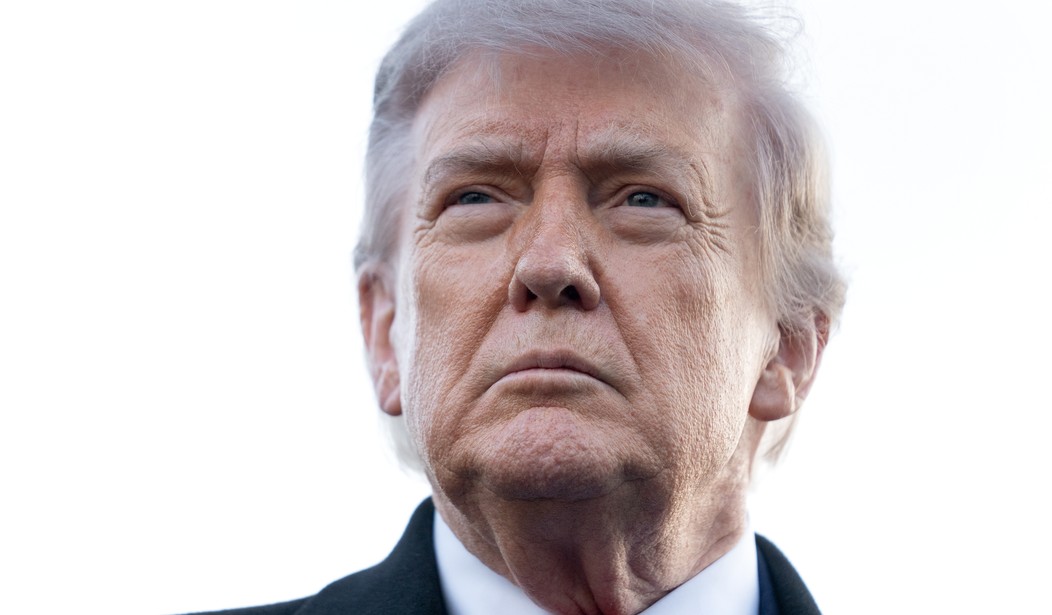
Ten years ago this month, Donald Trump clinched the Republican nomination for president, with a platform that was vastly different on trade and foreign policy from other recent presidents, Republican and Democratic alike.
How fares America — and the world — 10 years later?
In some important ways, things have moved in Trump's direction. In 2016 and since, he complained constantly that Europeans were not contributing their fair share to NATO. That had been the position of previous administrations, but none emphasized it as Trump did.
Early in Trump's first term, only five NATO allies met the stated goal of spending two percent of GDP on defense. A decade later, the goal has risen to five percent, and most NATO allies are moving toward that goal.
And as Russian President Vladimir Putin has threatened his neighbors, previously neutral (for nearly 75 years!) Finland and Sweden, with their highly competent militaries, have decided to join NATO and have made the Baltic Sea just beyond Putin's hometown of St. Petersburg a NATO lake.
In the Middle East, Trump has also made a difference. His predecessors' policy was based on the hoary assumption that the key to stability was to pressure Israel to make a peace agreement with the Palestinians. So America's task was to pressure Israel to make concessions.
Trump saw it differently. He pushed the Abraham Accords, diplomatic relations between Israel, Saudi Arabia and Persian Gulf oil producers. Progress has been uneven but palpable. Israel's pacification of Gaza has not prevented the Saudis and United Arab Emirates from supporting Trump's efforts, cooperating with Israel, to disarm and destabilize the regime in Iran.
On trade, Trump's on-again, off-again threats, impositions and adjustments of tariff rates have resulted in channeling trade in different patterns. The days of a jointly dependent "Chimerica" (historian Niall Ferguson's phrase) seem to be waning.
Not everything has gone Trump's way. His fixation on unproblematic trade "deficits" has led him to impose tariffs that have fed inflation and eroded his job approval at home. His initiatives in Iran, without persuasive explanations to voters or any attempt at buy-in by the political opposition, have also hurt him politically — although regime collapse in Iran remains possible and could put things in a different light.
More importantly, the world has changed, sometimes in line with his expectations, sometimes to the contrary. The prime example is Russia's war on Ukraine. As Trump has noted, Putin launched his 2014 attacks on Donbas and his 2022 march toward Kyiv when Democrats were president. And former President Joe Biden's restrictions on aid to Ukraine — especially bans on lobbing attacks on Russian territory — limited Ukraine's defense.
But like the Biden CIA's assumption that Kyiv would fall in days, Trump's obvious admiration for Putin as a strong leader has proved a poor guide to events. Note that this is not an endorsement of the Democrats' and much of the media's Russia collusion hoax; admiration is not collusion. But it turns out that Russia's enormous superiority in manpower and major weapons systems has proved unavailing against Ukraine's unexpected advantage in morale and adaptability.
As analysts of various stripes have concluded, Ukraine has developed drone warfare as a barrier to Russian advance and to make advances itself.
Ukraine has had one advantage Putin didn't count on in 2022: morale, a sense of national pride and resolve that is unquantifiable but has enabled seemingly ordinary people to adapt with extraordinary speed and inventiveness reminiscent of the best of American examples in World War II. It's interesting that Trump, for all his emphasis on building America's national morale, has been deaf to the importance of that factor in Ukraine.
The cheap drones that Ukrainians have invented and produced in astonishing numbers — some 60,000 per day — have routinely destroyed much more expensive Russian missiles and have enabled Ukrainian President Volodymyr Zelensky to destroy energy infrastructure in Perm, 1,000 kilometers beyond the Russian border, and prompted Putin to downsize his WWII victory parade in Moscow.
"The nature of war has changed," writes The Wall Street Journal's Walter Russell Mead. "Rifles, mortars and tanks appear to be going the way of sword fights and cavalry charges." As the liberal economist Noah Smith explains, "Drones are simply so cheap to produce in huge numbers that they can overwhelm any more expensive system."
This has worrying implications for the U.S., whose Cold War strategy has emphasized complex, expensive weapons systems to the point that, as Lockheed Martin CEO Norman Augustine projected, the cost of one ultimate fighter jet in 2054 would consume the entire defense budget.
Trump and War Secretary Pete Hegseth have concentrated on strengthening service members' esprit de corps, which may — no one can be sure — have contributed to the astonishing success of the removal of former Venezuelan dictator Nicolas Maduro from Caracas and the rescue of a downed pilot in Iran. But it's not clear that they're adapting to the obsolescence of mobile offensive warfighting that prevailed between 1939 and 2003, and to the new fixed-position-joystick defensive warfighting that resembles artillery in the trench warfare of World War I.
It is clear that the Trump policy of pressuring Ukraine to accept Russian control of provinces it hasn't occupied is as obsolete as Trump's predecessors' policies of pressuring Israel to accept Palestinian control of territory from which the Palestinians could launch attacks like those of Oct. 7, 2023.
It seems clear as well that the remnants of the Iranian regime are unwilling to abandon their 47-year hostilities toward the U.S., and that Trump's eagerness to deploy "the art of the deal," even under the auspices of a hostile Pakistan, is encouraging their continued resistance. And in the meantime, will the drawdown of America's expensive smart weapons in the Persian Gulf reduce American deterrence against Chinese aggression against Taiwan?
The final verdict on Trump's foreign policies cannot be written now, with 32 months left in his term and so many kinetic events in unpredictable motion. But perhaps it can be said that while his departures from his predecessors' policies have had some successes in reshaping the world, it is not clear that he has developed policies adapted to the world he has done so much to change.
Michael Barone is a senior political analyst for the Washington Examiner, resident fellow at the American Enterprise Institute and longtime co-author of The Almanac of American Politics. His new book, "Mental Maps of the Founders: How Geographic Imagination Guided America's Revolutionary Leaders," is now available.
Editor’s Note: Do you enjoy Townhall’s conservative reporting that takes on the radical Left and woke media? Support our work so that we can continue to bring you the truth.
Join Townhall VIP and use promo code FIGHT to receive 60% off your membership.

Join the Conversation
VIP members get the ability to comment on articles.