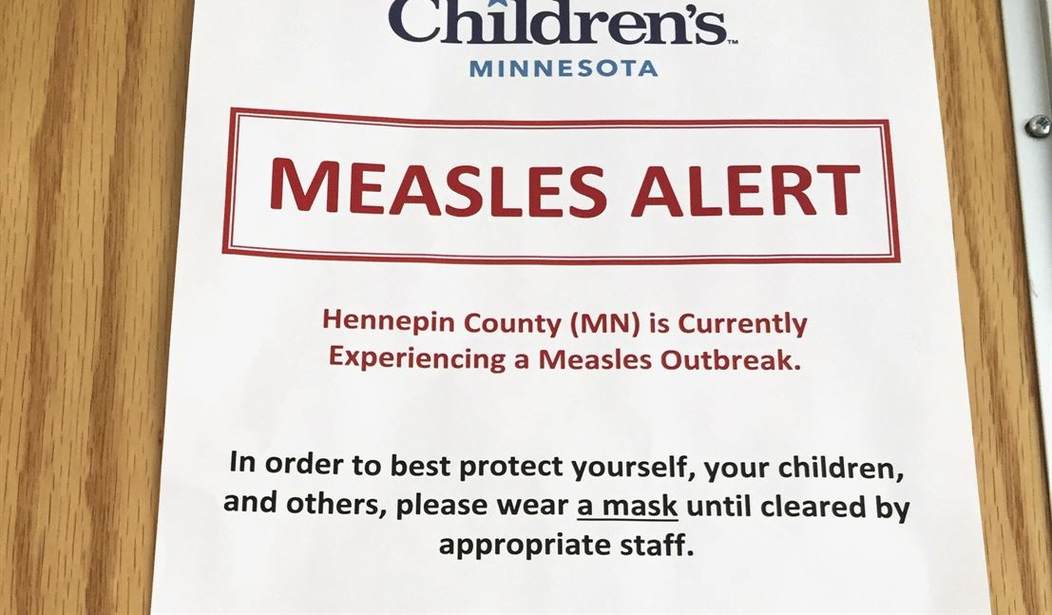

The United States lost its measles elimination status on Tuesday for the first time in 26 years. Almost immediately, some Republicans blamed “mass migration.”
Immigration has become a catchall explanation for seemingly every problem the United States faces: welfare spending, fraud, the insolvency of entitlements, housing costs, and now measles. Whatever the issue, the proposed solution is increasingly the same: deport more people and let fewer in. Yet too many Republicans seem to think the United States is one mass deportation away from utopia.
The problem goes beyond repetition as well. Too often, evidence that immigration affects an issue is treated as proof that it caused the problem, and that restricting immigration will solve it. But those claims are not the same, and measles is a case in point.
Let’s get a couple of things out of the way.
First, measles “elimination” does not mean zero cases. The designation allows for occasional cases and localized outbreaks. What it requires is the absence of continuous transmission for 12 months. The failure to interrupt that transmission is what cost the United States its elimination status. Some were eager to take the word “elimination” literally and suggest that, if measles had been entirely eliminated, the only way it could have returned was through immigration, but that's not true.
Second, if this were primarily a problem of illegal immigration, the history of American measles cases would need to support that explanation. Instead, the numbers have fluctuated dramatically. In 2008, there were 140 cases, followed by 72 in 2009 and 63 in 2010. Cases jumped to 220 in 2011, fell to 55 in 2012, and rose again to 187 in 2013. There were 667 cases in 2014, roughly 190 in 2015, 86 in 2016, 120 in 2017, and roughly 380 in 2018. In 2019, cases reached 1,274 before falling sharply during the pandemic even though those years were the peak of illegal immigration.
But even as things opened back up, especially in Texas and Florida, which have large populations of illegal aliens, measles cases remained low: 121 nationwide in 2022 and roughly 59 in 2023. Even in 2024, when the United States had its largest population of illegal aliens, we saw only 285 cases. Last year, however, as ICE began ramping up deportations, there was a massive spike to 2,289 confirmed cases, and this year alone we have reached 5,412. So if illegal immigrants are the problem, why don’t major deportation operations seem to be having an effect?
What is driving the measles outbreak? Declining vaccination rates, particularly among children. Children and teenagers have borne much of the outbreak: 951 cases this year were among children younger than five, and another 2,183 were among those ages five through 19, together, roughly 58 percent of all reported cases.
Among American kindergarteners, vaccination coverage fell to 92.7 percent in the 2023-24 school year, down from 95.2 percent in 2019-20 and below the 95 percent target for preventing measles outbreaks. Coverage was also below that target among toddlers, at 90.8 percent, and teenagers, at 92.5 percent.
And where were these cases concentrated? Several of the largest U.S. measles outbreaks in 2025 and 2026 began not in the major cities where most illegal aliens are, but in close-knit, often religious and rural, undervaccinated communities. These included Mennonite communities in West Texas, evangelical Slavic communities in South Carolina, fundamentalist religious communities in Utah, and Amish communities in Pennsylvania. Together, these communities have been at the center of outbreaks involving thousands of cases over the past two years, exacerbated by a growing willingness to forgo vaccination.
Other major outbreaks have begun with unvaccinated Americans traveling abroad, bringing measles home, and spreading it within undervaccinated communities.
Freedom of choice is sacred and should be protected. But the resurgence of measles in the United States is a homegrown problem, fueled by how Americans are exercising that freedom.
While COVID gave people plenty of reasons to question public-health authorities, too many have treated that experience as a reason to dismiss medical advice altogether. Skepticism about one vaccine has become suspicion of all vaccines, fueled by claims that they cause autism, infertility, and other developmental or reproductive problems, claims that require evidence, and that which have not been produced.
Why should questions about a vaccine promoted during COVID suddenly justify refusing the flu vaccine or the MMR vaccine, which has been around since 1971? Being right about a particular political policy or recommendation does not make every subsequent suspicion correct, but that is largely how many have treated the pandemic, and the measles outbreak is the result.
This is not an issue you can simply blame on “illegal aliens” or the “third world.” This is an issue of people exercising their freedom, and the very serious costs that can come with those choices. You are free not to trust Fauci, but no one has explained how distrust of one official justifies dismissing medical expertise altogether.
People say they don’t trust experts, but then turn to random podcasters for medical advice. At least Fauci had relevant qualifications. More striking is the willingness of some vaccine skeptics to inject themselves with products marketed as “research peptides,” without demanding the same evidence of safety. The irony is hard to miss.
But rather than confront that contradiction, it is easier to point the finger at “illegal aliens.” If you want to argue that illegal immigration is driving these outbreaks, the burden is on you to provide evidence. You do not get to shout “20 million illegal immigrants,” name whatever problem you see, and pretend you have established the cause. If that's how America had run for the last 250 years, we’d still be stuck in the Dark Ages.