
President Donald Trump’s visit with astronauts in Houston on Friday was just one step toward America’s major space endeavors, NASA press secretary Bethany Stevens explained to Townhall on Friday afternoon.
Stevens said that Trump has been “the most revolutionary space advocate and the best president for space of our time” – going above and beyond President John F. Kennedy’s original moon ambitions of the early 1960s.
“I mean, you look back, you have Kennedy saying to go to the moon, but you have President Trump establishing a moon base, launching a nuclear spacecraft,” she noted.
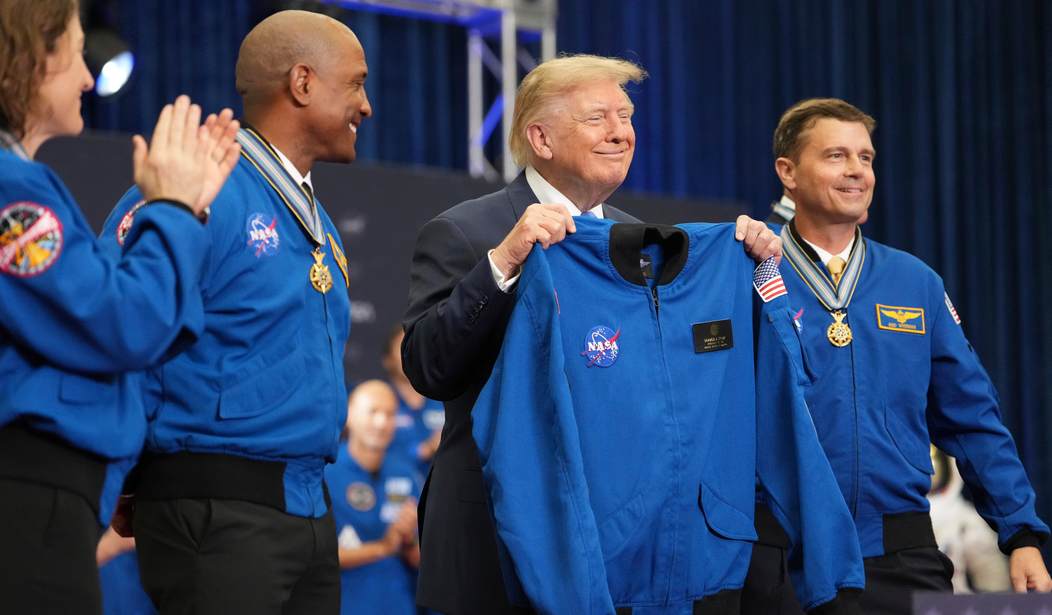
Trump awarded the Artemis II crew with the Congressional Space Medal of Honor and announced the effort to open up the United States Space Academy during his Texas trip – and Stevens said that NASA staff is “fired up” over the recent developments made in the nation’s space program.
“This agency has not worked this hard since the late 1960s, early 1970s to accomplish an objective. And it was the catalyst of the first space race, race to the moon, which in hindsight we had all of the margin in the world because no one has gone back since us,” she said.
“Now we see a real threat with China and people are responding in kind and living up to the challenge and meeting the moment,” Stevens added.
Today at @NASAJohnson, the four crew members of Artemis II received the Congressional Space Medal of Honor from President Donald J. Trump for their historic, record-setting mission around the Moon. https://t.co/9uGYYLxhES pic.twitter.com/SIknQU4lVr
— NASA (@NASA) August 28, 2026
A human has not been on the moon since Gene Cernan during Apollo 17 in 1972, leaving many wondering when people will head up there again. Stevens said NASA is incredibly confident that space travel is inching in that direction again “without a shadow of doubt.”
“I think what's actually ultimately going to happen is Americans are gonna get really used to seeing moon landings,” she said.
“What we saw happen in the 1970s is there were three network news options. All three of them were initially taking Apollo launches, and then we got to a point where they refused to take moon walks, moon landings […] because it had already been done. It was so overdone that people were like, ‘Yeah, yeah, we've seen this before,’” she added.
“We're gonna be in a world where it becomes normalized. Like the administrator [Jared Issacman] talks about it all the time, we're gonna have a live feed on our moon base where astronauts will be living and working just like we do on the International Space Station,” Stevens continued. “And people are going to be able to get online […] and immediately be able to see a live feed on the moon.”
When asked about the national security purposes of these efforts, like the academy and Space Force, she noted that space has critical implications ranging from flights to consumer technology.
“If you're able to secure superiority in the ultimate strategic high ground, that is something that will impact people's everyday lives,” Stevens said.
According to the press secretary, another underrated element of the military implications of the space program includes the Space Reactor-1 (SR-1) Freedom – “the first interplanetary nuclear spacecraft” expected to blast off toward Mars in December 2028.
“We're testing something with renewable energy and space. Eventually, we'll want to get that technology human rated,” she said, adding that "it completely changes the game. We'd be light years ahead of every single adversary in space, every single nation in space."
“We've established space superiority. We're maintaining it at this point. But with nuclear space travel, it blows everything outside of the water,” she said.
Editor's Note: Do you enjoy Townhall's conservative reporting exposing the radical left and woke media? Support our work so we can keep bringing you the truth.
Join Townhall VIP and use promo code FIGHT to receive 60% off your membership.