





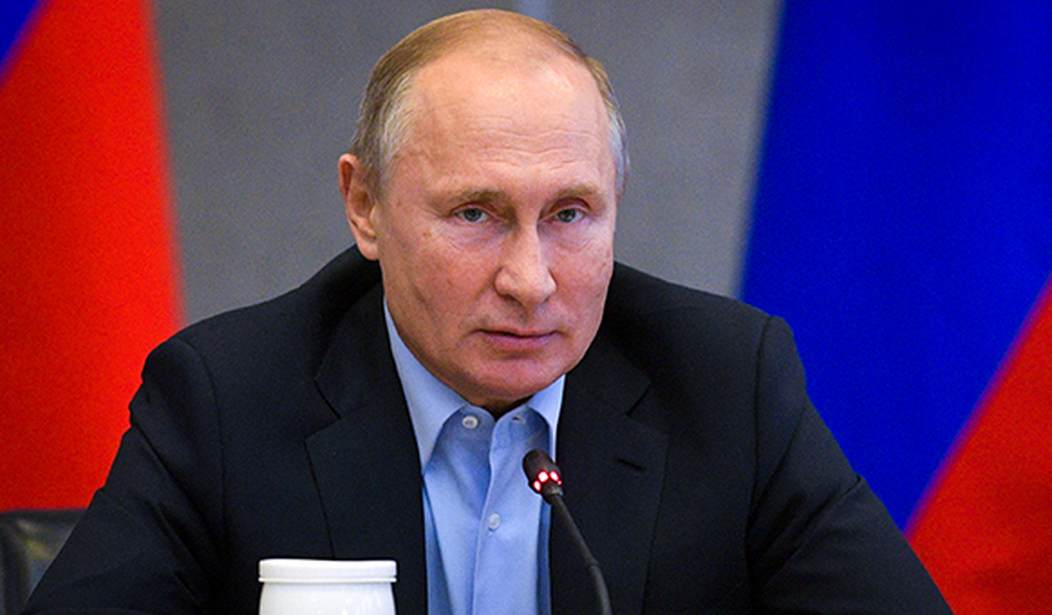
On departure for the G-20 gathering in Buenos Aires, President Donald Trump canceled his planned weekend meeting with Vladimir Putin, citing as his reason the Russian military's seizure and holding of three Ukrainian ships and 24 sailors.
But was Putin really the provocateur in Sunday's naval clash outside Kerch Strait, the Black Sea gateway to the Sea of Azov?
Or was the provocateur Ukrainian President Petro Poroshenko?
First, a bit of history.
In 2014, after the pro-Russian regime in Kiev was ousted in a coup, and a pro-NATO regime installed with U.S. backing, Putin detached and annexed Crimea, for centuries the homeport of Russia's Black Sea fleet.
With the return of Crimea, Russia now occupied both sides of Kerch Strait. And this year, Russia completed a 12-mile bridge over the strait and Putin drove the first truck across.
The Sea of Azov became a virtual Russian lake, access to which was controlled by Russia, just as access to the Black Sea is controlled by Turkey.
While the world refused to recognize the new reality, Russia began to impose rules for ships transiting the strait, including 48 hours notice to get permission.
Ukrainian vessels, including warships, would have to notify Russian authorities before passing beneath the Kerch Strait Bridge into the Sea of Azov to reach their major port of Mariupol.
Sunday, two Ukrainian artillery ships and a tug, which had sailed out of Odessa in western Ukraine, passed through what Russia now regards as its territorial waters off Crimea and the Kerch Peninsula. Destination: Mariupol.
The Ukrainian vessels refused to obey Russian directives to halt.
Russian warships fired at the Ukrainian vessels and rammed the tug. Three Ukrainian sailors were wounded, and 24 crew taken into custody.
Russia's refusal to release the sailors was given by President Trump as the reason for canceling his Putin meeting.
Moscow contends that Ukraine deliberately violated the new rules of transit that Kiev had previously observed, to create an incident.
For his part, Putin has sought to play the matter down, calling it a "border incident, nothing more."
"The incident in the Black Sea was a provocation organized by the authorities and maybe the president himself. ... (Poroshenko's) rating is falling ... so he needed to do something."
Maxim Eristavi, a fellow at the Atlantic Council, seems to concur:
"Poroshenko wants to get a head start in his election campaign. He is playing the card of commander in chief, flying around in military uniform, trying to project that he is in control."
Our U.N. Ambassador Nikki Haley, however, accused Russia of "outlaw actions" against the Ukrainian vessels and "an arrogant act the international community will never accept."
Predictably, our interventionists decried Russian "aggression" and demanded we back up our Ukrainian "ally" and send military aid.
Why was Poroshenko's ordering of gunboats into the Sea of Azov, while ignoring rules Russia set down for passage, provocative?
Because Poroshenko, whose warships had previously transited the strait, had to know the risk that he was taking and that Russia might resist.
Why would he provoke the Russians?
Because, with his poll numbers sinking badly, Poroshenko realizes that unless he does something dramatic, his party stands little chance in next March's elections.
Immediately after the clash, Poroshenko imposed martial law in all provinces bordering Russia and the Black Sea, declared an invasion might be imminent, demanded new Western sanctions on Moscow, called on the U.S. to stand with him, and began visiting army units in battle fatigues.
Some Westerners want even more in the way of confronting Putin.
Adrian Karatnycky of the Atlantic Council urges us to build up U.S. naval forces in the Black Sea, send anti-aircraft and anti-ship missiles to Ukraine, ratchet up sanctions on Russia, threaten to expel her from the SWIFT system of international bank transactions, and pressure Europe to cancel the Russians' Nord Stream 2 and South Stream oil pipelines into Europe.
But there is a larger issue here.
Why is control of the Kerch Strait any of our business?
Why is this our quarrel, to the point that U.S. strategists want us to confront Russia over a Crimean Peninsula that houses the Livadia Palace that was the last summer residence of Czar Nicholas II?
If Ukraine had a right to break free of Russia in 1991, why do not Crimea, Donetsk and Luhansk have the right to break free of Kiev?
Why are we letting ourselves be dragged into everyone's quarrels -- from who owns the islets in the South China Sea, to who owns the Senkaku and Southern Kurils; and from whether Transnistria had a right to secede from Moldova, to whether South Ossetia and Abkhazia had the right to break free of Georgia, when Georgia broke free of Russia?
Do the American people care a fig for these places? Are we really willing to risk war with Russia or China over who holds title to them?
Patrick J. Buchanan is the author of "Nixon's White House Wars: The Battles That Made and Broke a President and Divided America Forever."

Join the Conversation
VIP members get the ability to comment on articles.