





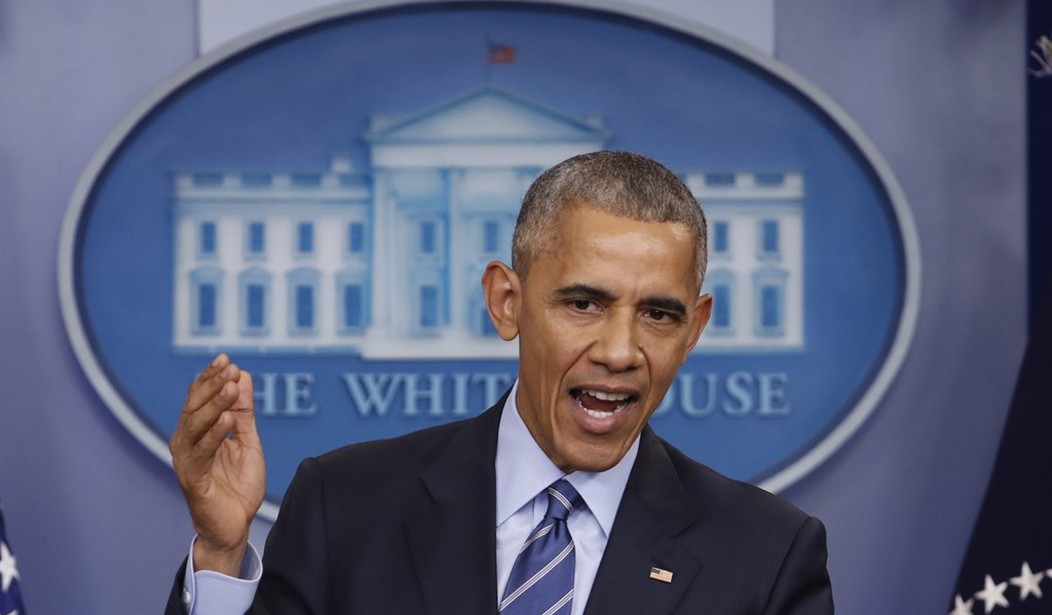
But to judge from the responses of some of the Democrats, his advice was typical of the approach he's taken to legislation in his eight years as president -- which is to say disengaged, above the fray, detached from any detailed discussion of how legislation actually works.
He was "very nostalgic," said Louise Slaughter, a veteran of 30 years in the House and the ranking Democrat on the House Rules Committee. But, she added, he left it up to Hill Democrats to come up with a strategy to protect Obamacare.
This is in line with the standoffish relations Obama has had with members of Congress, even with Democrats who are inclined to be and capable of being helpful. Schmoozing with those he gives the impression of regarding as his inferiors has not been his style.
Nor has he ever seemed interested in the content of laws, even his trademark health care legislation. His February 2010 decision to move forward on Obamacare despite the election of Republican Sen. Scott Brown in Massachusetts meant accepting a bill with multiple flaws, many of them glaringly visible after passage.
But policy just hasn't been his thing. At the Hill meeting, Obama -- according to Massachusetts Democrat Bill Keating -- was "basically saying, 'Let's not get down into policy language.'" The key word there may be "down."
The problem with this approach has been apparent since the 9 o'clock hour on election night, when it became clear that Donald Trump was going to be elected president. In 2010, Obama assumed there always would be a Democratic Congress to repair any glitches in Obamacare. In 2016, he assumed that there would be a President Hillary Clinton to keep his pen-and-phone regulations and "guidances" in place.
It's apparent that Obama is thrashing around trying to keep his policies in place. But more than those of other outgoing presidents replaced by successors of the other party, they're in danger of being overturned.
One reason is that they were never firmly established in the first place -- and not just because the Democrats' 60-vote Senate supermajority existed for only eight months, from July 2009 to February 2010.
Rather, the Obama Democrats' policies, passed through slapdash legislation or through questionably legal regulations, never really captured the hearts and minds of the American people.
Obamacare was based on the shaky premise that mandating often expensive and limited health insurance would be seen as guaranteeing good health care. As a result, as historian Walter Russell Mead recently wrote for The American Interest, "it did not generate enough public support to protect itself from its opponents."
Regulations imposed on coal and other fossil fuel production -- instituted after Democrats, even with strong congressional majorities, were unsuccessful in passing cap-and-trade legislation -- failed to impress a population that did not share liberal elites' faith that climate change is certain to produce catastrophe.
And regulations legalizing the presence of millions of undocumented immigrants have failed to pass muster in federal courts, thanks to legal maneuverings as sloppy as the legislative legerdemain that shoved through Obamacare.
Public policies prove to be enduring when they address what people regard as genuine needs and thus create constituencies that politicians dare not defy. Social Security retirement benefits are a prime example. You can jigger the taxes and benefits, as a bipartisan majority did in 1983, but voters who believe they paid for their benefits will insist they not be taken away.
Policies that induce long-term reliance also tend to endure, a prime example being the home mortgage interest deduction. There's a good argument that this policy, like the Social Security benefit formula, unduly benefits the affluent. But that argument doesn't move most voters.
In my view, Obama owed his election and re-election to the feeling -- widely shared by Americans, including many who didn't vote for him -- that it would be a good thing for Americans to elect a black president.
What they didn't expect, but got, was a president who governed according to the playbook of campus liberals, imposing -- or attempting to impose -- policies that he believed would be good for people, whether they knew it or not.
This was governance that was both inattentive to detail and law and out of touch with how policies affect people's lives. That is why so many of these policies seem headed for the ash heap of history.

Join the Conversation
VIP members get the ability to comment on articles.