





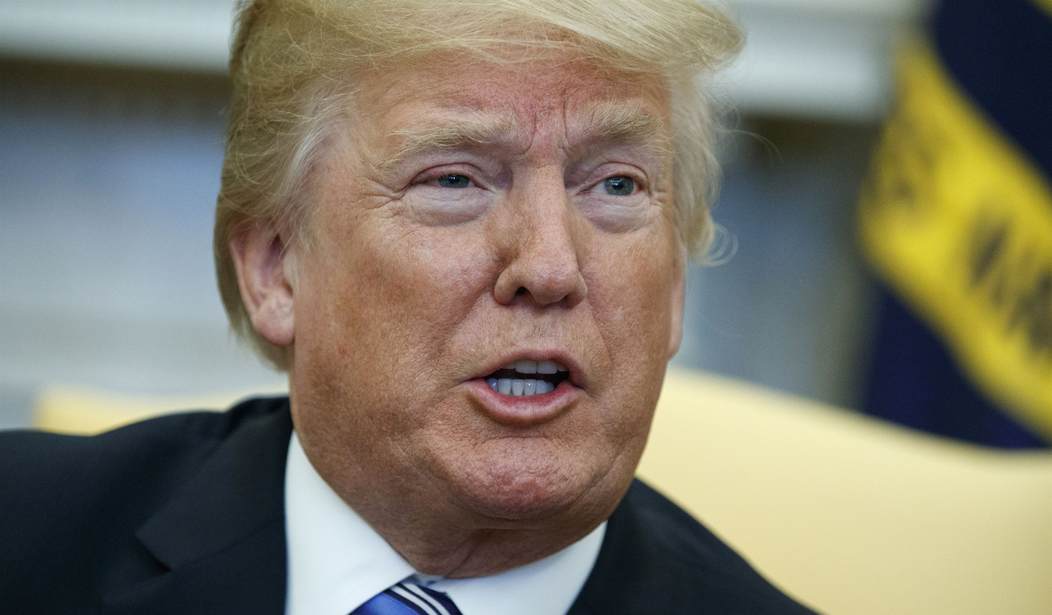
For the last couple of years I've been banging my spoon on my high chair about how Trumpism isn't a political or ideological movement so much as a psychological phenomenon.
This was once a controversial position on the right and the left. Former White House chief strategist Stephen Bannon devoted considerable resources to promoting Trumpist candidates who supposedly shared President Trump's worldview and parroted his rhetoric, including anti-globalism, economic nationalism and crude insults of "establishment" politicians. Those schemes largely came to naught.
The intellectual effort to craft or divine a coherent Trumpist ideology didn't fare much better. Just over a year ago, Julius Krein launched a new journal called American Affairs to "give the Trump movement some intellectual heft," as Politico put it. As I wrote at the time, American Affairs' dilemma was that by associating itself with Trump, it would be forced to either defend the incoherence of his behavior or break with him to defend its own consistency.
Six months later, after the debacle of Trump's response to the neo-Nazi rally in Charlottesville, Va., Krein recanted his support for the president.
On the left, there's an enormous investment in the idea that Trump isn't a break with conservatism but the apotheosis of it. This is a defensible, or at least understandable, claim if you believe conservatism has always been an intellectually vacuous bundle of racial and cultural resentments. But if that were the case, Commentary magazine's Noah Rothman recently noted, you would not see so many mainstream and consistent conservatives objecting to Trump's behavior.
Intellectuals and ideologically committed journalists on the left and right have a natural tendency to see events through the prism of ideas. Trump presents an insurmountable challenge to such approaches because, by his own admission, he doesn't consult any serious and coherent body of ideas for his decisions. He trusts his instincts.
Trump has said countless times that he thinks his gut is a better guide than the brains of his advisers. He routinely argues that the presidents and policymakers who came before him were all fools and weaklings. That's narcissism, not ideology, talking.
Even the "ideas" that he has championed consistently -- despite countervailing evidence and expertise -- are grounded not in arguments but in instincts. He dislikes regulations because, as a businessman, they got in his way. He dislikes trade because he has a childish, narrow understanding of what "winning" means. Foreigners are ripping us off. Other countries are laughing at us. He doesn't actually care about, let alone understand, the arguments suggesting that protectionism can work. Indeed, he reportedly issued his recent diktat on steel tariffs in a fit of pique over negative media coverage and the investigation into Russian election interference. His administration was wholly unprepared for the announcement.
News emanating from the White House is always more understandable once you accept that Trumpist policy is downstream of Trump's personality.
The president's attack on his attorney general's conduct as "disgraceful" makes no political, legal or ideological sense, but it is utterly predictable as an expression of Trump's view that loyalty to Trump should trump everything else.
Likewise, his blather about skipping due process to "take the guns" was politically bizarre but perfectly consistent with his poor impulse control and well-established tendency to tell people in the room with him what they want to hear.
And, of course, his decision to promote and protect his son-in-law, Jared Kushner, is purely psychological. Giving Kushner the responsibility to settle the Israeli-Palestinian conflict for all time seems like the premise of a sitcom -- yet is wholly congruent with Trump's management style.
Still, many of Trump's biggest fans stick by him, mirroring Trump's mode of thinking and discovering ever more extravagant ways to explain or rationalize the president's behavior. (Krein's abandonment of Trump was an exception to the rule.) When Trump attacked Attorney General Jeff Sessions, Jerry Falwell Jr. of Liberty University tweeted his support, floating the idea that Sessions was an anti-Trump deep cover operative who endorsed Trump to undermine his presidency from within.
It seems Trumpism is infectious. If this infection becomes a pandemic -- a cult of personality -- one could fairly call Trumpism a movement. But psychology would still be the best way to understand it.
Join the Conversation
VIP members get the ability to comment on articles.