





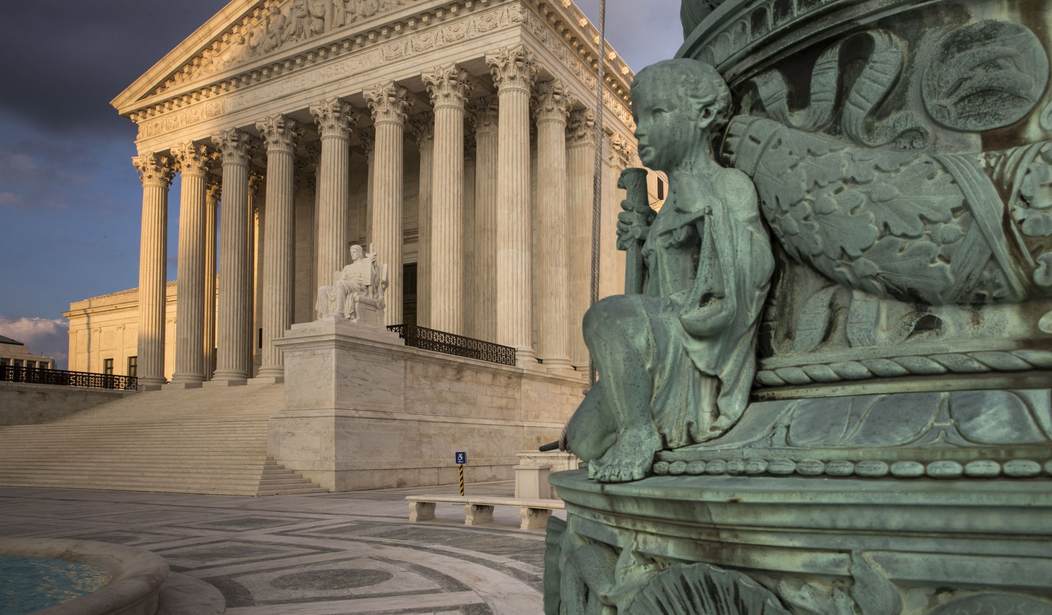
If your workplace is a union shop, are you forced to pay union dues? Next week, the Supreme Court will hear arguments about that.
When I worked at CBS and ABC, I was ordered to join the American Federation of Radio and TV Artists. That union had won a vote that gave them the right to speak for all reporters. I said, "I'm no 'artist.' I'm a reporter! I won't join!" But my bosses said they couldn't pay me unless I did.
In right-to-work states, unions can't force people to join. But only 28 states are right to work. Aging socialist bureaucracies like New York state are not among them.
But now the Supreme Court may say that no government worker, in any state, can be forced to pay a union.
"If we lose this case, the entire public sector will be right to work," warns Lee Saunders, president of AFSCME, the big government employees union.
That outcome would thrill Rebecca Friedrichs. She's the teacher who filed the right-to-work lawsuit that went to the Supreme Court two years ago.
Friedrichs got mad at the California Teachers Association during the last recession. Good teachers at her school were about to be laid off. She'd tried to protect them by getting all teachers to agree to a slight pay cut.
"All America was taking a pay cut then," she told me. "Why should we be any different?"
But her union wouldn't even allow her to survey other teachers. "They told me, Rebecca, don't worry about those teachers who were about to lose jobs. ... We're going to give them a seminar on how to get unemployment benefits."
That was one thing that made Friedrichs angry enough to sue the Teachers Association. Three years later, the Supreme Court agreed to hear her case.
Supreme Court watchers predicted that she would win. Union cheerleaders were pessimistic. Chris Hayes of MSNBC said that Friedrich's case might "decimate the way that public sector unions function."
But shortly before the justices voted, Antonin Scalia died.
"That was the most devastating day," says Friedrichs. Without Scalia's vote, the Court deadlocked 4 to 4.
Now a new suit has been filed by government worker Mark Janus. With Neil Gorsuch now the ninth justice, unions are worried.
In fact, they are so worried that AFSCME representative Steven Kreisberg agreed to do one of my YouTube interviews.
"Our members ... want their union to have power," he said. "It's (Janus') right to dissent and not be a member of our union. He only has to pay the fees that are used to represent him."
But what's the point of dissenting from the union if you still have to pay? Janus doesn't want to be forced to pay for something he doesn't agree with.
Kreisberg replied, "I'm not sure if he doesn't agree with it, or just simply doesn't want to pay because he'd like to get those services for free."
That's an argument a free-market advocate can understand: It's not fair if people freeload off others' work -- getting benefits others fund. But who judges what is a "benefit"?
"If I saw their representation as a benefit, I could agree with that, but I don't," Friedrichs said. "The benefits aren't worth the moral costs."
Kreisberg responded, "That sounds like the words of a right-wing activist, not the words of a teacher."
Janus's lawsuit points out that Thomas Jefferson wrote, "To compel a man to furnish contributions of money for the propagation of opinions which he disbelieves and abhors is sinful and tyrannical."
Kreisberg had a quick answer to that: "Thomas Jefferson had no sense of 21st-century labor relations."
That's probably true. But some principles are eternal, like deciding what to do with your own money and not being forced to fund speech with which you disagree.
The justices will announce their ruling sometime this summer. I hope that they'll side with Jefferson. Forcing people to pay for what we don't want is tyranny.



Join the Conversation
VIP members get the ability to comment on articles.