






“I’ve seen the people at 4 o’clock in the morning, waiting, hoping that they would win a seat for their child in a better school. This is not fair. Parents deserve more choices.”
That’s Bill Cosby, voicing his support for National School Choice Week. His words capture the real issue at stake here: Too many children are being robbed of a good education. And their parents, despite a desperate desire to change that situation, feel helpless. They’re stuck with whatever the local public school gives them.
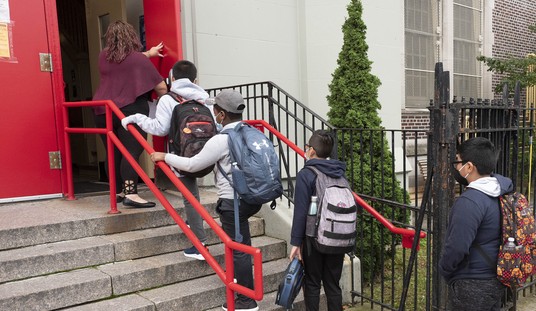
Now, many communities across the country are blessed with good public schools and caring teachers. But many other kids, especially those in low-income neighborhoods, are not. For those who are unfortunate enough to grow up in these areas, going to school is an ordeal, not an opportunity.
“In my old public school, people screamed at the teacher, walked out the school door in class, hurt me and made fun of all my friends,” says 11-year-old Paul, a student in Washington, D.C. “People did not pay attention, which made it hard for me to focus.” His dream of becoming an architect was off to a troubling start.
Thanks to the D.C. Opportunity Scholarship Program, however, things turned around. Paul’s parents received a voucher to pay the tuition at any private school they chose. “When I first came to [my private] school, I made lots of friends the first day,” he said. “It is easier for me to focus. In the second quarter I got all ‘A’s, except for French, [in] which I got a ‘B’.”
If only there were more such happy endings. You’ll find many students like Paul across the country -- and far too few opportunities like those provided by the D.C. Opportunity Scholarship Program.
In fact, unless Congress acts to reauthorize it, you won’t find the D.C. Opportunity Scholarship Program itself before long. Bowing to a high-pressure campaign by education unions and other special-interest groups, the Obama administration stood by as Congress began phasing it out.
This is inexcusable. These defenders of a pathetic status quo have shown no interest in enforcing a standard of excellence. They deliberately stand in the way of parents who wish to send their kids elsewhere but lack the means to do so.
Even for parents able to sacrifice and send their children to better schools, the current situation is a bad deal. They pay twice -- once for the school their children actually attend, and once (through their tax dollars) for an education they’ll never use.
So what do parents wind up doing? The kinds of things Bill Cosby was talking about: getting on waiting lists, standing in line at ungodly hours, writing letters, making phone calls. And all in the hope that maybe -- just maybe -- they’ll be among the lucky few. Cosby’s right: Plain and simple, this isn’t fair. Parents deserve better.
So do our kids. Federal spending on education has been skyrocketing since the Bush administration, but educational outcomes have not. Graduation rates are no better now than they were in the 1970s (about 75 percent nationally, but significantly worse in some urban areas). The latest Program for International Student Assessment shows that 17 out of 33 developed nations, including Estonia and Slovenia, have higher math scores than the U.S. We’re not much better off when it comes to reading -- or to closing the gap between white and minority students.
“School choice is a civil rights issue,” says Michelle Bernard, head of The Bernard Center for Women, Politics & Public Policy. “It is the natural extension of Brown v. Board of Education, of what Thurgood Marshall and Dr. Martin Luther King talked about -- access to great schools for families. Parents marched for equal rights; today, they should be marching for school choice.” So why aren’t we?

Join the Conversation
VIP members get the ability to comment on articles.