







The volatile situation inside the Islamic Republic of Iran will undoubtedly be a major topic at the Munich Security Conference (MSC), which begins this Friday. Unfortunately, conference organizers have invited the wrong opposition figure. Rather than amplifying authentic democratic activists, the MSC has given its platform to Reza Pahlavi—a figure whose manufactured prominence abroad far exceeds his support among the people he claims to represent.
Following the latest nationwide uprising in late December, the fourth in eight years, Pahlavi once again rushed to insert himself into Western policy discussions. This has become a familiar pattern. His high-priced PR campaigns have secured him media soundbites, even as they fail to inspire confidence inside Iran, where memories of his father’s corrupt and autocratic rule remain vivid. His invitation to Munich is a warning of the confusion and distortion he brings to debates about Iran’s political future.
Pahlavi’s father, Mohammad Reza Shah, was swept from power in 1979 by a popular revolution that rejected monarchical dictatorship. Nearly five decades later, despite the Islamic Republic’s catastrophic record on human rights and economic governance, Iranians show no indication of yearning for the restoration of a dynasty they overthrew. Yet Pahlavi continues to promote the fiction that Iranians face a binary choice between the current theocracy and a resurrected monarchy.
During the recent uprising, this narrative was pushed aggressively. Before the authorities shut down internet access, videos circulated online that appeared to show protesters chanting “Pahlavi will return.” Subsequent investigations revealed that the audio had been added later and then spread through coordinated influence networks using regime-provided internet access known as White SIM cards. By the time this manipulation was exposed, major international media outlets had already repeated the false narrative that the uprising was pro monarchist in character.
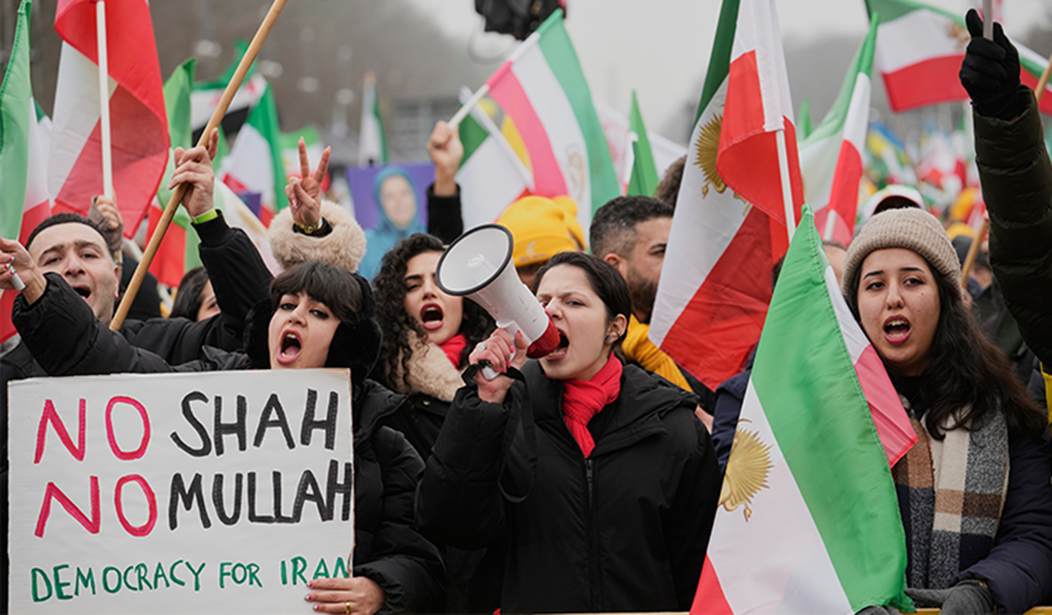
In reality, the protesters’ slogans were consistent with those heard during previous uprisings. Demonstrators overwhelmingly demanded regime change as a precondition for democracy, rejecting both the current and former dictatorships. One of the most defining slogans of the past decade has been “death to the dictator, whether Shah or Supreme Leader.”
Last Saturday, tens of thousands of Iranians from across Europe gathered at an NCRI rally in Berlin to amplify precisely this message. The event could have served as a powerful springboard for principled discussions on Iran’s future ahead of the MSC. Notably, the rally brought together a vivid microcosm of Iran’s diverse nationalities, Kurds, Arabs, Baluchis, Azeris, and others, communities that have long faced discrimination under both the Pahlavi monarchy and the current theocracy.
Groups like the NCRI now face a dual struggle: confronting the Islamic Republic while simultaneously countering the revisionist claims of the former monarchy’s heirs. This challenge has been exacerbated by Western policymakers and commentators who carelessly accept the premise that Iranians are confined to choosing between two forms of authoritarianism. That misconception is no accident; it is the product of a sustained media influence campaign fueled by the considerable wealth Pahlavi inherited from his father—much of it the result of corruption and state plunder.
The doctored protest videos were only the most recent manifestation of that campaign, which benefited both Pahlavi and, ironically, the ruling clerics. Iran’s Ministry of Intelligence and Security (MOIS) has long been accused of amplifying monarchist propaganda online to demoralize protesters and diminish international support for the democratic movement. The regime understands that associating the uprising with Pahlavi, whose name remains widely discredited inside Iran, helps undermine its credibility.
In this context, Pahlavi’s invitation to the MSC is troubling. By extending this platform to Pahlavi, the MSC risks appearing to anoint a “next ruler” for Iran—an unsettling echo of the paternalistic, colonial mindset that once presumed foreign powers could hand pick leaders for the Iranian people. Whether intentionally or not, it contributes to the very dynamic the Iranian regime seeks: the dilution and distortion of the democratic opposition. At a moment when Iranians have once again risked their lives in mass protests, such missteps by Western institutions carry real consequences.
Fortunately, thousands of Western lawmakers and officials have publicly recognized the NCRI as a viable democratic alternative and have rejected attempts to rehabilitate the monarchy. Their voices are urgently needed now. In the wake of the regime’s violent suppression of protesters, and ahead of Pahlavi’s appearance in Munich, those policymakers must reaffirm their support for the genuine opposition movement and resist efforts, whether by monarchist circles or through Tehran’s influence operations, to hijack the narrative.
The organizers of the Munich Security Conference still have time to correct course. They should rescind their invitation to Pahlavi and instead engage figures who have articulated, and fought for, a democratic vision for Iran’s future and presented a detailed roadmap for a secular, democratic republic.
As Iran stands at a potentially transformative moment, international forums must not allow discredited symbols of the past to overshadow the voices of those risking everything for a democratic future. The world owes the Iranian people better than a false choice between two dictatorships. They deserve their rightful place at the center of the conversation.
Prof. Vidal Quadras is President of the International Committee in Search of Justice (ISJ) and was the Vice President of the European Parliament (1999 – 2014).
Editor’s Note: Do you enjoy Townhall’s conservative reporting that takes on the radical left and woke media? Support our work so that we can continue to bring you the truth.
Join Townhall VIP and use promo code FIGHT to receive 60% off your membership.
Join the Conversation
VIP members get the ability to comment on articles.