







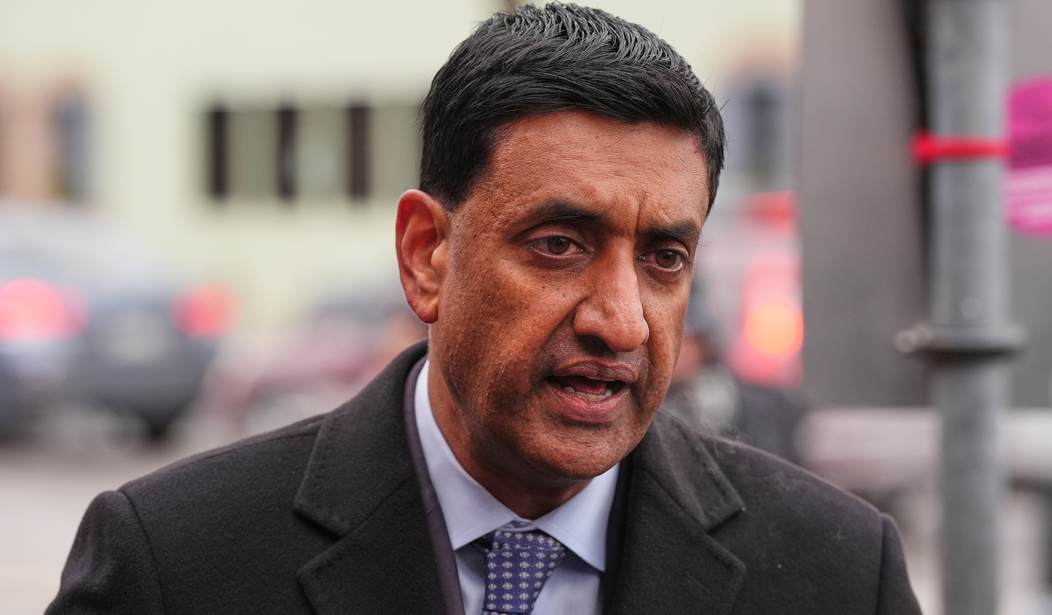
Rep. Ro Khanna's answer to inequality is the same one progressives always reach for: take from the market, hand it to the state, and call it fairness. Last week, the California Democrat published what he called "the philosophical case for tax fairness and taxing billionaire wealth," his defense of a bill, co-authored with Bernie Sanders, that would tax 5 percent of a billionaire's total net worth every single year.
There's just one problem: the philosophy never actually shows up. What Khanna offers instead is a bland list of things $4.4 trillion could buy, wrapped in the language of fairness, with none of the actual reasoning a philosophical case would require, and no real reckoning with his own underlying premise.
He said he'd welcome an argument on the merits. So here it is.
I make the philosophical case for tax fairness and taxing billionaire wealth.
— Ro Khanna (@RoKhanna) July 2, 2026
I welcome an argument on the merits for this new social contract.
Read here:https://t.co/NaIGP43oDq
His "philosophical case," in all honesty, isn't much of one. It amounts to little more than an appeal to the virtue of "fairness" and the assumption that the sheer amount of money a wealth tax could generate would be enough, on its own, to justify redistributing it to others for a net societal gain. He fails to address any of the reasonable critiques such a policy invites, why economic freedom apparently factors into this calculation not at all, for one, or how exactly that tax revenue would actually make its way to the people who need it, for another.
In his Substack piece, Khanna opens by arguing that he has spent his career fighting "for fairness in our tax policy," an appeal rooted in the broader philosophy that "if America has been good to you, you must do good for America."
Why exactly does handing the government more tax revenue equate to "do[ing] good for America"? Many of the wealthy Rep. Khanna seeks to tax have already done more good for this country than almost anyone else in its history. Business owners and entrepreneurs make up the overwhelming majority of the billionaire class, meaning their entire career, their entire fortune, was generated in direct proportion to how useful the goods or services they provided actually were to society.
Progressives routinely fail to reckon with a basic reality: the wealthy did not force anyone to hand over their money. They had to build something people actually wanted to buy. Why Rep. Khanna believes those goods and services somehow don't count as the real "good for America" in his own equation is beyond me. To anyone who believes in free markets and the right of individuals to do what they want with their own money, the good they did for America isn't separate from their wealth; it's baked into it.
Rep. Khanna goes on to make a bland appeal to the simple fact that the revenue generated by a five-percent wealth tax could do so much good for society:
This billionaire wealth tax will raise $4.4 trillion over a decade. This is enough to establish a $60,000 salary floor for every public school teacher in America, cap child care at 7 percent of a family’s income, and restore the $1 trillion stripped from Medicaid and the ACA, with a $3,000 check left over for every household under $150,000.
Let's set Medicaid aside for a moment and look at everything else on that list. Why exactly does a wealth tax need to be the mechanism that produces those results? The same goals, paying teachers more, reducing child-care costs, and putting more money in the pockets of American households, could be achieved just as easily by removing government from these industries in the first place, since government intervention is precisely what distorts price mechanisms, drives up costs, and degrades the quality of these services to begin with.
Enacting school choice, forcing schools to compete with one another to produce better educational outcomes, and tying teacher pay to performance rather than seniority would do more to improve education than any wealth tax ever could. Combine that with stripping away bureaucratic bloat and curbing the outsized power of teachers' unions, and suddenly billions of dollars are freed up to go directly to teachers, rather than being swallowed by administrative middlemen.
The same logic applies to child care and health insurance. Both industries are drowning in regulatory overhead, licensing restrictions, and government mandates that inflate costs far beyond what a genuinely competitive market would produce. Introduce real competition, let providers compete on price and quality instead of navigating a maze of compliance, and costs come down without confiscating a single dollar from anyone's bank account.
Khanna's entire premise assumes government must first seize wealth in order to later provide relief. The far simpler, far freer alternative is to stop government from creating the problem in the first place.
And therein lies the real problem with Khanna's new social contract. It assumes the worst of certain individuals and the best of government's intentions, a mockery of the very principles this country was founded on. Until Khanna can make the case that government isn't the problem in each of these areas, and reckon with an old truth progressives still refuse to learn, that nobody spends someone else's money as carefully as they spend their own, his ideas, however well-intentioned, simply carry no weight.
Editor's Note: Do you enjoy Townhall's conservative reporting that takes on the radical Left and woke media? Support our work so that we can continue to bring you the truth.
Join Townhall VIP and use promo code FIGHT to receive 60% off your membership.


Join the Conversation
VIP members get the ability to comment on articles.