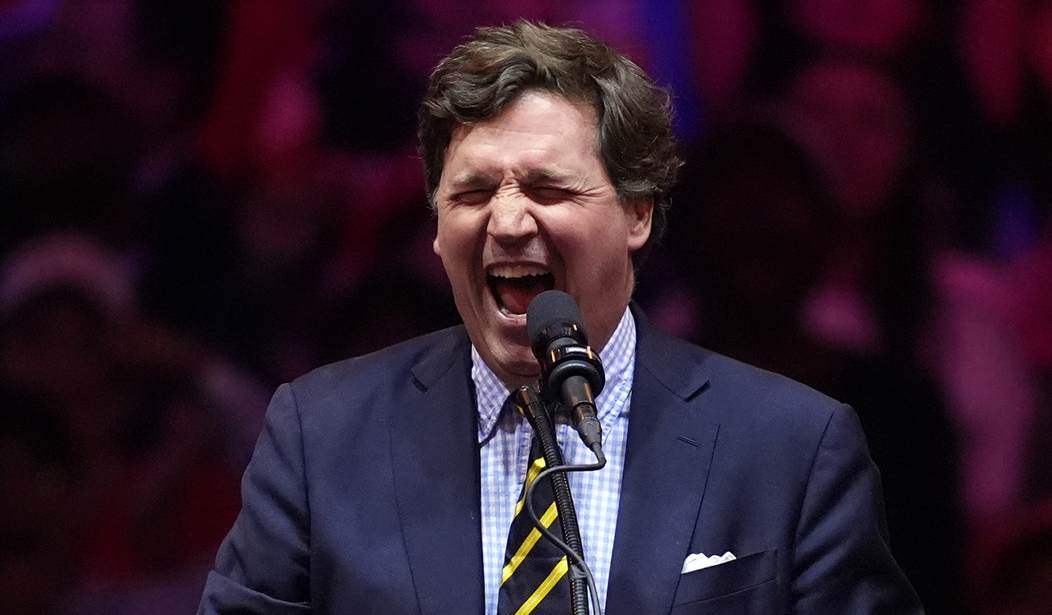

Tucker Carlson is a master of rhetoric and debate, a talent that has become increasingly clear as he uses his conservative base to rally opposition to Republicans. His evolving talking points now include opposition to any foreign policy that results in the deaths of innocent people, a position he proudly presents as a Christian principle, along with Hitlerian, radical-Islamic, and Russian apologism, plus a peculiar blend of social conservatism and progressive economics. In Carlson’s telling, this is what “America First” truly means.
Over the weekend, however, Carlson may have finally met his match: Sir Jacob Rees-Mogg, the British Conservative politician who served as a member of Parliament from 2010 to 2024 and as Leader of the House of Commons and Lord President of the Council from 2019 to 2022. Rees-Mogg’s exit from politics was largely the product of the progressive wave that swept through Britain, a development that should strike Americans as a massive disappointment. And once you watch this debate, the reason becomes painfully obvious.
The debate centered on a fundamental question: What deters war? For Tucker Carlson, the answer appears to be doing virtually nothing abroad, perhaps trading, at most, and engaging militarily only when foreign troops have reached American soil.
Sir Jacob Rees-Mogg offered a view much closer to President Trump’s: if a country hopes to deter war, it must be prepared to fight one.
The discussion began with the threats Russia poses to the United Kingdom: cyberattacks on critical infrastructure, Russian submarines operating near undersea internet cables, disinformation and propaganda campaigns, and other risks associated with Britain’s support for Ukraine since 2022. Carlson argued that those threats stem entirely from Britain’s decision to help Ukraine defend itself. Rees-Mogg countered that they are the predictable result of Britain, and Europe more broadly, failing to project strength.
Russia, he argued, detected weakness when Europe did little to stop Moscow’s 2014 invasion and annexation of Crimea. Concluding that it could act with limited consequences, the Kremlin became increasingly brazen in its intimidation of European nations, and eventually decided to test its luck again with a full-scale invasion of Ukraine.
Predictably, Carlson argued that helping Ukraine is not in Europe’s national interest because Russia has not invaded another European country, and because war, needless to say, is bad. Rees-Mogg offered a more serious argument: national sovereignty is among a country’s most vital interests. Failing to defend it against expansionist dictators, from Vladimir Putin and Xi Jinping to Adolf Hitler, is effectively an invitation for them to keep advancing. Carlson’s premise is that the threats facing Britain would largely disappear if Europe stopped supporting Ukraine. History, however, has an inconvenient habit of making that theory look dangerously naïve.
The conversation quickly deteriorated, largely because that is Carlson’s preferred method of escape. When challenged on deterrence and national sovereignty, he pivoted into revisionist World War II history and a childlike military ethic in which the obvious tragedy of innocent deaths manages to settle nearly every strategic question.
🚨 Extraordinary exchange between Tucker Carlson and Jacob Rees-Mogg on Hiroshima. Rees-Mogg says the bombs were justified because they ended the war and saved far more lives than it took. Carlson refuses to weigh the lives saved at all. When Rees-Mogg says WWII couldn't have been fought without innocent people being killed, Carlson's answer is "I don't know, no one tried." Tucker Carlson's two rules of war: 1. Never do anything that could cause the death of an innocent, even if the action would ultimately save more lives. 2. Unless you're Nazi Germany or Russia. In the same interview, Hitler "did not want war," and Russia invading Ukraine is "the state of play for all great powers." He is condescending the whole way through: "So you can behave like an animal once the war starts." "I don't even understand what you're saying." Then he asks, disingenuously, whether it's Christian to kill children. "I'm not Catholic, so I'm not an expert," he says, right after ruling for himself that the bombing fails Aquinas' just-war test.
— Max 📟 (@MaxNordau) October 5, 2026
In several viral moments, Carlson was simply shut down. At one point, he claimed that Russia has a larger economy than Britain, an assertion that is plainly false. When Rees-Mogg corrected him, Carlson pivoted to attacking GDP itself as a measure of economic development, a subject he then seemed eager to escape almost as quickly as he had raised it.
Brutal exchange: Tucker Carlson incorrectly tells Jacob Rees-Mogg that Russia has "a much larger economy" than Britain. It doesn't: by GDP, Britain's is about $4.0 trillion and Russia's about $2.5 trillion. Corrected, Carlson retreats to "GDP is not the only measure," then to Russia's "inherent wealth." Rees-Mogg: "Inherent wealth isn't very useful, is it? There are lots of African countries that have huge resources that have never been able to use them." Carlson: "It depends what your timeline is." Rees-Mogg: "Well, if you go for hundreds of years, they haven't used them. Russia has consistently been a poor country in spite of its resources." Carlson: "I don't agree, but I will grant you that."
— Max 📟 (@MaxNordau) October 3, 2026
They went on to debate the U.S. decision to drop atomic bombs on Japan during World War II, which Rees-Mogg defended with unusual clarity. He was equally direct when Carlson suggested that Hitler invaded Poland merely to reclaim territory “stolen” from Germany after World War I. Again and again, Carlson changed the subject; again and again, the British conservative rebutted him and steered the discussion back to the point Carlson seemed determined to avoid.
🚨🚨 Tucker Carlson insists three times that Hitler "did not want to go to war with the UK," and twice demands that Jacob Rees-Mogg "acknowledge" it. Hitler "didn't want war" with Britain the way a mugger doesn't want a fight with his victim. He wanted Britain to stand aside while he took Europe. Britain publicly guaranteed Poland's independence in March 1939. Hitler invaded Poland anyway. Rees-Mogg: "I'm very surprised you're verging on defending Hitler." Carlson sarcastically remarks that he is a secret Nazi, then clarifies that he is neither a secret Nazi nor a public Nazi.
— Max 📟 (@MaxNordau) October 2, 2026
At one critical point, Carlson, true to form, argued that Britain is not better off for having defeated Nazi Germany. This point matters tremendously because versions of that argument have gained traction elsewhere.
Carlson cited Britain’s current problems, particularly those tied to immigration policy, as proof that victory in World War II was somehow a mistake. But Britain’s modern failures are not the consequence of defeating Nazism. They are the consequence of a free people making disastrous choices for themselves, rather than having their future dictated by a foreign power. The freedom to make mistakes, even catastrophic ones, may be among the greatest freedoms of all.
If Carlson ever appeared to be winning, it was largely because he demanded that Rees-Mogg predict the future with impossible precision: exactly what Putin would do, exactly how Western governments would respond, and exactly how every contingency would unfold.
Nearly every question Carlson posed reeked of pro-Russian apologism: the assumption that Putin would inevitably use nuclear weapons, or the implication that Russia’s invasion is somehow understandable because Ukraine is corrupt. Ukraine has serious corruption problems, as do many countries. But there happens to be at least one country, more corrupt than Ukraine, currently invading its neighbor.
The British conservative’s performance was a masterclass in clarity and something I encourage you to watch in full.