


Editor's Note: This column was co-authored by Paul J. Larkin.
A drafting mistake in the Agricultural Improvement Act of 2018 (or 2018 Farm Act) contained a loophole that the hemp industry has driven through, putting intoxicating gummies, vapes, and drinks in gas stations and smoke shops and creating serious public health risks. Congress closed the loophole in 2025, but the industry is now pushing Congress to delay the fix again. Congress should deny those entreaties.
Pushed by Sen. Mitch McConnell (R-KY), the 2018 Farm Act sought to remove industrial “hemp” from the reach of the Controlled Substances Act of 1970 (CSA) so it could be used for nonpsychoactive purposes. Congress did this by defining hemp as any part of the cannabis plant, including its derivatives, with a concentration of delta-9 tetrahydrocannabinol (THC), the plant’s main intoxicant, at or below 0.3 percent on a dry-weight basis.
Congress, however, made a mistake. It capped one potential intoxicant but said nothing about its chemical siblings, such as delta-8, which also has a psychoactive effect.
Delta-8 occurs in hemp only in small amounts. But ganjapreneurs noticed that loophole, and chemists have taken advantage of it by synthesizing delta-8 from another cannabis compound, cannabidiol (CBD).
Asa Hutchinson, former head of the Drug Enforcement Administration, wrote recently in The Washington Times that members of Congress “were not trying to open a legal market for intoxicating drugs.” The “loophole,” however, did just that.
The 9th U.S. Circuit Court of Appeals acknowledged that possibility in AK Futures LLC v. Boyd Street Distro, LLC, noting that “[i]f . . . Congress inadvertently created a loophole legalizing vaping products containing delta-8 THC, then it is for Congress to fix its mistake.”
Congress did so in 2025. Section 781 of the FY2026 Agriculture Appropriations Act measures total THC, not just delta-9, caps finished products at 0.4 milligrams of total THC per container, and excludes cannabinoids synthesized or manufactured outside of the plant.
That fix was scheduled to take effect on November 12 of this year, but lawmakers postponed most of it to December 11 in the appropriations bill now in effect. Congress should not delay it again.
First, the Food and Drug Administration (FDA) has not approved delta-8 products as safe and effective for any use, yet a Villanova University study of Pennsylvania adults found that 87 percent of them mistakenly believe intoxicating hemp products are government-regulated.
Second, variability in product labeling and formulations can mislead consumers. When researchers tested 20 delta-8 products bought at Pittsburgh retailers, the labeled and measured amounts of delta-8 were only weakly correlated, and 35 percent of the products also contained delta-9.
Third, some delta-8 products might contain harmful contaminants such as lead, mercury, pesticides, mold, and household chemicals. Poison centers managed 10,434 delta-8 exposure cases from 2021 through 2025.
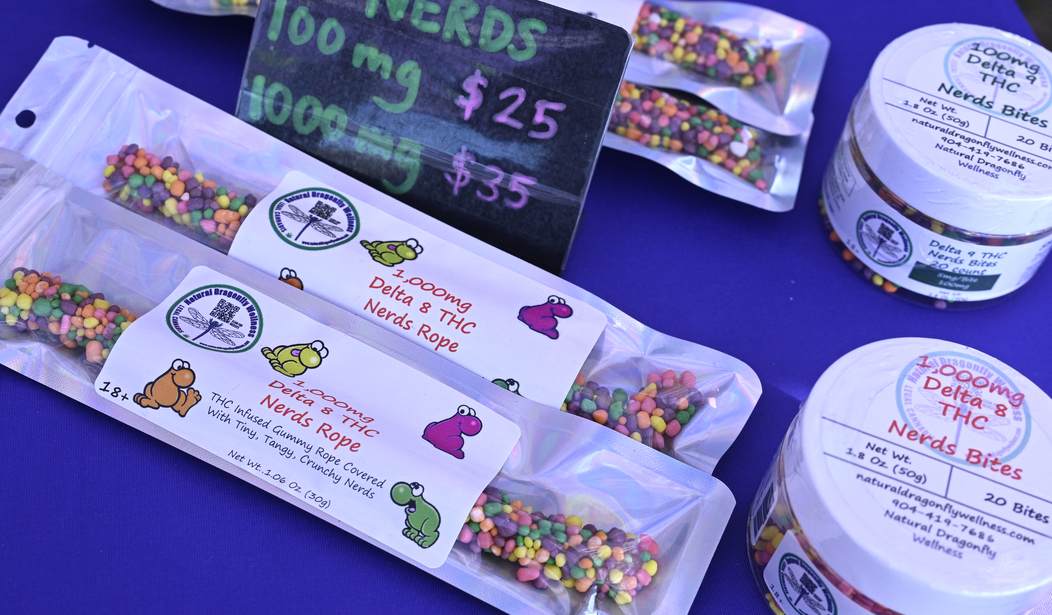
Fourth, as Hutchinson noted, “[t]here are often no age checks, no dosing standards and no child-resistant packaging, and the branding frequently borrows cartoon characters and candy styles that appeal to youngsters.” Nearly half of those poison-center cases involved accidental exposure in children.
Such concerns have persuaded the American Medical Association, the American Academy of Pediatrics, and the National Institute on Drug Abuse that minors should not use cannabis products, which can cause greater injury to the labile juvenile brain.
Fifth, one potentially fatal consequence of using delta-8 products is the risk that users will drive after consuming them. The result can be crashes that injure, maim, or kill drivers, passengers, or pedestrians.
Sixth, farmers do not need another delay. In 2025, they harvested 16,880 acres of floral hemp, the kind grown for cannabinoids. America has roughly 874 million acres of farmland. Do the math. (Hint: about 0.002 percent.)
Seventh, this is not some new federal ban. The 2018 Farm Act left the Federal Food, Drug, and Cosmetic Act alone, and the FDA reads that law to forbid putting THC in food sold across state lines.
Eighth, the White House has already said no. Axios reported that in early August, at a closed-door lunch with Senate Republicans, James Braid, then the White House’s legislative affairs director, “committed to no further delays” beyond the one in the stopgap. Congress should hold the administration to that.
Nor is Congress alone. On August 4, the attorneys general of 34 states and the U.S. Virgin Islands, Republicans and Democrats, wrote to Speaker Mike Johnson, Senate Majority Leader John Thune, and the two appropriations chairs, Rep. Tom Cole (OK-4) and Sen. Susan Collins (R-ME), urging them to reject “any effort to delay, repeal, suspend, or weaken” the new definition.
Congress made an unintentional mistake in the 2018 Farm Act, and the 9th U.S. Circuit Court of Appeals told Congress that only Congress could fix it. Congress did just that in 2025. The least that Congress can do now is let the fix take effect.
Paul J. Larkin is a Senior Legal Fellow in the Meese Institute for the Rule of Law at Advancing American Freedom. Paul Teller, Ph.D., is President of Teller Strategies and a Senior Advisor to Advancing American Freedom.
Editor's Note: Do you enjoy Townhall's conservative reporting exposing the radical left and woke media? Support our work so we can keep bringing you the truth.
Join Townhall VIP and use promo code FIGHT to receive 60% off your membership.

Join the Conversation
VIP members get the ability to comment on articles.