





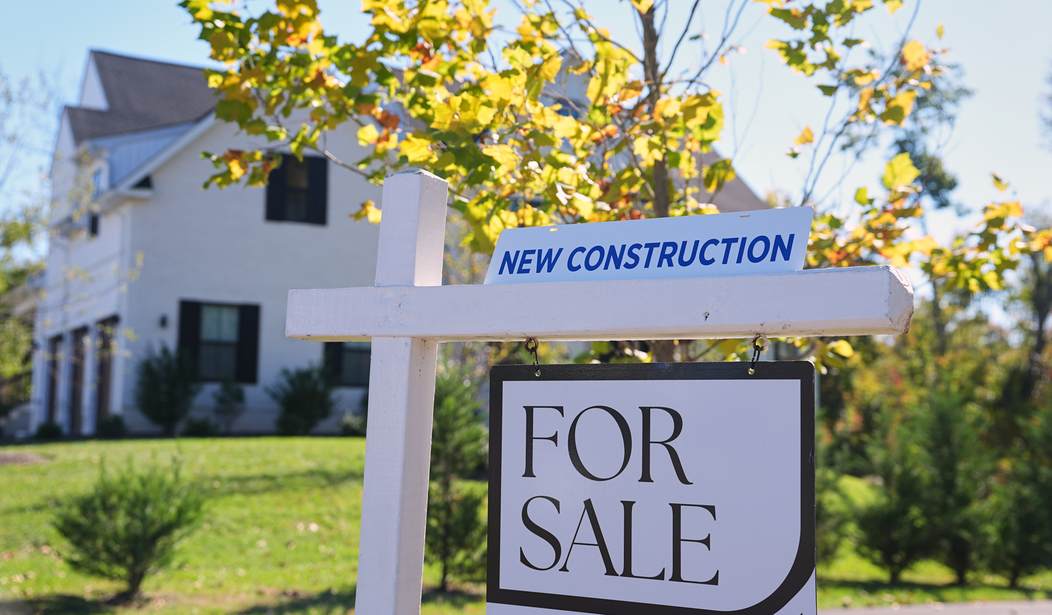
Affordability's all the rage, yet there's no bigger—or misunderstood—component than housing. A basic review of America's housing market now, and what it has gone through, shows that the "economy's biggest problem" is really a political one.
The gist of America's housing complaint is that mortgage rates and prices are too high and supply is too low. In a word, housing is "unaffordable" for many young Americans, to the point that it appears unattainable to many of the next generation.
The dream of homeownership strikes a fundamental chord for Americans. America was born as a nation of settlers. Unsurprisingly, we enshrined homeownership in our tax code by making home mortgage interest payments deductible—one of the biggest tax "breaks" for average Americans.
These factors make a family's home its treasure and often its biggest asset.
So, a threat to homeownership goes beyond an economic issue to a societal one.
Breaking down today's affordability, let's first look at interest rates, the most focal and moving housing metric. Over the last five years, the 30-year fixed-rate mortgage average jumped from 2.73 percent on February 11, 2021, to a 7.79 percent peak on October 26, 2023. By January 1, 2025, it had fallen to 6.96 percent; on February 5, 2026, it stood at 6.11 percent.
While it has fallen almost 1.70 percentage points from its 2023 peak, it is still almost 3.5 percentage points higher than five years ago. Why?
Usually, when housing prices rise, mortgage rates fall (because there is less demand); usually, when mortgage rates fall, housing prices rise (because there is more demand). COVID destroyed this norm.
With government lockdowns of the economy during the pandemic, demand for housing soared; yet as the Fed and Biden administration pumped money into the system, so did inflation. So, instead of housing demand and mortgage rates offsetting each other, they accelerated together.
Once inflation becomes expected, people react to it rather than to prices alone; they seek investments that won't be undermined by depreciating money: precious metals (e.g., gold) and, of course, housing, which has the added bonus of aforementioned favorable tax treatment. So, housing prices perversely became another driver of demand, as people saw them as evidence of inflation and sought housing simultaneously.
Unwinding this "double dynamic" has been hard. Inflation had to slow so people could get a real cue on prices and so mortgage rates could fall (because the inflation premium could drop).
We are now seeing the first steps. As mentioned, mortgage rates have fallen with inflation's slowing. Monthly inflation (CPI-U), which peaked at 9.1 percent in June 2022, was 2.7 percent in each of the last two reported months. Housing demand also lost its COVID surge: America's median home sales price peaked at $442,600 in Q2 2022; it was $410,800 in Q2 2025.
So, mortgage rate and median price have both dropped. Neither are where they were, nor where we would like them to be. However, they aren't, not because of our economy per se, but because of our politics.
Inflation surged because both the Fed and the previous administration pumped trillions of dollars into the economy. According to the Congressional Budget Office, in fiscal years 2021-2024, the federal government spent $8.2 trillion over its pre-COVID, FY 2019 baseline and ran $7.5 trillion in deficits. Simultaneously, the Fed's balance sheet went from a pre-COVID $4.2 trillion to $9 trillion by mid-2022—and this was just one of many ways it injected liquidity.
However, the surge in inflation and housing demand from COVID lockdowns was a political issue, not an economic one.
Regulation is yet another cause of high home prices. And another political one—particularly at the local level.
Unleash Prosperity just reported on a Realtor.com analysis on the time needed to save (at an annual 5.1 percent savings rate) the down payment amount for a median-priced home in different cities. The average number of years is seven; however, the ten lowest cities (one and a half in San Antonio to five in St. Louis) are all in red states, and the ten highest (14 in Denver to 36.5 in San Francisco) are in blue states. And blue states are routinely ranked as having the highest housing regulation costs.
What about housing supply? Another political problem. Of course, blue states' high housing regulation costs serve to limit supply and hurt demand. However, there is another problem, too.
America's home equity is a record high $35 trillion in $50 trillion worth of owner-occupied housing. Home equity is an economic factor (and certainly no problem), but the "lock-in" is a problem and purely political. Many homeowners find themselves "locked-in": Selling their homes would mean paying an onerous capital gains tax that does not factor in inflation's effect on their homes' increased value; they are taxed on nominal, not real, value appreciation.
Bottomline: Housing affordability is indeed an issue for many Americans; however, it's not an "economic problem," but a political one. As usual, solve the political problems, and the "economic problem" will be solved as well.
J.T. Young is the author of the recent book, "Unprecedented Assault: How Big Government Unleashed America's Socialist Left," from RealClear Publishing. Follow him on Substack.
Editor’s Note: Do you enjoy Townhall’s conservative reporting that takes on the radical left and woke media? Support our work so that we can continue to bring you the truth.
Join Townhall VIP and use promo code FIGHT to receive 60% off your membership.


Join the Conversation
VIP members get the ability to comment on articles.