





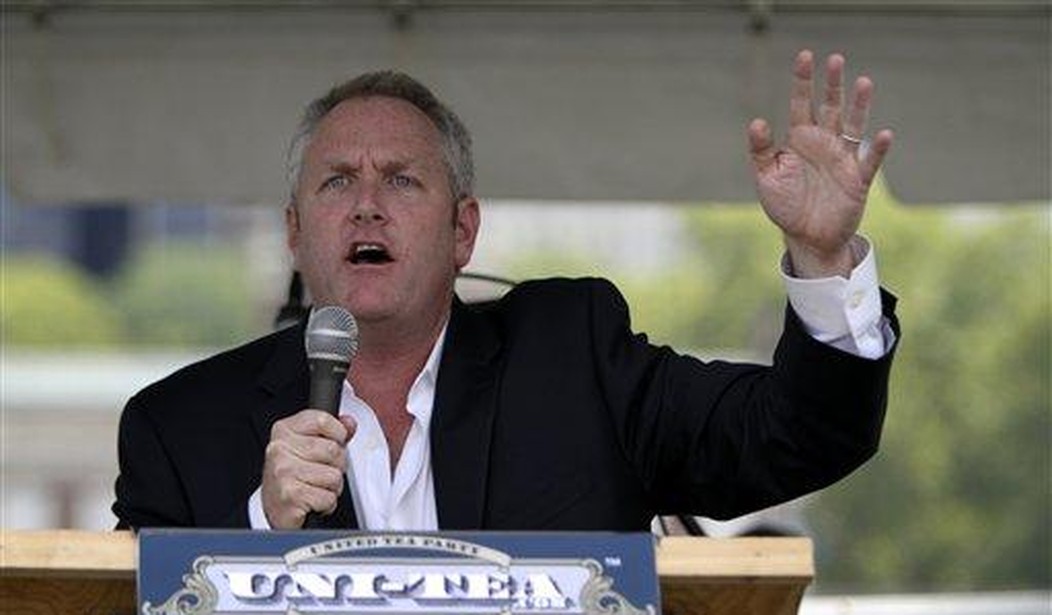
The late, great Andrew Breitbart was one of the most quotable conservatives of his era. "Walk toward the fire," he exhorted his fellow activists. "Don't worry about what they call you. All those things are said against you because they want to stop you in your tracks." It was good advice when Breitbart said it during the contentious Barack Obama years, and it's even better advice during the era of hyper-woke dogma today. But if Breitbart the man is singularly identified with any one line, it would undoubtedly be his well-known quip that "politics is downstream of culture." Indeed, this pithy formulation became known as the "Breitbart Doctrine."
Breitbart, a native Angeleno who frequently inveighed against the fetid rot in his nearby Hollywood, was a culture warrior to his core. He correctly observed -- and lamented -- the immense power that comes with left-wing dominance of Hollywood, Silicon Valley, the academy and sundry other formative civil society institutions. The message of the Breitbart Doctrine was simple: Win the culture, and you win the war. If you control America's key opinion-sculpting institutions, then you will eventually control opinion itself. And that, in turn, will inevitably translate into victory at the ballot box.
In all this, the sage of Brentwood was correct. But what if the Breitbart Doctrine wasn't actually complete? What if it was missing half the picture?
While politics is downstream of culture, it ought to be self-evident that culture is also downstream of politics.
For millennia, Western rulers have understood that political (and judicial) power and rhetoric can, and do, affect the culture and the ways that people think. Ralph Lerner, the longtime University of Chicago political philosopher, famously referred to the U.S. Supreme Court as a "republican schoolmaster" -- as the American institution intended to be "an educator, molder, and guardian of the manners, morals, and beliefs that sustain republican government." George Will's 1983 book, "Statecraft as Soulcraft," advanced a similar theme for political statesmanship. What is politics, after all, if not the use of power, however hard or soft, to stir our sensibilities and our very souls?
Consider, for instance, former first lady Nancy Reagan's "Just Say No" initiative. "Just Say No" was a concerted government effort to use political rhetoric, messaging and soft power to change American culture -- specifically, Americans' views on drug use. The campaign was remarkably successful. In 1979, just before Ronald Reagan's crushing defeat of the feckless Jimmy Carter, a whopping 14.1% of Americans reported using drugs. Then, during the Reagan presidency, William Bennett became America's first "drug czar," the first lady led "Just Say No," and the aligned nonprofit Partnership for a Drug-Free America created a now-famous public service advertisement, "This is your brain on drugs." By the end of the George H.W. Bush presidency in 1993, drug use had dropped by 60%.
Politics and culture thus constitute something of a two-way street: Each is both downstream and upstream of the other. Both politics and culture are crucially important, and each of them greatly affects the other.
The latest reminder of the "two-way street" nature of the politics-culture relationship came this week from an unexpected source: Mark Zuckerberg, the ultra-billionaire founder of Facebook and CEO of parent company Meta. During the 2020 election, $400 million of Zuck's eponymous "Zuckerbucks" were funneled to help elect Democrats and advance likeminded left-wing causes. But Zuck now seems to be on an elaborate mea culpa tour. This week, he followed his surprising August 2024 letter to House Judiciary Committee Chairman Jim Jordan (R-Ohio), in which he expressed "regret" for Facebook's role in previous censorship decisions, by announcing the termination of all "fact-checking" programs -- a euphemism for censorship of conservative speech. In its stead, Zuck has vowed to instead implement grassroots "community notes," as Elon Musk has done on X.
It is unlikely that Zuckerberg's about-face, which also includes the recent promotion of former George W. Bush White House deputy chief of staff Joel Kaplan to the prominent role of Meta president of global affairs, was done with purity of heart. There are two motivating factors.
First, and less salient, is Zuckerberg's likely jealousy of the coziness that his fellow ultra-billionaire technologist, Musk, has with Donald Trump. Second, and more important, Zuck, who recently jetted off to Palm Beach to dine with the maestro of Mar-a-Lago himself, is now scrambling to get on Trump's good side -- or at least avoid his bad side. Zuck knows that Trump, who leads a nationalist-populist political movement, does not instinctually view Big Tech favorably. It was Trump's own Department of Justice, after all, that first filed the sweeping -- and still active -- antitrust suit against Google.
But whatever the motive, Zuckerberg has now bent the knee to meet the Trumpian moment. Politics affected culture -- this time, before the politician even formally retook power.


Join the Conversation
VIP members get the ability to comment on articles.