





It's a bit of a cliche to quote "Casablanca" when it comes to Washington's gift for manufactured outrage, but the classics are classics for a reason. When Captain Louis Renault orders Rick's saloon shut down, Rick (played by Humphrey Bogart) protests: "How can you close me up? On what grounds?"
Renault (played by Claude Rains) replies, "I am shocked -- shocked -- to find that gambling is going on in here!"
Then, a croupier walks up to Renault and hands him some money: "Your winnings, sir."
"Oh, thank you very much," Renault says. "Everybody out at once!"
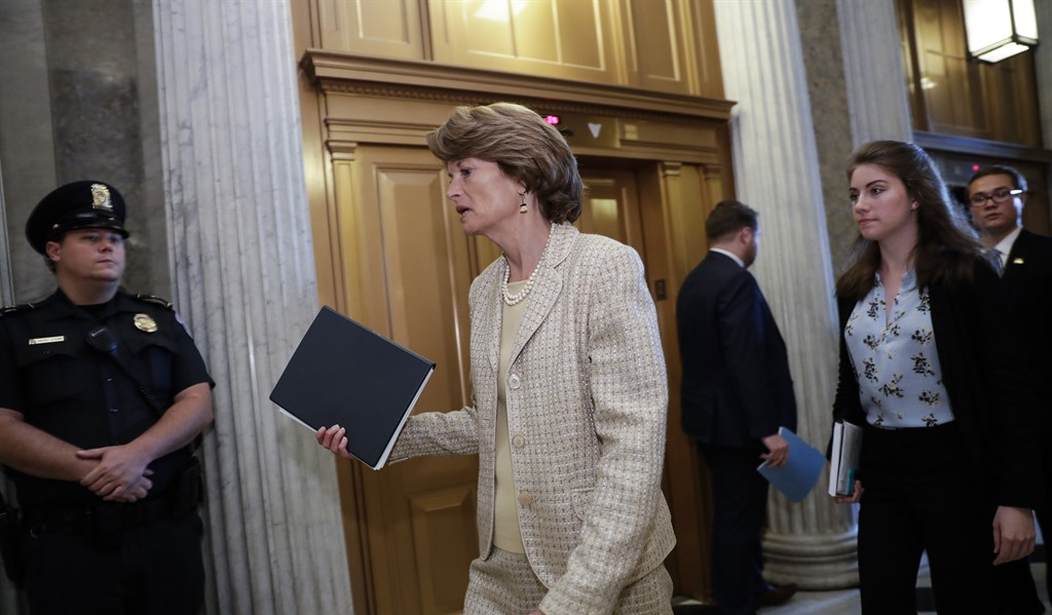
The scene came immediately to mind amidst the instant outrage over reports that the Trump administration was threatening Alaska's senators. On Tuesday, Sen. Lisa Murkowski voted not to move to debate on the Senate health care bill. That angered the president. She "really let the Republicans, and our country, down yesterday. Too bad!" the president complained on Twitter Wednesday morning.
That afternoon, Secretary of the Interior Ryan Zinke called both Murkowski and Alaska Sen. Dan Sullivan, according to a story first reported by the Alaska Dispatch News. "I'm not going to go into the details," Sullivan told the paper, "but I fear that the strong economic growth, pro-energy, pro-mining, pro-jobs [policies] and personnel from Alaska who are part of those policies are going to stop."
The story sent "shocked -- shocked!" shockwaves across Washington. How dare the Trump administration threaten the state of Alaska!
Come now.
Let me say up front that what Zinke did may be politically unwise. It may be unethical. It may be crude.
But it's not illegal. It's normal.
Every administration in American history, and every regime since the first city-states formed in Mesopotamia, has played some version of this game, not merely from time to time, but every single day. Rewarding your friends and punishing your enemies isn't some breach of the established rules of politics; those are the established rules of politics.
Every White House has a political operation that reminds policymakers that this state should get better treatment than that state for one political reason or another. It's the job of the policymakers to know when to listen to that guidance and when to ignore it.
The proper symbol of FDR's imperial presidency wouldn't be a ball and scepter but a carrot and a stick. Roosevelt held his coalition together by awarding massive defense contracts to Southern states whose senators were the barons of the defense and appropriations committees. His freshly minted Social Security Board threatened to withhold funds from states that resisted compliance with the Aid to Families with Dependent Children welfare program. LBJ's Health, Education and Welfare Department threatened to terminate funds for states that didn't enforce civil rights.
Congress is no better. It has used the Highway Trust Fund time and again to force states to comply with its will. In 1974, Congress declared that any state that didn't set its speed limit to 55 mph would see the money spigot turn off. In 1975, Congress did the same to force motorcyclists to wear helmets. In 1984, the same technique was used to raise the legal drinking age.
And now let's discuss the great state of Alaska, a place I love and have spent much time in. (My wife is from Fairbanks, and much of her family is still there.) Alaska fancies itself a land of rugged individualists. Its nickname, emblazoned on its license plates, is "The Last Frontier." A more accurate nickname might be "The New West Virginia" for its addiction to pork. At the height of the earmark era in Congress, Alaska ranked No. 1 on the list of recipients, thanks largely to former Rep. Ted Stevens, the self-styled "Emperor of Earmarks."
No one runs for federal office in Alaska without promising to bring home the bacon from Washington. In fairness to Alaskans, one reason that's seen as necessary is the federal government controls so much of the state (about 60 percent of its land is controlled by Washington).
Murkowski herself lobbied for months for a special Alaska-only carve-out under the Better Care Reconciliation Act -- the nearly $2 billion "Kodiak Kickback." It proved to be not enough, but the "for sale" sign had gone up.
Zinke's heavy-handedness will probably backfire because standing up to threats is one of the only things that plays better in Alaska than accepting porcine bribes.
But the outrage is all part of the show. As Hyman Roth says in "The Godfather Part II," "This is the business we've chosen."
Don't Be Shocked (Shocked!) by Alaska Threats
Opinion
The opinions expressed by columnists are their own and do not necessarily represent the views of Townhall.com.
Advertisement
Advertisement

Join the Conversation
VIP members get the ability to comment on articles.