






To many liberals, Rick Perry's audacious pledge to make Washington, DC, as "inconsequential in your life as I can" is tantamount to a pledge to bring back the Dark Ages.
Commenting on Twitter as the Texas governor announced his presidential candidacy last weekend, longtime Washington journalist Howard Kurtz wondered: "Perry wants to make DC 'inconsequential in your life.' Does that include Medicare, Soc Sec, vets' programs, air safety, FDA?" Former Bobby Kennedy aide Jeff Greenfield, calling Perry's words "nothing short of astonishing," ran through a litany of Washington's contributions to American life -- from railroads, interstate highways, and the Hoover dam to land-grant colleges, civil rights, and subsidized mortgages -- and marveled at the depth of the right's "disdain for all things Washington."
But it isn't highways or veterans' programs or minority voting rights that conservatives find so objectionable about Washington. When Perry speaks of making the nation's capital "inconsequential," he isn't proposing to dismantle the Hoover Dam. Hard as it may be for liberals to accept, the Republican base isn't motivated by blind loathing of the federal government, or by a nihilistic urge to wipe out the good that Washington has accomplished.
What conservatives believe, rather, is what America's Founders believed: that that government is best which governs least, and that human freedom and dignity are likeliest to thrive not when power is centralized and remote, but when it is diffuse, local, and modest.
"It is not by the consolidation or concentration of powers, but by their distribution, that good government is effected," wrote Thomas Jefferson in 1821. In part that is because central planners and regulators rarely know enough to be sure of the impact their decisions will have on the innumerable individuals, communities, and enterprises affected by them "Were we directed from Washington when to sow and when to reap," Jefferson dryly remarked, "we should soon want bread." The Beltway blunders of our own era -- from the subprime mortgage meltdown to Cash-for-Clunkers to minimum-wage laws that drive up unemployment -- would not have surprised him.
But that isn't the only reason that shrinking Washington and decentralizing power promotes better government. While curbing the federal behemoth is important in its own right, it is indispensable to the moral health of a nation rooted in the conviction that men and women can govern themselves. Our social arrangements tend to work best when they are organized at the lowest possible level, closest to concrete, day-to-day experience. Only as a last resort should we seek to transfer power upward, from individuals and families to city hall, or from city hall to the statehouse, or from the statehouse to Washington, DC. This is the principle of subsidiarity that historically underpinned American federalism.
Once it was commonly understood by Americans that the best way to get things done was usually to do them privately.
"Americans of all ages, all conditions, and all dispositions, constantly form associations," an impressed Alexis do Tocqueville wrote in 1835. "They have not only commercial and manufacturing companies . . . but associations of a thousand other kinds -- religious, moral, serious, futile, extensive or restricted, enormous or diminutive. The Americans make associations to give entertainments, to found establishments for education, to build inns, to construct churches, to diffuse books, to send missionaries to the antipodes; and in this manner they found hospitals, prisons, and schools. . . . Wherever, at the head of some new undertaking, you see the government in France, or a man of rank in England, in the United States you will be sure to find an association."
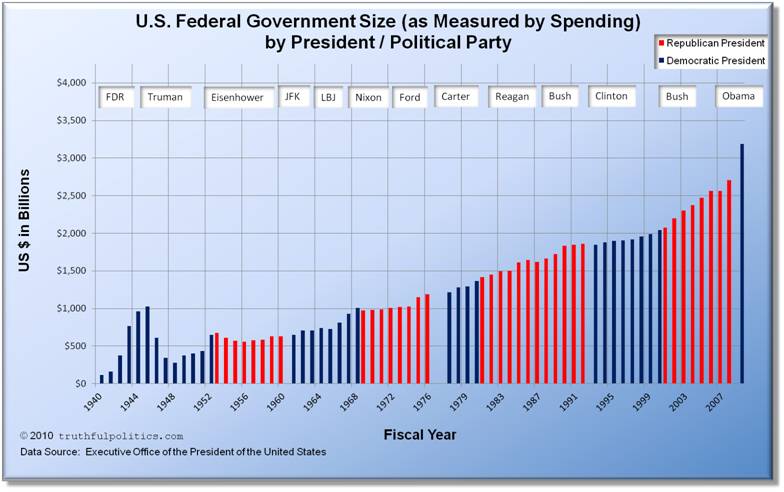
But as government grows larger and more powerful, it crowds out private action. It replaces local, familiar, and organic institutions with remote bureaucratic ones. As state and federal governments swell, taking over functions that used to be left to individuals and voluntary organizations, communities are weakened. Increasingly citizens are taught to rely on government, rather than on themselves or their neighbors. They develop a sense of entitlement, and entitlement in turn fuels selfishness. Other people's needs come to be seen as the government's responsibility. Government gets bigger and bigger -- and citizens get smaller and smaller.
Of course some functions can only be performed at the national level. But Washington does far more than it should, in so many ways treating Americans like children who cannot be trusted to run their own lives. The effect of that infantilization has been an erosion in the virtues without which no free society can thrive: Work, honesty, discipline, gratitude, moderation, thrift, initiative.
The way to undo that erosion? We can start by making Washington more inconsequential.



Join the Conversation
VIP members get the ability to comment on articles.