







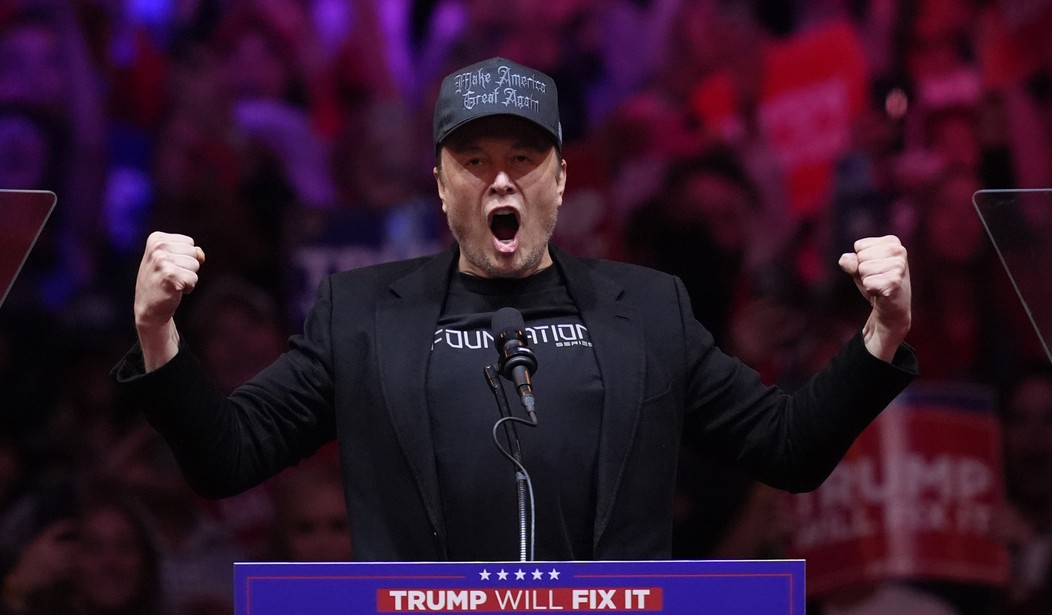
Donald Trump's much-ballyhooed Department of Government Efficiency does not actually exist. The program's official status is more significant than it might seem, because it reflects the yawning gap between the president's promises of fiscal restraint and the reality of what can be accomplished without new legislation.
Billionaire entrepreneur Elon Musk first pitched the DOGE idea last August after Trump said he might appoint the world's richest man as a policy adviser. "I am willing to serve," Musk wrote on X, his social media platform, above an AI-created image of himself standing at a lectern labeled "Department of Government Efficiency."
That imaginary department's acronym alluded to dogecoin, a Musk-championed cryptocurrency that was originally created as a joke but became "too important to laugh off," as Barron's put it in 2021. Musk's DOGE concept followed a similar trajectory after Trump took him up on his offer, putting him in charge of a project that Trump said would bring "drastic change" to the federal government.
From the beginning, DOGE's mission was ambiguous. While Musk had said the Trump administration could cut "at least 2 trillion" from annual federal spending, which totaled nearly $7 trillion in fiscal year 2024, Trump's vision sounded decidedly more modest.
After the election last November, Trump said DOGE would "drive out the massive waste and fraud which exists throughout" the federal budget, resulting in "a smaller Government, with more efficiency and less bureaucracy." A week later, Musk and former presidential candidate Vivek Ramaswamy, who at that point was supposed to help run DOGE, clarified that they would focus on "driving change through executive action based on existing legislation rather than by passing new laws."
Trump dampened expectations further on his first day in office, when he issued an executive order "Establishing and Implementing the President's 'Department of Government Efficiency.'" The scare quotes were appropriate.
Trump's order renamed the United States Digital Service, a "small team" that then-President Barack Obama created in 2014 to make government websites "more consumer friendly" and "help upgrade the government's technology infrastructure." That team, Trump declared, would henceforth be known as the United States DOGE Service.
Trump's order also established "the U.S. DOGE Service Temporary Organization." That Musk-run organization -- confusingly subsumed under the USDS, a previously obscure unit within the Executive Office of the President -- is charged with "modernizing federal technology and software to maximize efficiency and productivity."
This is what became of Musk's so-called department. Its shoehorned nature was necessary because only Congress can create new executive-branch departments.
It likewise remains true that only Congress can deliver the sort of spending cuts that Musk originally imagined. The national debt held by the public is already about the same size as the entire U.S. economy, and tackling that problem is impossible without addressing the main components of the federal budget, including Social Security, Medicare and military spending.
Trump's commitments, reflected in his campaign promises and the 2024 Republican platform, seem to rule out any such changes. Worse, Trump, after adding an estimated $8.4 trillion to the national debt during his first term, has proposed policies that could add another $7.8 trillion.
In this context, DOGE's dramatically downgraded mission makes sense. That does not mean Musk cannot achieve significant savings by attacking "waste and fraud." But his splashiest attempts so far have involved politically motivated cuts that don't amount to much, may not stick because of legal challenges, or both.
The Trump administration's controversial attempt to dismantle the U.S. Agency for International Development epitomizes both problems. While foreign aid is a perennially appealing target for conservatives, the entire USAID budget accounts for less than 1% of federal spending, and the agency cannot be legally abolished without congressional approval.
While rooting for Musk's success, Ramaswamy says the now-solo DOGE chief's "technology-focused approach" contrasts with his own "legal, constitutional, legislative focus in downsizing government." No matter what Musk achieves with the former, averting fiscal catastrophe will still require the latter.


Join the Conversation
VIP members get the ability to comment on articles.