





I realize that as an evangelical Christian I have a dog in this fight, but I want to say a few words about evangelicals and the unfortunate effort afoot to make them the political boogeyman.
There are so many misconceptions about "evangelicals" -- from the definition of the word to the intentions of the people themselves -- but the most damaging myth is that we evangelicals seek a theocracy for the United States of America, which couldn't be further from the truth. I'll get back to that, but first a little background.
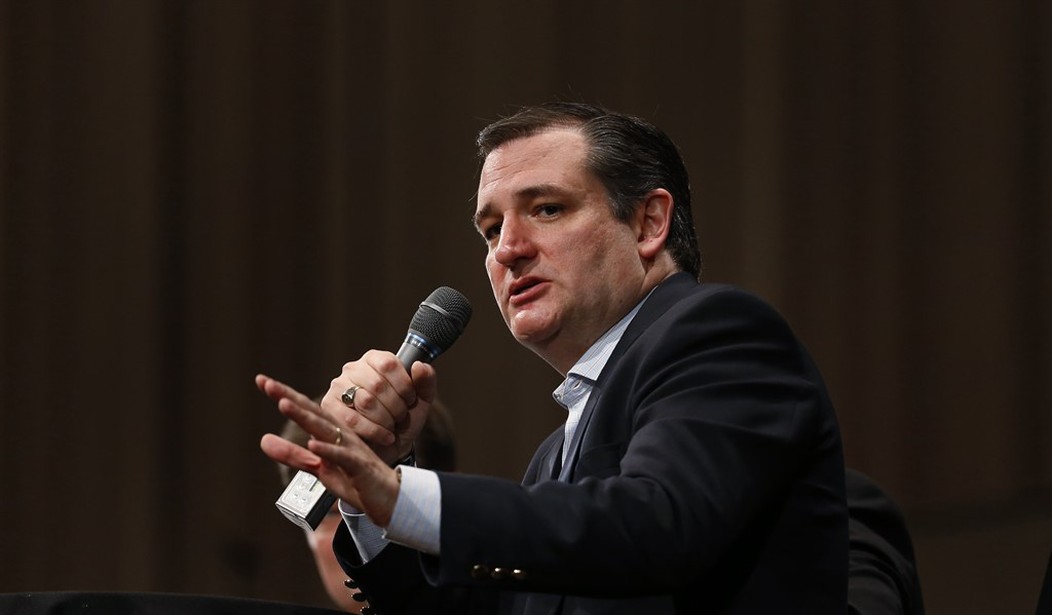
Recently I've had several people ask me what the deal is with Ted Cruz and "the evangelicals." The people inquiring are Christians, some even evangelicals. They ask, "What exactly is an evangelical, anyway?"
In our culture, the term is used rather loosely -- and, more often than I'd like, pejoratively. I'm seeing columns, blog posts and tweets galore suggesting in hushed terms that Ted Cruz adheres to some fringe philosophy that Christians must take over the world. It's not enough to accuse them of advocating a theocracy limited merely to the United States. No, world domination is their aim. This fear-mongering propaganda needs to be addressed and discredited.
One tweet to me reads, "TedCruz is a theocrat. He is unbiblical & most Christians theologians/scholars believe he is a heretic. Cruz thinks he's Christ." Another asks, "Does Cruz want to be President or the 'Christian' Imam for the USA?"
To laugh or cry?
So, let's examine the meaning of "evangelical."
One respected dictionary defines it: "Of, relating to, or being a Christian church believing in the Bible as the sole source of religious authority, in salvation only through conversion and spiritual regeneration, and in the necessity of public witness to faith."
Many use the term loosely, as a synonym for protestant. More precisely, and in line with the dictionary definition, I'd say evangelicals are a subset of Protestants. They are Bible-believing individuals who believe in salvation by faith in Jesus Christ alone. They believe that Christians are spiritually "born again," but only because the Bible says so, and not because they are snake-handling fanatics, as is sometimes assumed.
Part of the angst over evangelicals, I think, is based on the rise of the Moral Majority in the '80s, a coalition of mostly evangelicals who became political activists, not just on social issues but for all conservative causes.
It wasn't only the secular left that reacted adversely to what came to be known as the "religious right" but also some socially liberal and even establishment Republicans, who enjoyed the religious right's electoral power but feared they would alienate moderates and independents.
When you consider that evangelicals take fire from both sides of the political spectrum it's not difficult to understand how they've been so easily demonized and why misconceptions about their beliefs and intentions abound.
Contrary to popular belief, this nation was largely established by evangelical Christians, united in the unshakable belief that our liberties are God-given, and that the nation's founding documents are dedicated to preserving those liberties through a sophisticated scheme that limits governmental power to that end.
Indeed, Christians whose ancestors came to America for the very purpose of escaping religious persecution and seeking religious liberty founded the United States. And they enshrined that liberty in the First Amendment to the Constitution, in two separate clauses: the Establishment Clause and the Free Exercise Clause.
But historians have revised our history, and the conventional wisdom is that our liberties are owing to secular enlightenment influences. Christianity, they say, is intolerant, rigid and incompatible with freedom. To the contrary, Christianity undergirds, rather than undermines, our liberties. Christian precepts formed the intellectual underpinnings of American constitutional government. Even if French Enlightenment thinking had its run for a time, America experienced its "Great Awakening" around 1734, which was a nationwide Christian revival that re-energized America's spiritual flames and gave it a sense of unity. Its unique cultural identity was centered on Christian principles.
Most of America's Founding Fathers were strong practicing Christians, who believed that man was created in God's image and likeness, which means that man has intrinsic worth and dignity. It is that firm conviction that leads to the notion that man is endowed with inalienable rights -- that he has God-given liberties. The Biblical affirmation of man's inherent worth, then, is indispensable to the unique political liberty Americans have historically enjoyed.
Don't believe fear-mongers who preach that evangelicals and other Christians seek to suppress liberties. You can be sure that precisely because of their Christian and biblical worldview, they are theocracy's worst enemy and liberty's best friend -- the people most committed to preserving our freedoms by honoring the Constitution, whose integrity must be protected to keep government power in check.
Don't misunderstand. Christians have a right, and, I would argue, a duty, to be engaged in the culture and in politics. They will advocate for issues in which they believe, like any other group, but they do not seek to suppress the freedoms, religious or otherwise, of anyone else. The same cannot be said, sadly, for some other groups.
God bless America.



Join the Conversation
VIP members get the ability to comment on articles.