





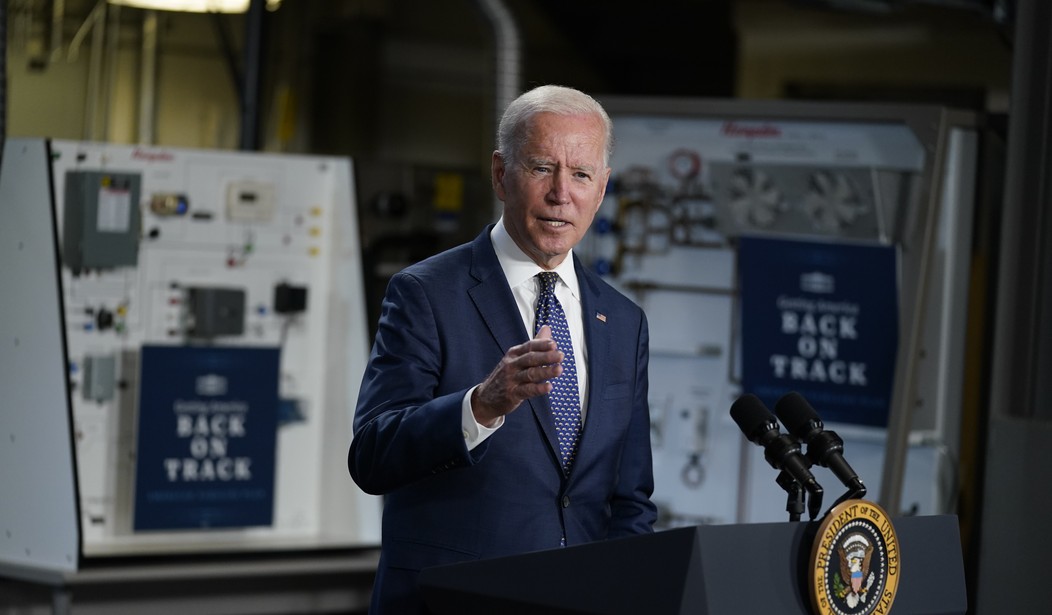
There’s nothing politicians love more than extra revenue without having to raise taxes. And at first glance, that’s what Internal Revenue Service (IRS) Commissioner Chuck Rettig appeared to offer at a recent Senate Finance Committee hearing when he discussed the so-called “tax gap”: the difference between what taxpayers legally owe and what the IRS actually takes in. Unfortunately for President Biden, attempts to take on the “tax gap” would probably yield far less revenue than they think.
Commissioner Rettig’s testimony appeared to provide groundbreaking new information that the tax gap has reached $1 trillion, with major media outlets like the New York Times taking this statement as gospel — even though it’s nearly three times what had been previously estimated by the IRS. Rettig’s statements were soon followed by a plan from Biden to raise $780 billion over the next decade by spending $80 billion on increased enforcement.
But the context of Rettig’s statements show that it was not a new agency estimate. Rettig was asked by Senator Ron Wyden (D-OR) to state his “personal opinion” on the size of the tax gap, and responded by saying that “it would not be outlandish to believe” that the tax gap “could approach or possibly even exceed $1 trillion.” Note also that the IRS Commissioner made this statement while trying to secure increased agency funding.
While this statement may be interesting, to portray it as equivalent to an official IRS estimate is absurd. Less than two years ago, the IRS estimated that, after factoring in enforcement and late payments, the net tax gap was $381 billion. Clearly the gap hasn’t more than doubled in just over 18 months.
And Rettig’s estimates have hardly gone unchallenged. Former Taxpayer Advocate Nina Olson, who served as the official watchdog of the agency for 18 years, disagreed with Rettig’s analysis. Olson argues that, even factoring in underreporting through cryptocurrency transactions and by offshore entities, the tax gap could not reach $1 trillion. A previous IRS Commissioner, Charles Rossotti, recently placed the size of the tax gap at $574 billion. Even assuming current institutional IRS estimates underestimate some sources of underreporting, the most rigorous estimates of the tax gap still don’t come close to $1 trillion.
But Rettig’s off-the-cuff remark risks (ill)-informing bad policy. Fueled by media reports of a massive tax gap in the wake of Rettig’s testimony, Biden is proposing to increase the IRS’s $11.5 billion annual budget by more than 70 percent over the next decade in the hopes of capturing $780 billion in previously uncollected revenue. All the evidence indicates that that’s a pipe dream.
The government’s official budgetary scorekeeper, the Congressional Budget Office (CBO), does believe that some additional revenue could be raised by increasing tax enforcement spending. But the CBO estimates that increasing IRS funding by $40 billion would increase collections by just $103 billion over ten years. Based on that, the Administration’s claim that it could raise $700 billion on net is ludicrous.
After all, the IRS has not proven all that successful in tracking down unpaid revenues thus far. According to the most recent IRS data, enforcement efforts raised the tax compliance rate by only about two percent, from 84 percent to 86 percent. While giving bureaucrats new tools to extract resources from taxpayers will have some effect, expecting a massive revenue windfall is inviting major disappointment.
It’s also worth noting that, while the tax gap conjures images of corporate fat cats hoarding wealth, only about 10 percent of underreported income comes from the corporate tax code. Truly cracking down on the tax gap would mean going after businesses small enough to file through the individual income tax code, as well as crackdowns on progressive tax provisions like the Earned Income Tax Credit, the Child Tax Credit, and the American Opportunity Tax Credit, each of which are paid out incorrectly at least 20 percent of the time.
All of this means that closing the tax gap is not as simple as grabbing revenue the IRS thus far simply has not bothered to collect. It would cost money and would end up targeting a broad swath of taxpayers, not just the wealthiest. That means auditors combing through the lives of thousands of Americans, many of whom would be lower income. And it would probably yield far less than Americans are being led to believe.
Biden’s promises of easy revenue from tax cheats are overblown at best. While enforcing owed tax payments isn’t inherently bad, throwing more money at the problem than the IRS would know what to do with is impulsive and wasteful.
Andrew Wilford is a policy analyst with the National Taxpayers Union Foundation, a nonprofit dedicated to tax policy research and education at all levels of government.


Join the Conversation
VIP members get the ability to comment on articles.