



While Russia and health care have more or less dominated the news, two liberal agenda items have been undercut. The first is single-payer, where even The Washington Post had to comment on its astronomical costs and tradeoffs that will probably not be accepted by the larger public. California tried to pass such a system at the cost of $400 billion. It met a legislative death in the State Assembly, where state Democrats faced a brutal backlash from the progressive Left, some even receiving death threats.
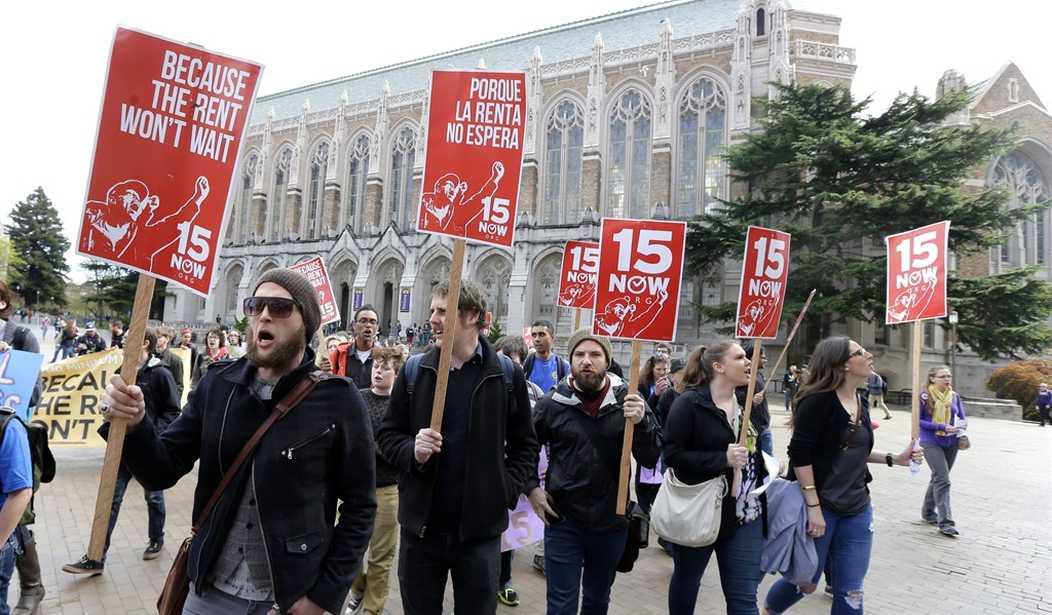
The other is the minimum wage, where liberal bastions have increased the rate at the cost of reduced pay to their workers and fewer jobs. In Seattle, the city council passed a $15/hour rate in 2014, which was to be phased in over a four-year period. It’s currently at $11/hour, but the detrimental economic impacts can already be seen. A preliminary report by the University of Washington threw more cold water on the initiative, which angered the mayor’s office. So, they shopped it over to UC Berkeley, where there were friendlier data crunchers. That study was released a week before the University of Washington report in what appears to be an apparent attempt to preempt the detrimental findings. Now, we have the USA Today editorial board suggesting that we should slowdown on the minimum wage pushes, which has also screwed over New York.
In recent years, the popular idea has begun to translate into electoral and legislative victories. San Francisco, Los Angeles, Pittsburgh and Washington are among the cities where a $15 minimum is set to go into effect in coming years. California has a statewide law being phased in. And New York will go to $15 an hour in and around New York City with a $12.50 wage upstate. Both states allow a suspension in the increases if they are found to cause economic harm.
There is just one problem to all of this. Minimum wage increases don't translate into big income increases for low-skill workers when taken to extremes.
Witness the city of Seattle, where civic leaders adopted a phased-in $15-an-hour wage in 2014. Though it is not fully in place, a study by the University of Washington and the National Bureau of Economic Research found that employers have already cut back on hours to compensate for the higher wages.
The study, backed by the city and with unusually detailed access to employment data, found that the second round of wage boosts to $13 an hour (depending on the employer's size, whether it pays benefits, and whether tips are involved) produced a 3% increase in average wages. But employers cut back on hours by 9%, meaning that the city actually suffered a 6% drop in the total wages paid.
[…]
Other communities should take notice. If $15 is too much in Seattle, a booming and wealthy city whose region is home to the likes of Amazon and Microsoft, it is too much elsewhere.
It is certainly way too high to be imposed nationally, as some progressive lawmakers such as Sen. Bernie Sanders want. If rural employers had to pay anything near $15, they might not just cut back on hiring, they might shut down entirely.











Join the conversation as a VIP Member