




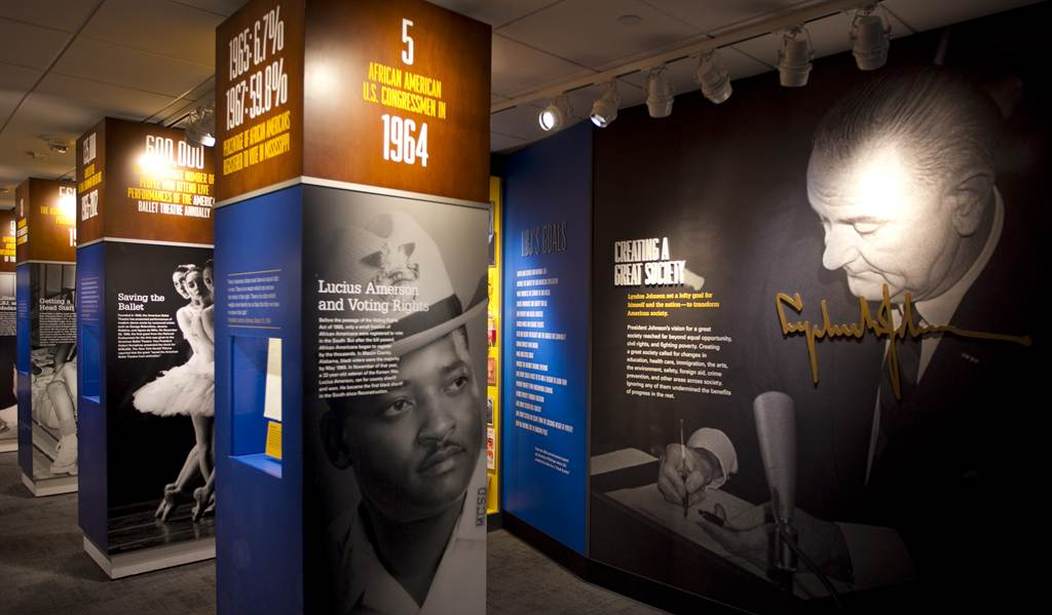
A birthday is often a time to celebrate, but just as often a time to reflect. What’s been accomplished so far? What’s left to do?
So let’s take a moment to reflect on the legacy of Lyndon Johnson’s “Great Society” as it turns 50. In May of 1964, LBJ had been president for just six months. He’d been sworn in after the tragic murder of John Kennedy the previous November. But Johnson was a man in a hurry to implement big changes. He traveled to the University of Michigan to challenge the graduates.
In his 1964 speech, LBJ celebrated the American ingenuity and industry that has created “plenty for all our people.” But it was now time, he insisted, to “use that wealth to enrich and elevate our national life.”
“Will you join in the battle to give every citizen an escape from the crushing weight of poverty?” he asked them. “Will you join in the battle to build the Great Society, to prove that our material progress is only the foundation on which we will build a richer life of mind and spirit?”
“Will you join in the battle to give every citizen an escape from the crushing weight of poverty?” The goal was to lift people up. But the end result was lots of federal spending, and no real progress toward the self-sufficiency he ostensibly sought.
Fifty years later, the U.S. has spent some $20 trillion on various welfare programs. Total government welfare spending is 16 times greater today than it was then. Yet, strikingly, the official poverty rate today is the same as it was five decades ago. While the Great Society’s material aid may have raised living standards, it did not lead to greater flourishing. . Rather than helping Americans escape poverty, it has led to long-term dependence. In fact, LBJ’s programs helped break down families and reduce male participation in the labor force.

As a result, “a large segment of the population is now less capable of self-sufficiency than when the war on poverty began,” as poverty analyst Robert Rector wrote this year.
LBJ insisted that: “The challenge of the next half century is whether we have the wisdom to use that wealth to enrich and elevate our national life, and to advance the quality of our American civilization.” Looking back now, it’s clear that by its own measures the “wisdom” of the Great Society was unwise, and the program, in sum, is a massive failure, except as a redistribution scheme.
Exactly 50 years later, it’s obvious the country needs a different approach.








Join the conversation as a VIP Member