





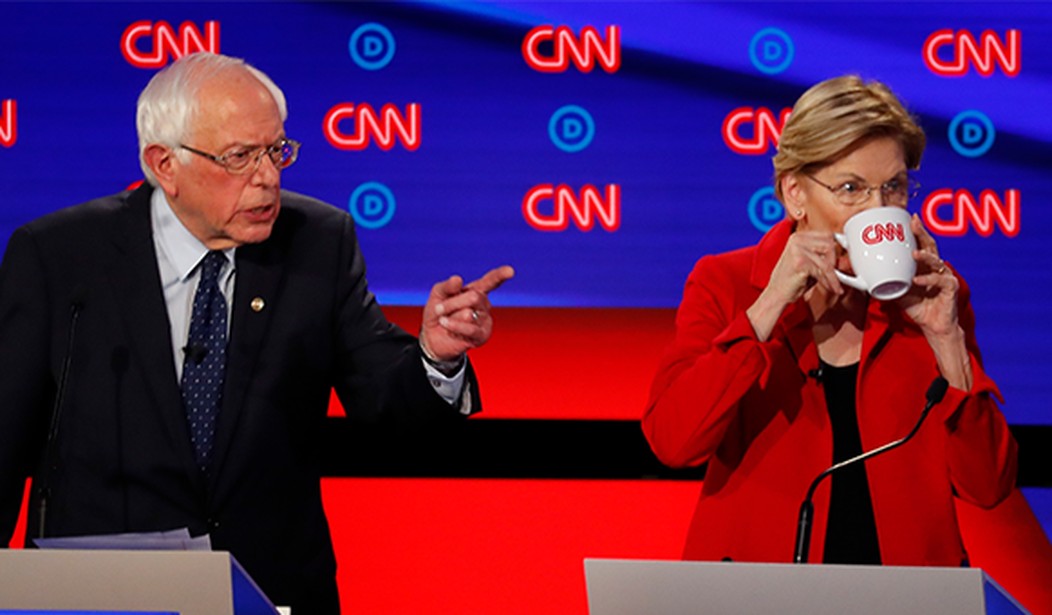
We have been making the case against single-payer healthcare for years -- see here, here and here for just a few examples -- and it seemed as though full-blown government-run healthcare was on track to be a litmus test issue in the 2020 Democratic primary. Once President Obama himself endorsed the repeal and replacement of Obamacare, in favor of single-payer (a move that appears to fly in the face of his recent admonitions to this party), the shift of the Overton Window felt nearly complete. But a funny thing happened on the rush to 'Medicare for All:' Voters recoiled, and many Democrats noticed. And the retreat is on -- via the New York Times last week:
Prominent Democratic leaders are sounding increasingly vocal alarms to try to halt political momentum for “Medicare for all,” opting to risk alienating liberals and deepening the divide in the party rather than enter an election year with a sweeping health care proposal that many see as a liability for candidates up and down the ballot. From Michigan to Georgia, North Dakota to Texas, Democratic elected officials, strategists and pollsters are warning that the party’s commitment to the Obama-era Affordable Care Act — widely seen as critical to electoral gains in 2018 and 2019 — could slip away as a political advantage in 2020 if Republicans seize on Medicare for all and try to paint Democrats as socialists on health care.
“When you say Medicare for all, it’s a risk. It makes people feel afraid,” said Gov. Gina Raimondo of Rhode Island, who headed a successful national effort as chairwoman of the Democratic Governors Association, to win governor’s mansions in Kentucky and Louisiana this month. “We won in Kentucky and Louisiana, barely, in part, because we won on health care. I don’t think we can afford to lose on health care.” ... Warnings are being issued at all levels of the Democratic Party, from union members who fear losing hard-won benefits, to candidates running in swing districts, all the way up to former President Barack Obama, who offered a pointed warning about the risks of overreach at a gathering of donors in Washington, D.C., this month. People close to the former president said his remarks were rooted in his experience passing the health care law, which prompted his concerns about how willing voters would be to embrace an even more sweeping change.
Some 2020 contenders declined to endorse 'Medicare for All,' citing its massive disruptions and staggering costs -- though many of those same 'build on Obamacare' Democrats are backing a so-called "public option," which is designed to usher in a single-payer regime (watch this and read this), albeit on a slower time table. Others rushed to co-sponsor Bernie Sanders' far-Left legislation in 2017, including every Senate Democrat who ran, or is still running, for president, with the exception of Amy Klobuchar. Shackled to the radical BernieCare framework, which more than half of House Democrats have also signed onto, several 2020 candidates have attempted to wriggle free from this political trap. Kamala Harris tied herself into knots on healthcare, reducing her position to an incoherent jumble.
Elizabeth Warren has followed suit, releasing a ludicrous 'plan,' then quasi-flip-flopping on single-payer, without executing the sort of reversal that could actually help her in a general election setting. This has taken an undeniable toll. Add up a chronic truth problem, major electability liabilities, a wildly infeasible agenda, and an unfolding healthcare debacle, and the bloom is off the rose, despite the media's clear and aggressive favoritism. Two recent national polls, which are snapshots, followed by the telltale two-month trajectory:
New Q-poll: Support for impeachment/removal drops 5 net points compared to October’s survey. Was (+2), now (-3)
— Guy Benson (@guypbenson) November 26, 2019
Dem primary (National):
Biden 24
Pete 16 ??
Warren 14 ??
Bernie 13
#NEW National CNN Poll:
— Political Polls (@PpollingNumbers) November 27, 2019
Biden 28%
Sanders 17%
Warren 14%
Buttigieg 11%
Bloomberg/Harris/Steyer/Yang 3%
Booker/Klobuchar 2%https://t.co/nEKERTI9Wx
National 2020 Democratic Primary polling average, since October (Biden Green, Bernie Blue, Warren Brown, Pete Purple): pic.twitter.com/YbD0206DGG
— Guy Benson (@guypbenson) December 1, 2019
Biden is chugging right along as the national frontrunner (despite being in serious danger of losing each of the first two nominating contests) with Warren swooning, Sanders narrowly creeping back into second place, and Buttigieg on the rise. Among those top four, two are running explicitly against mandatory and immediate single-payer healthcare, one is flailingly hedging and deceiving, and the loud and proud socialist maintains steadfast support. We've written before that the more voters learn about 'Medicare for All ' -- which sometimes polls pretty well in theory -- the less they like it. Support falls off a cliff when specific downsides are mentioned, including long wait times, lost private coverage and enormous tax increases. Sure enough, amid lots of debate and chatter about the implementation of a single-payer scheme, with multiple Democrats making aggressive cases against the prospect (employing what Sanders and Warren have assailed as "Republican talking points"), public sentiment has turned against the idea:
“Medicare for All has grown increasingly unpopular among all American voters, as 36% say it is a good idea and 52% say it is a bad idea. ... The highest support came in an August 3, 2017 poll when voters said it was a good idea 51 - 38%.” https://t.co/n6CgLs9TBk
— Holly Otterbein (@hollyotterbein) November 26, 2019
Almost a total reversal -- and that's without any sort of sustained, high-dollar, high-volume public relations blitz, highlighting the idea's disqualifying drawbacks. Here's one such drawback:
Research from University of Massachusetts economists who have consulted with multiple 2020 campaigns has estimated that 1.8 million health care jobs nationwide would no longer be needed if Medicare for All became law, upending health insurance companies and thousands of middle class workers whose jobs largely deal with them, including insurance brokers, medical billing workers and other administrative employees. Even if a bigger government expansion into health care left doctors, nurses, and other medical professionals’ jobs intact, it would still cause a restructuring of a sprawling system that employs millions of middle-class Americans.
Warren's response to this? A shrug, with some bizarre, ignorant nonsense tossed in for good measure.


Join the Conversation
VIP members get the ability to comment on articles.