
The percentage of Americans viewing socialism favorably has surged over the past year as more Americans support far-leftist candidates.
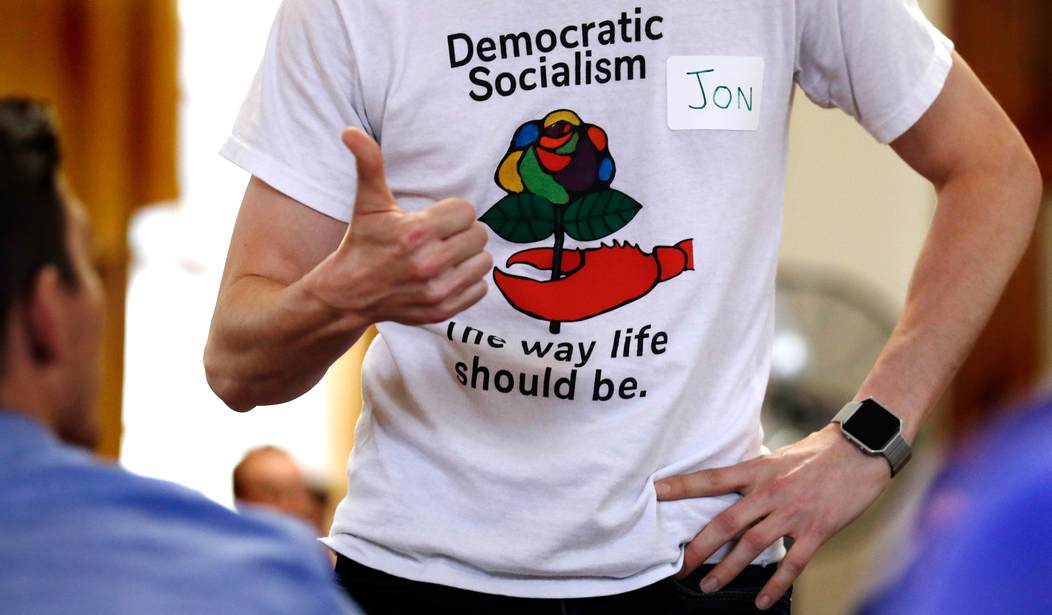
These numbers come as politicians backed by the Democratic Socialists of America (DSA) have been racking up primary victories in multiple states.
A Gallup poll released on Wednesday showed that much of the increase in support for socialism occurred among Independents.
Forty-three percent of Americans now have a positive view of socialism, marking the first time this figure has exceeded 39% in Gallup’s trend since 2010. Socialism still trails capitalism and free enterprise in public favorability but now ranks ahead of big business. Small business remains the clear leader among the five economic concepts tested, with 95% viewing it positively.
Gallup has measured Americans’ overall views of these five economic concepts periodically since 2010, with the latest update conducted Aug. 3-24.
Over the longer term, Americans have become less positive about most of the market-oriented concepts Gallup tracks. Since 2010, positive views of big business have fallen by 14 percentage points, free enterprise by nine points and capitalism by six points. Small business is the exception, with views of it unchanged. Meanwhile, positive impressions of socialism have risen by seven points.
Most of the increase in socialism’s positive rating through 2025 reflected increasingly positive views among Democrats, rising from 50% in 2010 to 66% last year. The latest uptick, however, comes entirely from political independents, whose positive rating jumped from 37% last year to 45% today. Democrats’ rating is essentially unchanged, at 65%, while Republicans’ remains below 15%
Party subgroups differ not only in their views of socialism but increasingly in their views of capitalism and other market-oriented concepts.
Independents’ positive rating of socialism has risen by eight points this year, as their view of big business has fallen to a new low of 32% after several years of decline. Socialism now ranks ahead of big business among independents, although capitalism, free enterprise and small business remain more positively viewed.
Among Democrats, support for free enterprise has fallen drastically and is now tied with socialism at 65 percent. Fewer Democrats now support capitalism at 35 percent today compared to 42 percent last year.
The numbers among Republicans have remained stable, with the majority continuing to favor small business, free enterprise, and capitalism. About 14 percent view socialism positively.
Age is also a factor, with adults aged 18 to 34 preferring socialism over capitalism 57 percent to 42 percent. Among Americans 55 and older, about 65 percent prefer capitalism compared to 34 percent who favor socialism. Those aged between 35 and 54 rank socialism and capitalism equally.
There are a myriad of factors contributing to this trend. Emily Ekins, vice president for policy and society at the Cato Institute, told Fox Baltimore that younger Americans grew up after the Cold War, so they are not aware of the dangers of left-wing authoritarianism. They only need to hear a simple pitch. “And someone comes along and says, ‘I can make it cheaper. Democratic socialism can make it cheaper,’” she said. “And so that really appeals, especially to young people.”
Michael New, a professor of social research at the Catholic University of America, told The Washington Times that “Many Americans have no memory of the Cold War or the poor economic conditions of socialist Eastern European countries.”
Vivek Chibber, a New York University sociology professor, put it more bluntly. “Young people really don't care about communism,” he said. “They don't know what it is, and in fact, a lot of them think it's kind of cool.”
These experts are spot on in their assessments. But I believe there is more to the story. I just turned 46 (I’m getting old!) and I remember learning about the horrors of fascism and communism in K-12 schools. Not so much in college. But I still had an idea of why folks like Josef Stalin and Mao Zedong were evil people.
It doesn’t appear this is happening in K-12 schools nowadays. There are no national requirements that students learn about the Holodomor, the Gulag, and The Great Leap Forward, or Khmer Rouge as a set of cautionary tales. So coverage depends on the state, the course, the textbook, and the teachers.
A 2019 YouGov survey conducted for the Victims of Communism that revealed some disturbing findings about what children are learning in school.
This year’s study showed increased support for communism (36%) among Millennials compared to 2018. Opinions of capitalism took a steep decline from 2018 to 2019, with only one-in-two among Millennials (ages 23-38) and Generation Z (ages 16-22) having a favorable opinion of capitalism. Socialism’s favorability decreased markedly from 2018, among all generations except for Millennials and the Silent Generation (ages 74+). 72% of Generation Z and 62% of Millennials said they did not learn about communist regimes from elementary to high school.
The reality is that children are no longer being educated about the evils of communism and the millions of lives it has destroyed. Even further, they are less knowledgeable about how current communist regimes like China and North Korea routinely oppress their citizens.
This is why it’s so easy for leftists to persuade younger Americans to embrace socialist ideals. They point to countries like Sweden and Norway as the template the United States should adopt, and it sounds attractive — especially for those disillusioned with the promise of the American dream.