







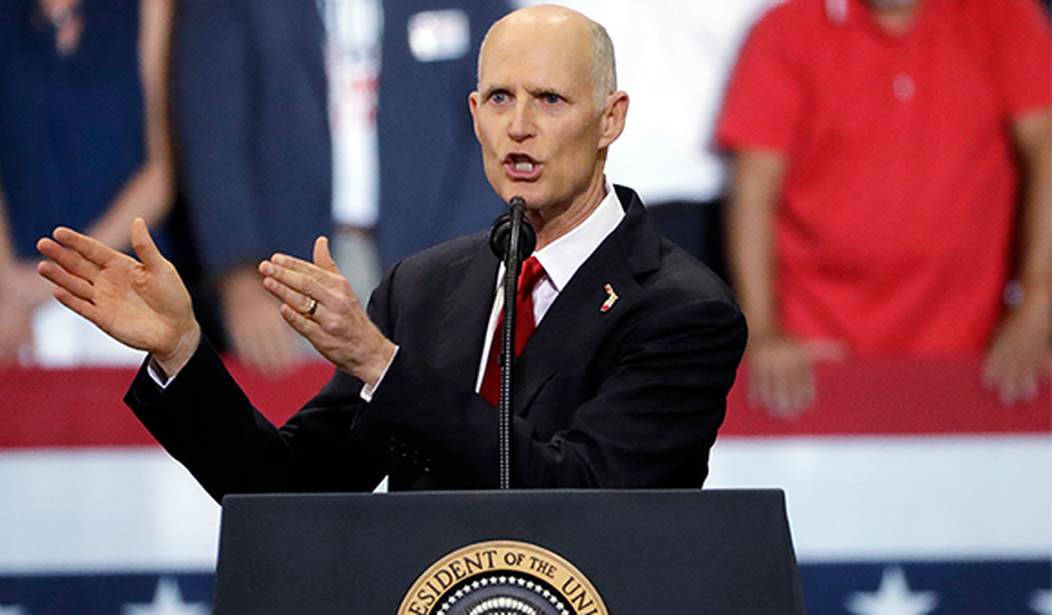
Nine years ago Rick Scott, then a Florida businessman, sat down with a group of self-described jaded Republican strategists to discuss what it would take for him to run for governor.
"You are not going to get anywhere with Hispanic voters, but we'll try," said Wes Anderson, founding partner and pollster for OnMessage Inc. (where my co-author, Brad Todd, works).
"Rick Scott looked at us and just shook his head. He said, 'I reject your dismissal of Hispanic voters. We are going to pursue them, and we're gonna pursue them hard,'" explained Anderson. "He flat-out rejected that there was this big chunk voters that you can just write off and you're never gonna get."
It is a rejection every Republican candidate running for office should emulate.
Scott, who won by two-tenths of a percentage point over incumbent Sen. Bill Nelson, did so despite suffering the same poor performance among suburban voters all Republicans did. He made up for that shortfall with healthy support among Hispanic voters. He won 48 percent of the Hispanic vote, just about the same portion he won in his two gubernatorial victories.
Anderson said OnMessage conducted a post-election survey of 1,014 Hispanic Florida Senate election voters for contemplation: "Every time we win in a state we do a post-elect so that we can figure out what we did right, and what we did wrong, and what we need to do for the future." In an exclusive to the Examiner, OnMessage released the findings of the survey, which was stratified to reflect turnout.
The bilingual telephone interviews were conducted Dec. 10-15 of last year with a margin of error of plus or minus 3 percentage points.
The Hispanic voter breakdown was 35 percent Cuban, 21 percent Puerto Rican and 44 percent other, which includes Colombian, Venezuelan and other South American countries.
The partisan breakdown was 44 percent Democrat, 42 percent Republican and 11 percent independent, with 2 percent refusing to answer.
The first question was "Who is the most popular statewide elected official, Gov. Rick Scott, Sen. Bill Nelson, Sen. Marco Rubio, or President Trump?"
"This is the image test," Anderson said. "The most popular person of the four we tested without question was Rick Scott." Scott topped out at 56 percent, with Nelson and Rubio both at 53 percent and Trump at 45 percent.
On job approval, Scott scored at 61 percent, with 47 percent strongly approving and 14 percent somewhat approving.
"Hispanics, including a chunk who said, 'I'm not sure if I like him personally,' said, 'Yeah, he's doing a good job as governor,'" explained Anderson.
Then the survey asked a series of agree/disagree statements, where surveyors read the voters a question and they answered whether they agree or disagree. On whether Scott cares about the concerns of Hispanic communities in Florida, 58 percent agreed, and 37 percent disagreed.
"Scott blows it out with Cubans, but we had majorities of all Hispanic voters agreeing that yes, Gov. Rick Scott, in fact, cares about the concerns," Anderson said.
The next agree/disagree question on Scott's time as governor of Florida was whether he made it a better place for Hispanics to prosper. Fifty-eight percent agreed, and 35 percent disagreed.
Scott, who was sworn in Tuesday, Jan. 8, talked to the Examiner exclusively about this survey and his early refusal to give up on Hispanic voters.
In his first sit-down interview since becoming senator, Scott said he's never believed people vote just based on the color of their skin.
"I think that their vote is tied to what's in their best interest, as a general rule. And so as governor, what I found is most issues come down to one of three things: They want a job; everybody does. They want their kids to get a good education. And they want to live in a safe community," he said. "And so what I did was I showed up, and I showed up and I talked to everybody."
Scott said he went to Hispanic communities, Hispanic groups and small businesses and focused on their issues "no different than" he focuses on everyone else's. "I put a lot of effort into making sure I could speak Spanish," he said.
What is his message for his fellow Republicans who often struggle with Hispanic voters, especially as the debate in Washington heats up over border security and what to do with illegal immigrants, especially given the sentiments expressed at the end of the survey?
He said: "I think what we have to talk about is what people care about. They care about security. I don't meet people that don't want border security. And I'll talk to anybody, right?"
He added: "People want a secure border, and they want everybody to have the same chance. And we want it to be fair. And I agree with them. And so what we've got to talk about is the dream of this country, which I lived. From public housing, getting to go build companies, being governor now senator. You've gotta talk about, 'I want that for you. And I want that for your children, and I want that for your grandchildren.' And it's gotta be sincere."
Anderson said his biggest takeaway from the survey is that it's a result of eight years of showing up. "That is not six months of showing up. That's eight years of showing up and speaking Spanish the best you can," he said. "You don't get to that level where a Republican sitting governor has 58 percent of Hispanic voters saying that he cares about them without doing that."
Salena Zito is a CNN political analyst, and a staff reporter and columnist for the Washington Examiner. She reaches the Everyman and Everywoman through shoe-leather journalism, traveling from Main Street to the beltway and all places in between.


Join the Conversation
VIP members get the ability to comment on articles.