





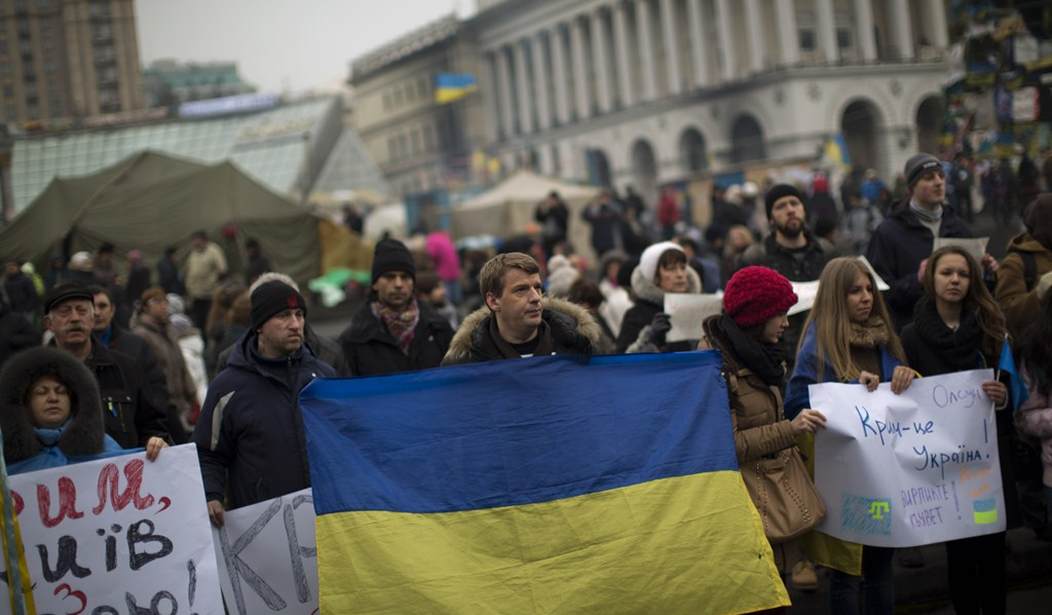
It turns out that we live in a nationalist world. That's one of the lessons people are learning from the surprise early results of the Russo-Ukrainian war.
This is certainly not a welcome development for Davos Man -- for the leaders of great international agencies, financial institutions and corporations that gather in Switzerland in January or at Bilderberg conferences in May. They've been hailing the erosion of national barriers and the benefits of cross-national decision-making for years.
But Russia's invasion of Ukraine, and the responses to it (by Ukrainians and by leaders and people around the world) prove that nationalism matters, for the worse but also for the better.
Start with the version of Russian nationalism that evidently inspired Vladimir Putin to invade. It is an incomprehensible decision not only to Davos Men but also to viewers of every cable news channel.
But it was telegraphed by Putin's speech at the March 2007 Munich Security Conference and in his July 2021 article on "the historical unity of Russians and Ukrainians."
Putin traced that unity back to the Ninth Century Rus' federation centered on Kyiv and in Tsarist Russia's conquest of much of what is now Ukraine in the 17th and 18th centuries. He cited the similarity of the Russian and Ukrainian languages and their common Eastern Orthodox religious tradition.
The actual history is more complicated. As the historian Timothy Snyder has shown, the boundaries of political entities in Eastern Europe have changed many times in the past 500 years. Most recently, there was the split-up of the multiethnic empires after World War I, Josef Stalin's reshufflings after World War II and the changes after the fall of the Soviet empire in 1989-91.
Since Feb. 24, Ukrainians' resistance to the Russian invasion has shown that Ukrainian nationalism is strong even if, as Putin claims, it has shallow historical roots. Election results show that although eastern and southern Ukraine strongly supported pro-Russia candidates for president from 2004 to 2014, that support had largely dissipated by 2019.
Putin's annexation of Crimea and Donetsk seizures seemed to have strengthened Ukrainians' nationalism, whereas the desultory performance so far of the Russian military suggests that Russian nationalism is not as strong as Putin would like.
The larger lesson is not that all nationalism is bad but that good nationalism can have strengths bad nationalism lacks. It's a lesson that Winston Churchill, Franklin Roosevelt and Charles de Gaulle taught more than seven decades ago, and that the world is learning once again.
Another lesson is that the age of armed conflict is not over. German diplomats at the United Nations laughed when President Donald Trump chided their country for spending less than the promised 2% of GDP on defense. But no one was laughing when new Chancellor Olaf Scholz, shocked by Putin's aggression, told the Bundestag Feb. 26 that Germany must spend 110 billion euros more this year.
Germans are, admirably, wary of bad nationalism. But they have just learned that sometimes there is no substitute for the good variety.
The Ukraine war is also teaching a lesson about energy. Europe, with Germany in the lead, and the United States under President Joe Biden have been raising energy prices and reducing reliability. They have leaned increasingly on renewable wind and solar sources and, in Germany's case, on natural gas piped in directly from Russia.
Now, Germany has nixed the Nord Stream 2 pipeline, and the U.S. has stopped buying Russian oil. Germans may be ruing their 2011 decision to shutter nuclear power plants. Europeans, now welcoming American liquefied natural gas, may question why they banned fracking, which, at least until Biden imposed restrictions, has produced so much oil and gas here.
The larger lesson is that it makes sense for nations to rely on their own available energy sources now and that the costs of depending on Russia or on intermittent green renewables are much greater than putative climate benefits that might arise 75 years from now.
Another lesson: Nationalisms have historical roots, with consequences. Davos Man in the 1990s hoped that elections and privatizations in Russia and trade and technology in China would make those nations liberal societies. Unhappily, they haven't.
Russia's history of suppressing personal and property rights (see historian Richard Pipes) and China's history of obedience to central authority persisted. The sweeping aside of term limits by Putin and Xi Jinping were warning signs that American leaders, beneficiaries of George Washington's precedent, unwisely ignored.
Now Americans and Europeans have no difficulty in identifying Putin's nationalism as malign, with some people going to childish extremes and boycotting Russian composers and Russian-cuisine restaurants.
Time for a better lesson -- for newly aroused nationalists to appreciate the strengths and achievements of other people's nationalisms, even as we try to improve our own.


Join the Conversation
VIP members get the ability to comment on articles.