







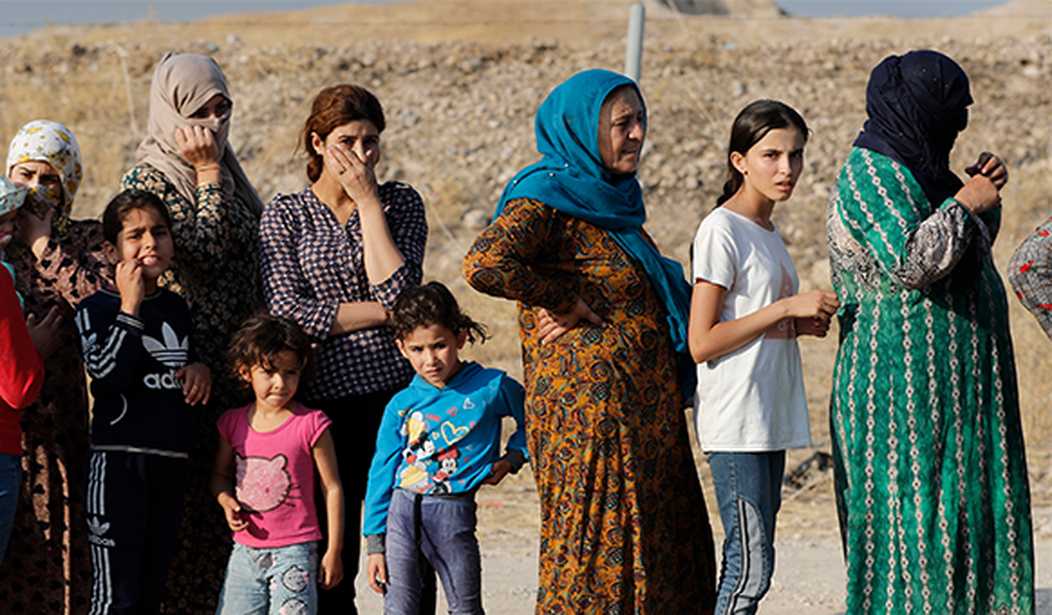
The brutal dictatorship of Bashar al-Assad has fallen. This is very welcome news to anyone that cares about basic human decency. For the last thirteen years the Assad regime, abetted by its allies Iran, Russia, and Hezbollah has inflicted the worst brutality and violence seen yet in the 21st century against its own citizens, the Syrian people. Aerial bombings that have flattened once vibrant cities, use of chemical weapons against innocent men, women, and children, mass graves, industrial scale torture, this is all the very definition of pure evil.
The sudden and total collapse of the Assad regime presents the United States with a moral imperative and a strategic opportunity. I have been to Syria twice, and the Syrians are by and large like us, people with families and children they love and care about. They have endured unimaginable deprivation and terrors, hunger, fear, sickness without medical care, endless deaths.
For less than a twentieth of one percent of the federal budget, we could dramatically relieve the immense pain and suffering these people still endure. We spent trillions of dollars (and thousands of American live) in a futile effort to remake Iraq and Afghanistan. For one or two billion dollars we could make a real humanitarian impact, and gain an awful lot of goodwill from the Syrian people, all while serving our national interests.
Assad and his thugs ran a government that was as corrupt as it was incompetent. By the time Assad fled to his friend Putin in Moscow, the government was literally bankrupt. The country is finally free of Assad, but now it has to begin the difficult process of rebuilding. Housing and basic infrastructure have been devastated, the bombed-out cities like Aleppo and Hamas look like Stalingrad 1943. It may take 300 billion dollars to rebuild long-term.
That is not our concern. The oil-rich Gulf States can and should finance Syria’s long-term reconstruction. Right now, there are a multitude of urgent needs but no money to finance them. Many hospitals lack basic medical equipment, medical supplies, and medicines. Nobody should die from a shortage of something as simple as a defibrillator. Many hospitals also need such things as ambulances, and generators since Syria’s crumbling electric system is operating a half capacity.
Electricity is the lifeblood of any economy. And Syria is bleeding to death. Full reconstruction will be an expensive long-term undertaking. But we can relatively cheaply provide equipment for short-term repairs to transmission wires, sub-stations, and generating plants.
There is severe food scarcity, especially for the millions of impoverished Syrians who can barely afford bread. The United States produces 1.8 billion bushels of wheat per year. We could easily at least make bread cheap and plentiful by providing 1.8 million bushels of wheat to Syria, just a tenth of one percent of our production.
Many Americans are reluctant to get involved in “yet another Middle Eastern mess.” But this is not a replay of Afghanistan or Iraq. We did not defeat the Assad regime with American troops, the Syrian people overthrew Assad. We will not be sending soldiers to secure Damascus and Aleppo. And we will not be committing to massive nation-building projects. We will simply be acting as the Good Neighbor helping people in severe straits.
Timely assistance will help stabilize the internal situation in Syria. It is not in our strategic interests for the country to collapse in front of CNN. It is in our strategic interests to enjoy the goodwill of the Syrian people, and its new government. It is in our national interest to help secure internal stability on Israel’s northern border. It is in our national interest to weaken Iran. It is in our national interest to make it possible for millions of Syrian refugees to return home. Two billion dollars would barely be missed in our almost seven trillion-dollar budget. But for many Syrians it would make real life and death differences.
This is a deal we should make, for our own sakes, as well as for a long-suffering people who need help.
Mark Nuckols teaches law and business in Moscow. He has a JD from Georgetown and an MBA from Dartmouth. He has lived in Eastern Europe for most of the last 20 years, including Russia, Ukraine, Slovenia, and Georgia.
Join the Conversation
VIP members get the ability to comment on articles.