





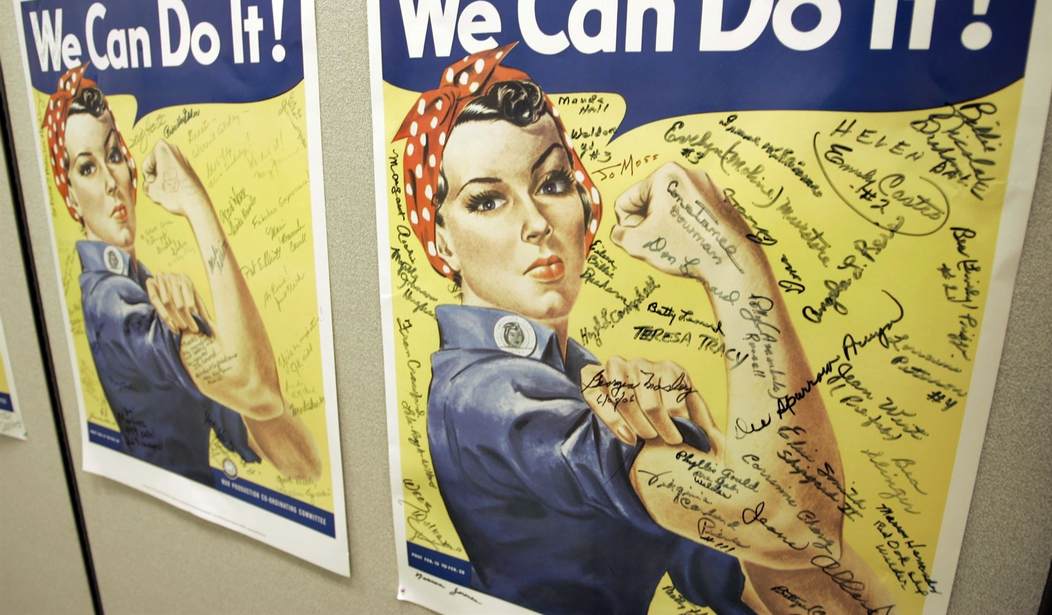
Can you use an electric mixer?” a government advertising campaign asked American women during World War II. “If so, you can learn to operate a drill.”
Women did learn—millions of them. When men shipped overseas to fight World War II, women lined up at defense plants to build the weapons needed to defeat the Axis powers. The 1943 song “Rosie the Riveter” hailed the working women who had become the backbone of the war effort:
All the day long,
Whether rain or shine,
She's a part of the assembly line.
She's making history,
Working for victory,
Rosie the Riveter.
I’ve had the good fortune to meet some of the original “Rosies”—the women who left their homes, learned unfamiliar skills, and kept the engines of American manufacturing burning bright during World War II.
I met one woman who told me about the unique riveter numbers she and other riveters printed into the machinery parts they made. It was a quality control system, yes, but also a way for the women to pour themselves into the individual parts of the planes, tools, and weapons they made. Each woman felt responsible for the parts she created. And incredibly, this Rosie told me, these unique riveter numbers could even provide comfort to soldiers abroad: one Navy sailor on a ship in trouble reported that he instantly felt safe when he saw his aunt’s riveter number on the ship’s machinery.
For a former military wife like myself, the Rosies of World War II are a constant source of inspiration and motivation. When the men in their lives were called to defend our nation, the Rosies did not stand on the sidelines; they jumped full-force into the economy and propelled the country forward—and found purpose in their work.
That’s a tough act to follow for today’s military wives. On average, modern military families move every three years. Because of the transient lifestyle, constraints of moving, cost of caregiving, and flexibility required to balance family obligations when a servicemember is away, 57% of today’s military spouses do not work outside the home.
This isn’t a trivial issue. Like the Rosies of World War II, today’s military spouses are the backbone of the American military. A U.S. Chamber of Commerce Foundation study found that a family's decision to remain in service depends on the likelihood of civilian career opportunities for a dependent spouse.
And that uncertainty affects not just a military family’s home life – it impacts the military’s readiness on the battlefield as well. A recent study released by the Department of Defense found military spouse unemployment and underemployment “has a national security component, as the high spouse unemployment rate ‘compromises the quality of life of military families and the readiness of the military force.’ The barriers to employment make it harder to recruit and can be especially onerous for spouses who work as teachers or in other fields that require specific licenses or certifications at the state level.”
It was that exact frustration which led to my new mission in life – providing empowering, mobile, and flexible income for military spouses so they can continue to provide a service for their families and their country.
Several years ago, my friend (and fellow military wife) Cameron Cruse and I, frustrated in our attempts to establish productive careers while following our husbands from base to base, founded our company R.Riveter, which provides income opportunities to military spouses around the country as “Riveters” who work together on a virtual assembly line to produce handmade leather and canvas bags. Each Riveter is responsible for individual parts of our products and each has a unique stamp. While our Riveters aren’t building planes or saving lives, they’re taking part in a symphony of production that brings them an opportunity to develop manufacturing skills, a way to bring extra income to their families, and a sense of purpose--and, most importantly, allows them to provide that backbone of support for their spouses in uniform.
And that, fundamentally, is similar to what the original World War II Rosies found in their work. Betty Jane Cook was one of those Rosies. She left her Iowa farm community for California and took a job paying 80 cents an hour on a Lockheed assembly line producing the P-37 Lightning fighter aircraft. In a speech archived by the Library of Congress, Cook remembers that time fondly: “After the Depression and the lack of confidence after the 30s, the demands of a war economy stirred up Americans like a cement mixer! With industries sprouting on every horizon it gave the average American the feeling that his and her work was needed.”
We do not need a world war to bring that feeling back. We need innovative businesses-- like R.Riveter--that redefine what it means to be a working military spouse, while still maintaining the tradition laid forth by the original Rosies.
As a company founded by women, we owe it to those who came before us, and those who will come after, to continue acting as positive agents of change. In turn, these steady income opportunities can provide ease of mind for our spouses abroad and help them be as focused as possible on their mission at hand. R.Riveter is certainly focused on its mission. Together, we can continue to build each other up. I can do it. You can do it. We can do it.



Join the Conversation
VIP members get the ability to comment on articles.