





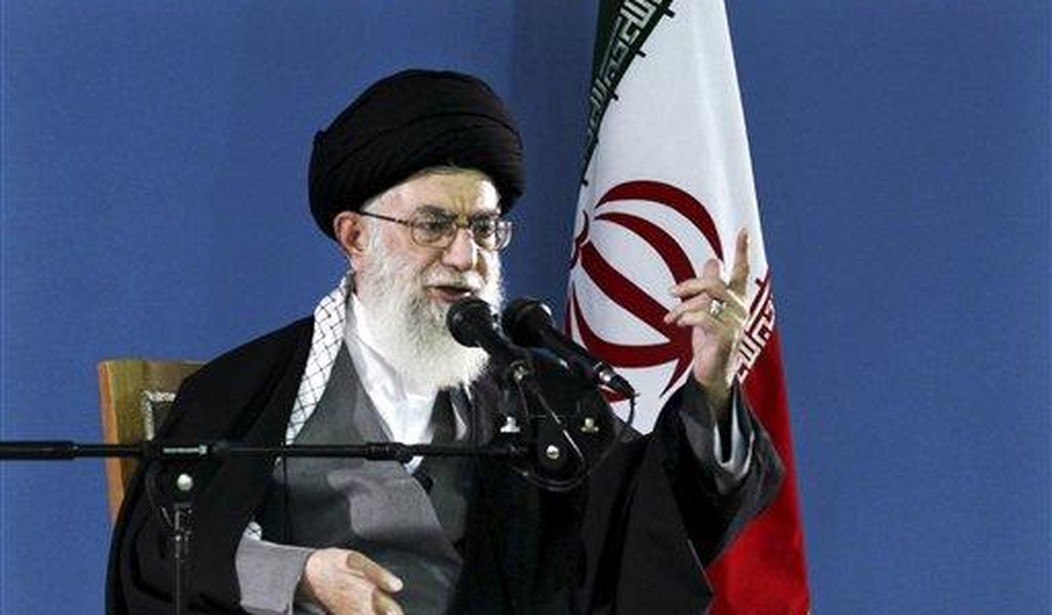
“America cannot do a damn thing.”
A banner displaying that slogan adorned the stage of an elegant mausoleum in Tehran where Iran’s supreme leader, Ayatollah Ali Khamenei, appeared last week. Negotiations to conclude a deal ending Western sanctions on the Islamic republic, the world’s foremost sponsor of terrorism, in exchange for a verifiable halt to its nuclear weapons program, are now in a critical phase with a new round of talks to begin Monday in Geneva. At this moment, it would make sense for Iran’s rulers to soothe and reassure their American interlocutors. Why are they provoking and taunting them instead?
Because they can. They are convinced that the U.S. government is as feckless and self-deluding today as it was when “America cannot do a damn thing” was first proclaimed, 35 years ago this fall, by Iran’s revolutionary leader, Ayatollah Ruhollah Khomenei, after his followers seized the American Embassy in Tehran and took the diplomats working there hostage.
Doing so was not just a violation of international law. It was a casus belli — an act that unquestionably would have justified going to war against the fledgling Islamic republic. Instead, President Jimmy Carter launched a rescue attempt that failed. After that, he utilized diplomacy to no effect.
Ayatollah Khomeini would go on to hold America’s diplomats hostage for 444 days, the remainder of Carter’s tenure, releasing them only as Ronald Reagan was entering the White House. An important lesson was taught: When the threat of force is credible, the use of force often becomes unnecessary.
But teaching is not synonymous with learning. At the mausoleum last week, the current supreme leader triumphantly told Iran’s uniformed, religious and political elites that the military option President Obama has often said is “on the table” is now in the trash bin of history. A “military attack is not a priority for Americans now,” he said. “They have renounced the idea of any military actions.” That he believes this represents a defeat for the United States and a victory for the Iranian Revolution goes without saying.
In recent days, developments have bolstered his analysis. For example, on May 27, Mr. Obama announced the withdrawal of American troops from Afghanistan, a conflict he once called a “necessary war” that he intended to win, but which he now is content merely to “wind down.” (Would you really be surprised if, sometime after the next American presidential election, the Taliban returned to power?)
A day later, Mr. Obama was at West Point disconnecting the dots linking Afghanistan, Iraq, Yemen, Somalia, Syria, Libya, Mali, Kenya, Pakistan, India, Nigeria and so on. After all these years, he appears not to see the big picture: a global jihad against the West with various actors — Iran and al Qaeda most prominent among them — competing to lead it.
Next, the president released five senior Taliban officials, all of whom have ties to al Qaeda, in exchange for an American soldier who had abandoned his post on June 30, 2009, and was subsequently taken prisoner by those it was his duty to fight. Mr. Obama might at least have made this deal with regret, acknowledging that a steep price was being paid, both by the United States and, almost certainly, by those Afghans who have supported the American mission in their country. Instead, he held a celebration in the Rose Garden. His national security adviser, Susan Rice, exulted that it was “an extraordinary day for America a joyous day.”
It’s needs to be emphasized: “Leave no soldier behind” is a commendable principle. However, like most principles, it is neither absolute nor inviolable. To prove I’m right, try this thought experiment: If the Taliban had said they would trade Sgt. Bowe Bergdahl not for five Gitmo detainees, but just one — and that one was Khalid Shaikh Mohammed, the mastermind behind the attack of Sept. 11, 2001, would Mr. Obama have taken the deal? What if the Taliban had asked for no detainees but a tactical nuke, or chemical weapons, or even just a dozen Apache helicopters? Would anyone say that Mr. Obama had no choice but to agree — because he could not leave Sgt. Bergdahl behind?
Other evidence that Ayatollah Khamenei has no doubt been mulling: In Syria, Mr. Obama drew a red line, then erased it, then cut a diplomatic deal that saved dictator Bashar Assad, whose regime he had vowed must end. Last week, Robert Ford, who months ago resigned as American ambassador to Syria, acknowledged that he had done so because he could no longer support the administration’s inept and damaging policies.
As if to illustrate his point, Secretary of State John F. Kerry respectfully asked Hezbollah, Iran’s Lebanon-based terrorist proxy, to help bring the war in Syria “to an end.” Of course, Hezbollah will — so long as the war ends with them as winners, and with the United States diminished.
The ayatollah also saw the Obama administration decide last week to support the Palestinian “unity” government, which means American taxpayers will be funding Hamas, a designated terrorist organization, one to which Iran has sent money and weapons, one openly committed to a genocidal war against Israel, America’s most reliable ally.
Going back further, the supreme leader knows that despite many carrots and a few sticks, U.S. negotiations with North Korea eventually ended with the Hermit Kingdom becoming nuclear-armed. The American diplomats who were beaten have either been promoted or given prestigious academic positions.
For all these decisions and failures, there are explanations and justifications aplenty. There also is a pattern. America’s enemies and allies perceive it. And they are responding.


Join the Conversation
VIP members get the ability to comment on articles.