





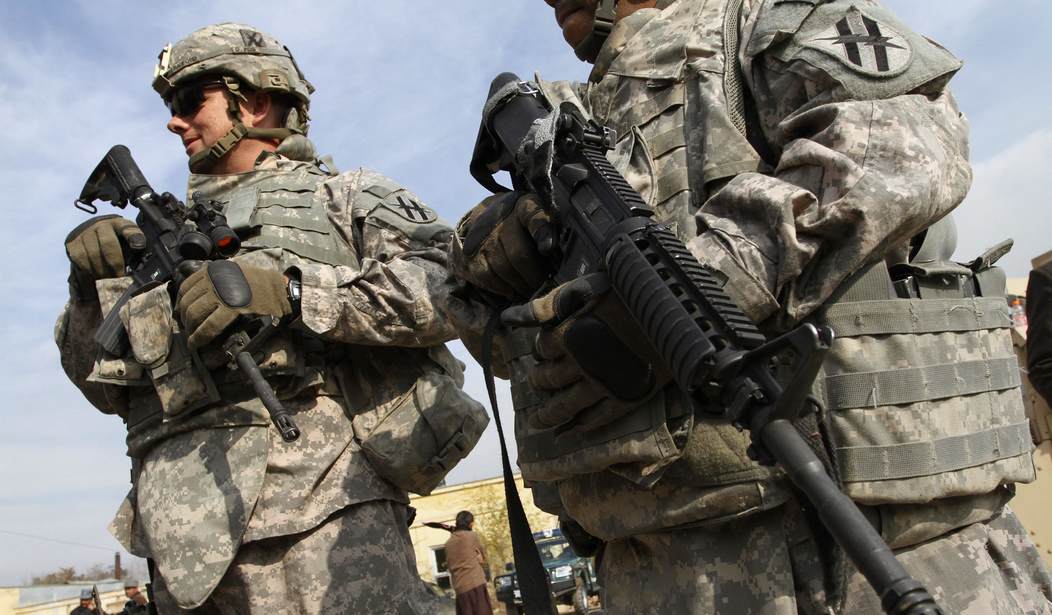
President Trump is not the first U.S. leader to pivot when it comes to foreign policy. His speech Monday night before American military personnel at Fort Myer in Arlington, Virginia, was in stark contrast to his campaign pledge to put "America first" and his promise to avoid "foreign entanglements," as George Washington put it in his Farewell Address.
The president admitted that reality caught up with him after his inauguration and that America must ensure that al-Qaida does not again gain a foothold in the country from which it could plot another massive terror attack on the U.S.
A Trump administration official said the Pentagon will send an estimated 4,000 additional American forces to Afghanistan, a plan reminiscent of the Iraq "surge" ordered by President George W. Bush and successfully led by Gen. David Petraeus. What is different about this latest tactic is the threat of financial consequences if Pakistan doesn't stop harboring terrorists and do more to help win the war.
The question remains: What does "winning" look like? President Trump promised not to engage in "nation building," but what is its alternative? After 16 years in Afghanistan, the cost of war has risen to an estimated $700 billion. More than 2,000 American lives have been lost and thousands more wounded. We have hardly established a foundation for a stable nation, much less built anything on it.
Departing from President Obama's announcements of timetables for withdrawal, Trump said "Conditions on the ground -- not arbitrary timetables -- will guide our strategy from now on," adding, "Another fundamental pillar of our new strategy is the integration of all instruments of American power -- diplomatic, economic, and military -- toward a successful outcome."
I'm all for successful outcomes, but what does he have in mind? How will success be determined? How does one stabilize an unstable country mired down by rival tribes and religious conflict?
In his speech there was an implied threat to India if that country doesn't help with the war effort: "India makes billions of dollars in trade with the United States, and we want them to help us more with Afghanistan, especially in the area of economic assistance and development. We are committed to pursuing our shared objectives for peace and security in South Asia and the broader Indo-Pacific region."
The president noted he has already "lifted restrictions the previous administration placed on our war fighters that prevented the secretary of defense and our commanders in the field from fully and swiftly waging battle against the enemy. Micromanagement from Washington, D.C., does not win battles. They are won in the field drawing upon the judgment and expertise of wartime commanders and frontline soldiers acting in real time, with real authority, and with a clear mission to defeat the enemy."
The "rules of engagement" have contributed to American casualty figures. The enemy plays by no rules. Will the lifting of U.S. rules kill more of the enemy, or kill more civilians behind whom enemy forces often hide?
The president also issued a warning to the Afghan government: "America will work with the Afghan government as long as we see determination and progress. However, our commitment is not unlimited, and our support is not a blank check. The government of Afghanistan must carry their share of the military, political, and economic burden. The American people expect to see real reforms, real progress, and real results. Our patience is not unlimited. We will keep our eyes wide open."
If they don't comply, will we pull out anyway? That's what al-Qaida is banking on.
There is much that is right about the president's announced new strategy and objectives, but the question remains: Can this war be won and the country stabilized, or will Afghanistan always be a bottomless pit?
It shouldn't be long before we have an answer.


Join the Conversation
VIP members get the ability to comment on articles.