







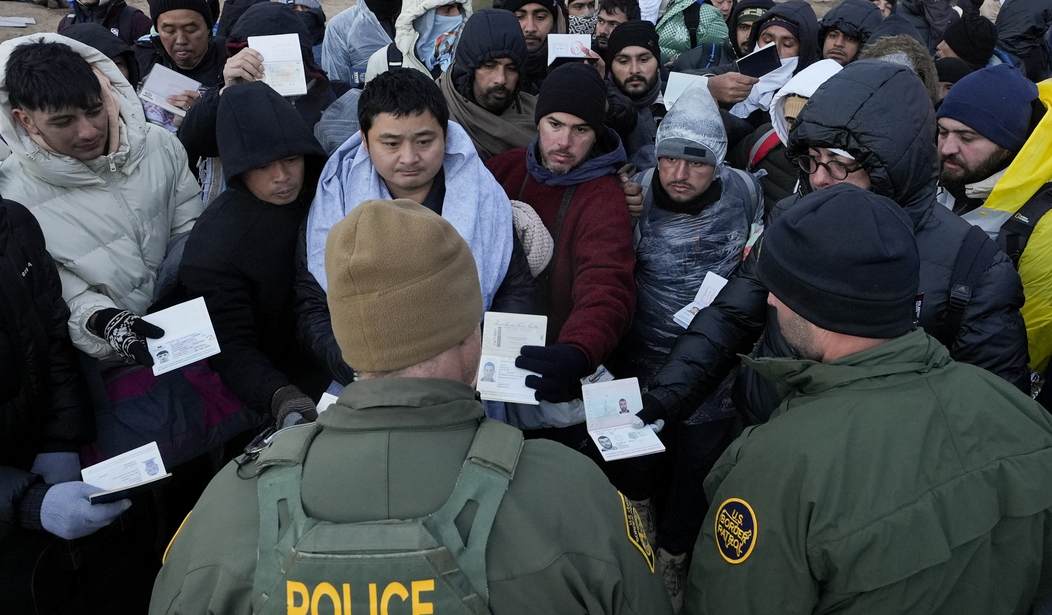
Get ready for a Supreme Court showdown over President Donald Trump's challenge to birthright citizenship -- the idea that all children born in the United States have the same rights, regardless of where their parents came from. Despite what many pundits and even lower court judges are saying, this is not a slam dunk for the president's opponents. There are powerful arguments and Supreme Court precedents on both sides.
The case often cited, United States v. Wong Kim Ark (1898), actually supports Trump. The court ruled that the protections and guarantees afforded by the 14th Amendment belong to citizens and noncitizens alike, "so long as they are permitted by the United States to reside here."
That was 127 years ago.
On Jan. 20, Trump declared, by executive order, that babies born to illegal immigrant mothers, and lacking a father who is a citizen or legal U.S. resident, will no longer automatically receive U.S. citizenship. Starting on Feb. 19, 2025, hospitals would be barred from issuing U.S. birth certificates for these newborns, who number about 250,000 per year.
Trump also took aim at birth tourism, ending automatic citizenship for the 30,000 babies born each year to women who enter the U.S. legally on temporary visas to give birth here.
Some women wade across the Rio Grande, others fly first class, but both claim citizenship for their newborns under the birthright clause of the 14th Amendment.
The clause was originally proposed to guarantee citizenship to children born to former slaves, but during the drafting in 1866, Congress expanded it to children of any race or ethnicity born in the U.S.
At the time, Congress did not debate whether offspring of people in the country illegally were guaranteed citizenship. There were no immigration laws or illegals in 1866. Even the odious Chinese Exclusion Act wasn't passed until 1882, and the U.S. didn't put numerical limits on immigration until 1921.
Yet Trump's executive order triggered lawsuits by 22 states, the city of San Francisco and numerous nonprofits. Within days, federal judges were blocking its implementation. Judge John C. Coughenour of the Western District of Washington state called it "blatantly unconstitutional." Judge Deborah Boardman of Maryland claimed that in the past the Supreme Court has "resoundingly rejected the president's interpretation" of the 14th Amendment.
These are overstatements. There's no predicting how the Supreme Court will rule. Only Justice Samuel Alito has expressed a view, stating during his confirmation hearing that birthright citizenship "may turn out to be a complicated question."
As for precedent, there's only one Supreme Court ruling on birthright citizenship in the last 160 years. Defenders cite the Ark decision, but in fact, it actually undercuts their argument by specifying that 14th Amendment protections extend to all people who "are permitted by the United States to reside here."
Justice Horace Gray, writing for the court, supported the decision by citing an earlier Supreme Court ruling -- Yick Wo v. Hopkins (1886) -- which said the 14th Amendment's equal protection clause applied to people of all races "who have the right to temporarily or permanently reside within the United States." Not people here illegally.
These cases do not back up Boardman's flamboyant claim that the court has "resoundingly rejected" Trump's interpretation.
Lacking precedent, the justices will likely look to founding principles. Birthright citizenship is a noble idea. Its defenders warn that making children born to illegal immigrants ineligible would produce a subclass of people with fewer rights and threaten American egalitarianism.
But birthright's critics argue that its abuse makes a mockery of citizenship and turns taxpayers into saps.
Nationwide, nearly 60% of households headed by an illegal immigrant collect federal benefits like Supplemental Nutrition Assistance Program aid and Medicaid, according to the Center for Immigration Studies. Often a U.S.-born child is the meal ticket making the household eligible.
Illegal border crossings are down 90% since Trump took office. But executive orders are temporary, lasting only as long as the president remains in office.
Regardless of how the court rules, Congress must act. Congress can revise eligibility for welfare benefits and impose stricter time limits, alleviating the cost to taxpayers and reducing incentives to enter the country illegally.

Join the Conversation
VIP members get the ability to comment on articles.