





The Obama Administration's decision to permit sales of U.S. weaponry to Vietnam is another step toward publicly acknowledging that a trans-Pacific coalition is forming to oppose China's imperial expansion in southeast Asia and east Asia.
The Philippines, Vietnam, Japan, South Korea and the U.S. are key members of this coalition, which began emerging over a decade ago. Public evidence of extensive cooperation is indisputable. South Korea and Japan are firm U.S. allies. The U.S. Navy has conducted Freedom of Navigation Operations in the South China Sea that tacitly support Filipino territorial integrity.
Given the Vietnam War, Vietnam has been something of the Odd Man Out. However, South Korea and Vietnam have agreed to conduct senior officer training exercises that are a wink away from cooperative planning exercises and policy coordination. In August 2013, Vietnam and the Philippines announced that they were developing joint military and diplomatic plans to counter aggressive Chinese territorial expansion in the South China Sea.
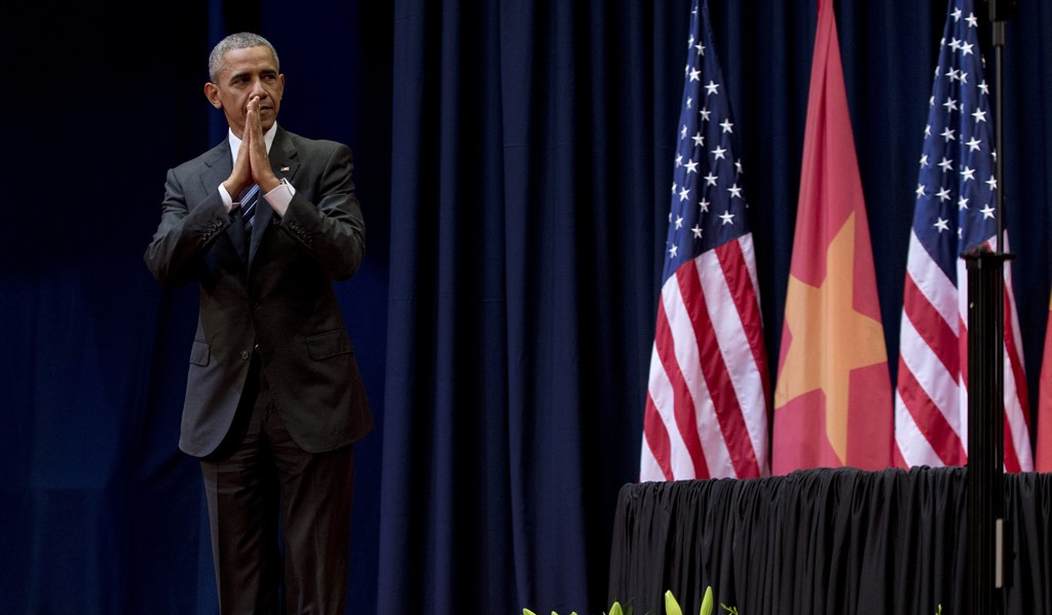
On May 23, the coalition further solidified when President Barack Obama, while visiting Vietnam, officially ended the U.S. weapons embargo on Hanoi. Obama insisted the U.S. decision to terminate the weapons embargo and expand trade links with Vietnam was not aimed at any nation.
The polite term for the President's denial is "diplo-speak." For at least 25 years, Vietnam has expressed a desire to establish a closer strategic relationship with the U.S. in order to counter China's increasing military strength and its threatening policy of territorial expansion. In this context, the Vietnamese government regarded U.S. presidential visits as diplomatic coups. President Bill Clinton visited Vietnam in 2000 and called for strengthening ties. President George W. Bush visited in November 2006. Bush normalized trade relations with Vietnam and expanded bi-lateral cooperation.
However, no nation in Asia wants to be perceived as actively promoting an "anti-China" alliance, and that includes China's most powerful regional rival, India.
For its part, the U.S. seeks to coax China without antagonizing it. The U.S. prefers peaceful persuasion that convinces China's Communist government to end its island-creation policy in the South China Sea (which certifiably encroaches on Vietnamese and Filipino territory), accept international arbitration over disputed areas, and then accept arbitrator decisions. The U.S. encourages China to negotiate with Japan over disputed islands in the East China Sea.
China's government, however, disdains arbitration and displays no intention of halting its expansionary activities. So it was no surprise that Chinese state media immediately scorned Obama's diplo-speak as a "poor lie" and accused the U.S. of seeking regional dominance. State media accused America of attempting "to knit three nets" around China: a net of ideology, a security network and an economic network centered on trade.
If "three nets" sounds like a Cold War-esque alliance-based containment strategy, well, fundamentally, it is.
China correctly identifies the strategic "nets," but denies the root cause spurring the trans-Pacific strategic net knitting: China's belligerent military and economic bullying of its neighbors and its provably illegal territorial acquisition.
The termination of the U.S. arms embargo is receiving the most media attention, but the truth is Washington has violated the spirit of its own embargo. For example, in June 2015, the U.S. gave Vietnam $18 million for the purchase of Metal Shark coastal patrol boats. The boats themselves aren't weapons per se. However, they can carry search radars and machine guns. They are fast, maneuverable and can remain at sea for several days.
Why the implicit embargo breach? In May 2014, Vietnam and China clashed in the Paracel Islands when China deployed a drilling rig in Vietnamese-claimed waters. China uses coast guard vessels and fishing boats to establish a continual "presence" in disputed waters. Vietnam needed -- and still needs -- more small boats to counter Chinese intrusions. India, understanding the threat, has loaned Vietnam $100 million to buy patrol boats. Another stitch in the net? Yes.


Join the Conversation
VIP members get the ability to comment on articles.