





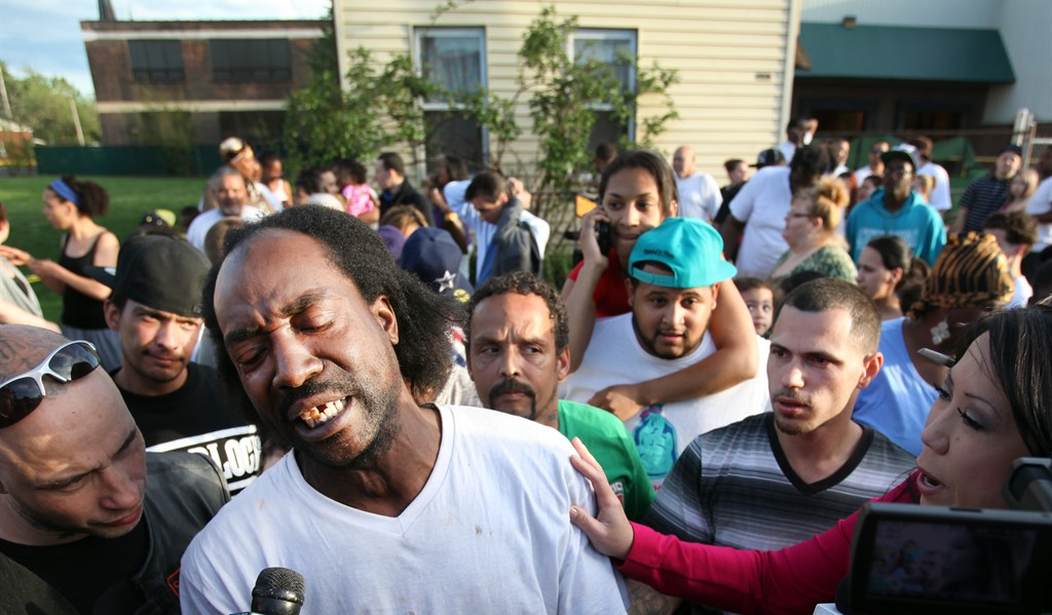
Three young Cleveland girls missing and presumed dead turned up alive and in good health. A hero of the story is a neighbor, Charles Ramsey, a black man who helped free the girls from the home in which they were apparently imprisoned for some 10 years.
Among other things, Ramsey said: "I knew something was wrong when a little pretty white girl ran into a black man's arms. Something is wrong here. Dead giveaway. Dead giveaway. Dead giveaway. Either she homeless or she got problems. That's the only reason she run to a black man." Presumably the black man the "pretty white girl" ran up to was Ramsey himself.
But a check of The New York Times, The Washington Post and The Cleveland Plain Dealer shows that while the papers quoted Ramsey, none saw fit to include his observation that "a pretty white girl" running up to a black man means "something is wrong here." Looking uncomfortable, the television reporter, from local Channel 5, an ABC affiliate, promptly broke off the interview. No follow up, as in, "What, you've never seen a Shirley Temple movie?" (Kidding, just kidding.)
News sometimes makes reporters feel uncomfortable. So what? Ramsey's comments reflect how the Good Samaritan felt -- which makes it news. If Ramsey's other comments get reported, why not that one? Besides, Homeland Security tells us, "See something, say something," But when this particular citizen does, many in our establishment media do not want to tell us what he said?!
Question: Assume Ramsey were white and said: "I knew something was wrong when a little pretty white girl ran into my black neighbor's arms. Dead giveaway. Dead giveaway." Does the comment get removed, excised or cleaned up? Not likely, for a favorite media narrative is that racism remains a major problem in America. Put Ramsey's comment in a white man's mouth, and voila! In the soul of this otherwise Good Samaritan, we have "stereotyping," if not "bigotry" or "racism."
Recommended
When athletes, for example, say "ain't" or use double negatives, sportswriters sometimes clean up the language, presumably to avoid making the players sound uneducated. That's one thing. But when you ignore comments like those of Ramsey, then media serve as a public relations bureau, not as a conveyor of "news."
In 1991, researchers for the National Race and Politics Survey asked both blacks and whites if they agreed with a series of politically incorrect statements about black people: "Blacks are aggressive or violent"; "Blacks are boastful"; "Blacks are complaining"; "Blacks are lazy"; and "Blacks are irresponsible."
In almost every case, more blacks agreed with the negative statements than did whites. While 52 percent of whites, for example, agreed with the statement, "Blacks are aggressive or violent," 59 percent of blacks also agreed. On the question of blacks being boastful, more blacks than whites agreed, at 57 percent and 45 percent, respectively. On, "Blacks are complaining," 51 percent of blacks agreed, while fewer whites, at 41 percent, agreed. Fewer whites (34 percent) than blacks (39 percent) agreed that "blacks are lazy."
Stanford University's political scientist Paul M. Sniderman and survey research specialist Thomas Piazza examined the 1991 survey. They write: "In every case, blacks are at least as likely as whites to hold a negative view of blacks. ... Indeed, when it comes to judgments of whether blacks as a group exhibit socially undesirable characteristics, where there is a statistically significant difference between the views of blacks and whites, it always takes the form of blacks expressing a more negative evaluation of other blacks than do whites."
Years ago, the Los Angeles Times ran a front-page story about black tradesmen who work in predominately wealthy white areas like Bel-Air and Beverly Hills. All experienced instances of racism. One said a woman refused to open her door when he, a suspicious looking black man, came to answer her service call. Another talked about the time someone sicced dogs on him.
I discussed this article with a non-reporter friend who works for the Times. I told him a white roofer recently did work for me and told me that someone shot at him as he tried to repair the roof on a building in Compton, a predominately working-class black and Hispanic neighborhood in the Los Angeles area. The roofer told me that he experienced other instances of mistreatment that could only be attributed to anti-white racism.
"Where are the stories of white tradespeople working in predominately black and brown areas? What about their stories?" I asked my newspaper friend. "You won't get that story," he admitted. "Too many people would be upset. But a story about how badly whites treat blacks offends no one."
Whites, he said, remain deeply guilty about white racism -- and feel comfortable about being called on it. Stories about black or brown racism against whites can spark angry calls and letters from the "civil rights establishment," ever vigilant for examples to show the "persistence" of white racism.
As for Ramsey's comments, our racially sensitive major media find it easier to excise this black man's provocative remarks rather than explore what Ramsey meant. Dead giveaway...




Join the conversation as a VIP Member