


Politicians of all stripes have promised to rein in Washington’s out-of-control spending for years, and sadly most have failed to deliver once in office. Most recently, Congress passed the Budget Control Act of 2011 with bipartisan support promising to cap overall discretionary spending at certain levels every year for the following decade, and President Obama signed it into law. Unfortunately, as the deadline for the budget conference committee report draws near, we sadly see waning support in Washington for fulfilling these promises to control spending.
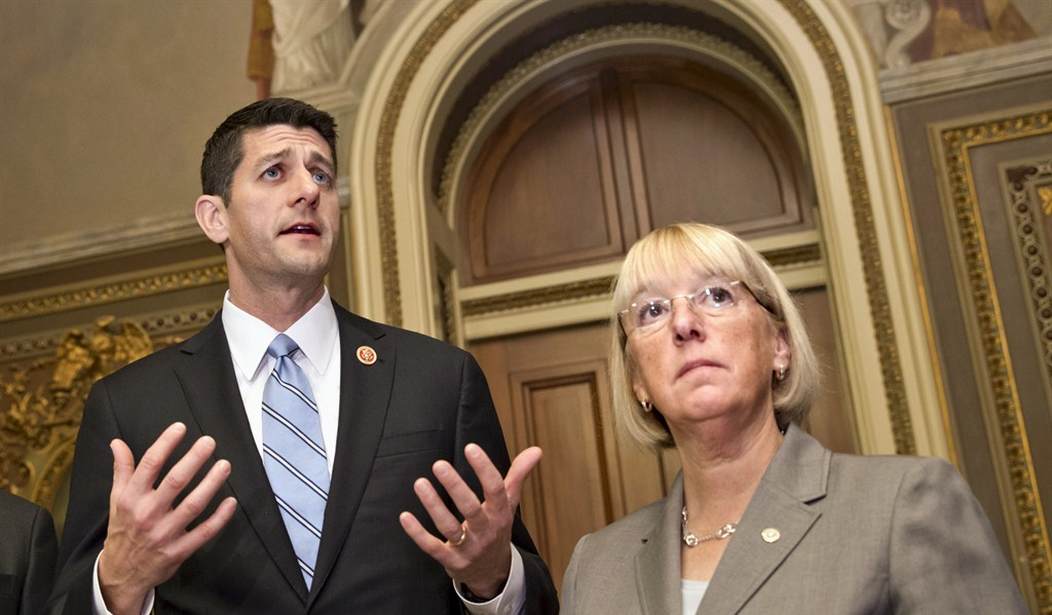
Both sides of the aisle in both chambers are guilty. Senate Democrats, lead by Budget Committee Chairman Patty Murray and Appropriations Barbara Mikulski, show particular determination in seeking spending levels of at least $1 trillion without any attempts to offset the new expenditures with mandatory spending cuts. Even House Budget Committee Chairman Paul Ryan, who is currently leading the budget conference committee, seems willing to accept revenue raisers such as aviation fees and spectrum sales in exchange for higher levels of spending.
More important than statements, recent votes reflect this bipartisan support for higher spending levels, too. When considering the continuing resolution this past September, the Senate voted on a motion to waive the spending caps. The motion to waive the spending caps passed with a 68-30 vote. Fourteen Senate Republicans—the purported party of fiscal restraint—joined their Democrat colleagues in voting to waive the spending caps. They cast a united vote to proliferate spending instead of standing up for taxpayers, an overwhelming signal that few in Congress are serious about keeping their promises on spending control.
Now is a critical time for Congress to stop the excuses and finally get federal spending under control. Capping spending at $967 billion in 2014 is a promise that members of Congress should honor. $967 is not just some arbitrary number; it’s important for a number of reasons.

First, as we approach the debt limit again in the spring, it is hugely symbolic whether or not Congress and President Obama will stick to the deal they made last time over the federal budget and the debt ceiling. If policymakers will not live up to past agreements, why should the American people have any faith they will live up to future ones?
Second, the separation of powers is once again at stake. Even though Congress has been transferring ever-increasing amounts of authority to the executive branch, it still has control over budgetary issues. Allowing the President to allocate tens of billions of dollars above the spending caps gives him outsized power over the federal purse. Letting the President allocate the sequester cuts, for instance, gives him the power to create the kind of panic he tried to get this past March when the first round of sequestration cuts went into effect. With nine months of hindsight, we see that the President overplayed his hand by going after the highly visible cuts such as closing White House tours instead of going after all the waste, fraud, and abuse in federal spending. We learned that cutting two percent of the discretionary budget did not cause the world to end.
Third, the federal government will spend $967 billion, one way or the other. Even if Congress passes legislation exceeding $967 billion, sequestration will bring the spending levels down to the appropriate level. It’s better budgeting to spread those reductions over all 12 months instead of concentrating them in the last three quarters of the fiscal year, between January and September, as the sequester mechanism would require. It’s also better to focus these cuts on mandatory spending on entitlements instead of spreading them across-the-board.
Americans for Prosperity has more than two million activists living in all 50 states, and they are fed up with their elected officials’ unwillingness to live up to their agreements. The grassroots are paying close attention to what Congress does next on spending. They want real spending control, not more empty promises. While American households and businesses continue to struggle in the sluggish economy, now is not the time for ever-higher levels of spending coming from Washington.









Join the conversation as a VIP Member