



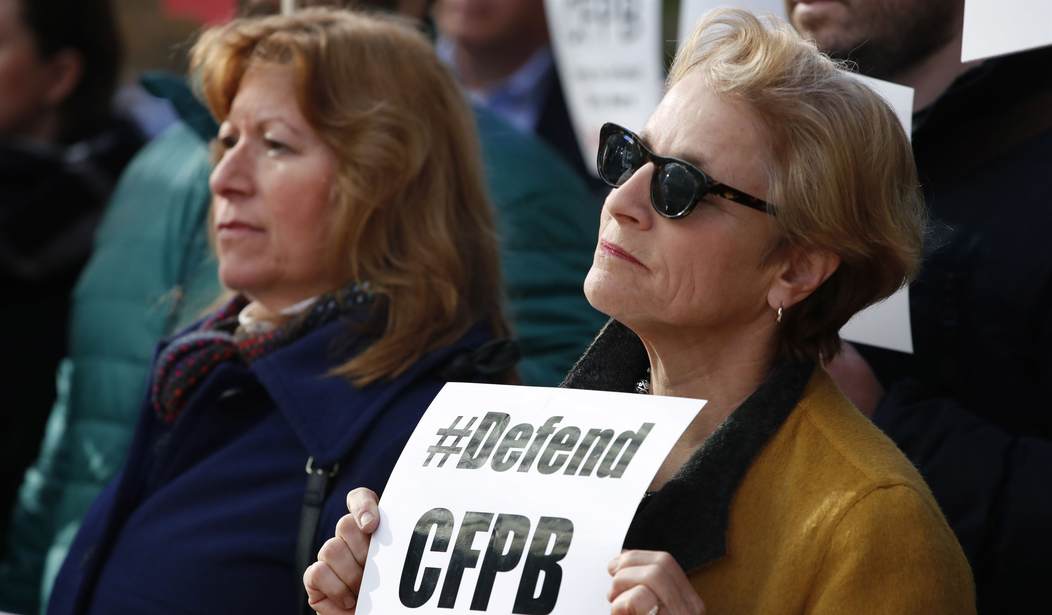
Remember the Consumer Financial Protection Bureau? I know. It’s been quite some time. We all know the drama that emanated from that agency when Richard Cordray resigned in 2017. It was pretty much a coup attempt by anti-Trump officials at the agency. It was settled when the Trump administration won a legal fight with Leandra English, whom Cordray appointed to take over for him. But there was an election in 2016, and Trump could pick whomever he wants to run the agency. Cordray’s successor, Leandra English, filed a lawsuit but decided to resign instead. That didn’t mean everyone was happy, as we had reports of disgruntled employees using encrypted devices to communicate. It was nonsense.
Acting White House Chief of Staff Mick Mulvaney headed the agency until its current director, Kathy Kraninger, was confirmed. He did clean house, however, firing the entire advisory board. And before he left the agency, a court ruled that the CFPB’s structure was unconstitutional; Mulvaney is on the record voicing his disdain for this agency. That ruling was handed down in July of 2018. Flashforward to October 2019 and the Supreme Court has agreed to hear arguments regarding the agency’s constitutionality (via WaPo):
The Supreme Court on Friday said it will consider whether the creation of the watchdog Consumer Financial Protection Bureau by Congress in 2010 was unconstitutional, something the Trump administration and even the bureau’s director say they now believe.
Conservatives have long contended that the authority given to the bureau’s director violates the separation of powers. The CFPB, created in part by consumer advocates such as now-Sen. Elizabeth Warren (D-Mass.), and Congress have defended its independence.
But Solicitor General Noel J. Francisco, representing the Trump administration, told the Supreme Court in a brief last month that new director Kathleen Kraninger “has reconsidered that position.”
That view could find a receptive audience at the Supreme Court. Justice Brett M. Kavanaugh took such a position in a similar case when he was a judge on the U.S. Court of Appeals for the D.C. Circuit.
The issue is that in creating the CFPB, Congress said it was protecting the bureau’s autonomy by giving the director a five-year term and allowing removal only for “inefficiency, neglect of duty, or malfeasance in office.” But the Constitution gives the president the power to remove top executive branch officials for any reason or no reason at all, the challengers say.

Supreme Court will decide whether the structure of the Consumer Financial Protection Bureau is constitutional
— Adam Liptak (@adamliptak) October 18, 2019
The case is called Siela Law v. CFPB.











Join the conversation as a VIP Member