







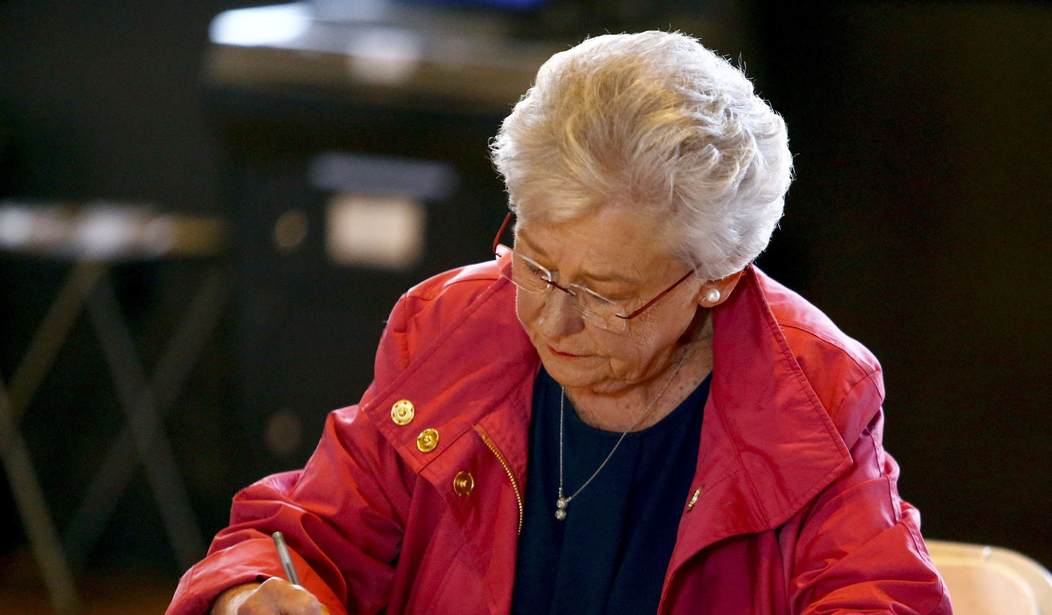
Republican Gov. Kay Ivey of Alabama signed two bills Friday pertaining to transgender minors, one of which makes it a felony for medical professionals to provide “gender-affirming” medical care to minors. Townhall reported how the Alabama legislature passed the legislation this week.
The legislation, Senate Bill 184, will “prohibit the performance of a medical procedure or the prescription of medication, upon or to a minor child, that is intended to alter the minor child’s gender or delay puberty.” It is to be known as the “Alabama Vulnerable Child Compassion and Protection Act.”
The legislation explains fully how “gender-affirming” medical care in minors occurs, including kinds of treatments that are not approved by the U.S. Food and Drug Administration (FDA). In addition, the legislation points out that there are people in the medical community who are “aggressively” pushing for this type of health care to be available to minors.
“(1) The sex of a person is the biological state of 4 being female or male, based on sex organs, chromosomes, and endogenous hormone profiles, and is genetically encoded into a person at the moment of conception, and it cannot be changed.
(2) Some individuals, including minors, may experience discordance between their sex and their internal sense of identity, and individuals who experience severe psychological distress as a result of this discordance may be diagnosed with gender dysphoria.
(3) The cause of the individual's impression of discordance between sex and identity is unknown, and the diagnosis is based exclusively on the individual's self-report of feelings and beliefs.
(4) This internal sense of discordance is not permanent or fixed, but to the contrary, numerous studies have shown that a substantial majority of children who experience discordance between their sex and identity will outgrow the discordance once they go through puberty and will eventually have an identity that aligns with their sex.
(5) As a result, taking a wait-and-see approach tochildren who reveal signs of gender nonconformity results in a large majority of those children resolving to an identity congruent with their sex by late adolescence.
(6) Some in the medical community are aggressively pushing for interventions on minors that medically alter the child's hormonal balance and remove healthy external and internal sex organs when the child expresses a desire to appear as a sex different from his or her own.
(7) This course of treatment for minors commonly begins with encouraging and assisting the child to socially transition to dressing and presenting as the opposite sex. In the case of prepubertal children, as puberty begins, doctors then administer long-acting GnRH agonist (puberty blockers) that suppress the pubertal development of the child. This use of puberty blockers for gender nonconforming children is experimental and not FDA-approved.
(8) After puberty blockade, the child is later administered ‘cross-sex’ hormonal treatments that induce the development of secondary sex characteristics of the other sex, such as causing the development of breasts and wider hips in male children taking estrogen and greater muscle mass, bone density, body hair, and a deeper voice in female children taking testosterone. Some children are administered these hormones independent of any prior pubertal blockade.
(9) The final phase of treatment is for the individual to undergo cosmetic and other surgical procedures, often to create an appearance similar to that of the opposite sex. These surgical procedures may include a mastectomy to remove a female adolescent's breasts and ‘bottom surgery’ that removes a minor's health reproductive organs and creates an artificial form aiming to approximate the appearance of the genitals of the opposite sex.”
NBC News reported that Ivey said in a statement as she signed the bill that "we should especially protect our children from these radical, life-altering drugs and surgeries when they are at such a vulnerable stage in life.”
"If the Good Lord made you a boy, you are a boy, and if he made you a girl, you are a girl,” she added.
On March 31, which is “Transgender Day of Visibility” two government agencies released documents promoting “gender-affirming” care for minors, which Townhall covered.
In one document, the United States Department of Health and Human Services’ Office of Population Affairs claimed “gender-affirming care is crucial to overall health and well-being” for children and adolescents and that it allows minors to focus on “social transitions” and boosts their confidence while “navigating the healthcare system.”
On the same day, the Substance Abuse and Mental Health Services Administration's National Child Traumatic Stress Network, another branch of the HHS, released a parallel document called “Gender-Affirming Care Is Trauma-Informed Care.”
“Providing gender-affirming care is neither child maltreatment nor malpractice,” the NCTSN document states. "It may include evidence-based interventions such as puberty blockers and gender-affirming hormones."
Other states, such as Arizona and Idaho, have taken steps to protect minors by outlawing "gender-affirming" medical care for this age group.



Join the Conversation
VIP members get the ability to comment on articles.