





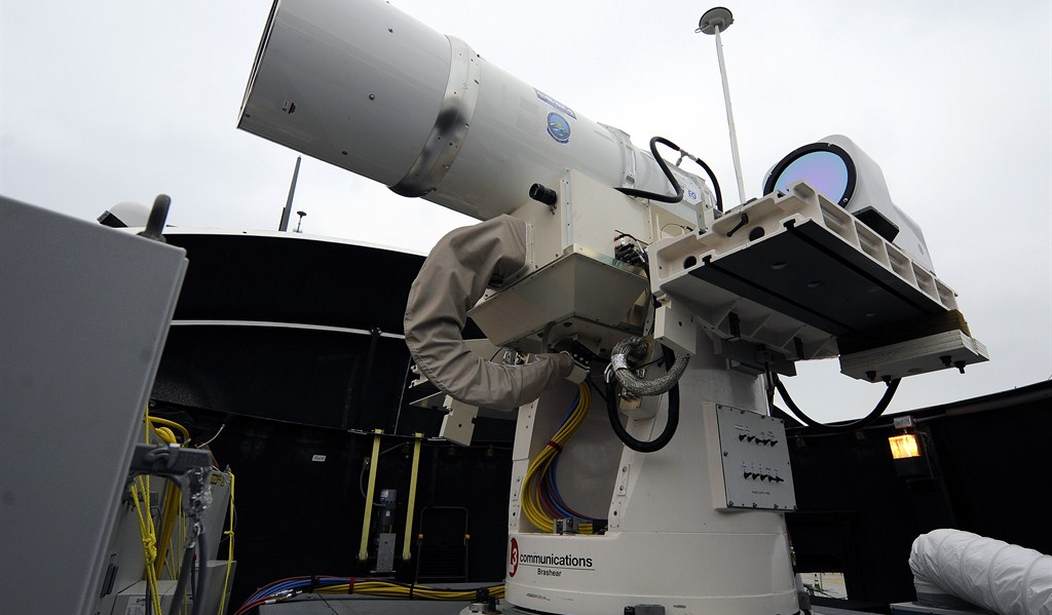
The U.S. military has taken another step into the future of warfare.
This week, the Pentagon confirmed that U.S. forces have been using laser weapons in the Strait of Hormuz to shoot down incoming drones and missiles fired by Iran’s Islamic Revolutionary Guard Corps (IRGC) and other terrorist groups in the region. Nor is this futuristic weapon, 50 years in the making, limited to the Middle East. It has also been deployed along the southern border, where it is being used to combat Mexican drug cartels.
🇺🇸 The U.S. military is now zapping drones with freakin' LASERS in real combat!
— Mario Nawfal (@MarioNawfal) September 24, 2026
The Pentagon has confirmed that laser systems are being used in the Strait of Hormuz to take down Iranian drones and incoming cruise missiles at a fraction of the cost of traditional interceptors.… pic.twitter.com/lggx4hIAOl
Instead of expending costly interceptor missiles to take out relatively cheap drones or incoming munitions, the military’s laser systems rely largely on electricity. Power generated by onboard generators or battery packs is converted into a highly concentrated beam of light particles, which are focused on a target. Once locked on, the beam rapidly heats the target’s surface until critical components melt, fail, or detonate.
“It’s weaponized light that spends several seconds of what we call ‘dwell time’ on the target to bring it down,” Jared Keller, who puts out the newsletter Laser Wars, said.
“It now makes sense to actually take them outside of a laboratory and into real-world environments. The most significant [development] is the Army awarding a half-billion-dollar contract for building war-ready lasers [which] focus photons on a target to deliver catastrophic, destructive effects,”
Perhaps the most unexpected part is that the weapon can be operated with repurposed video-game controllers. For anyone recalling the ill-fated Titan submersible, that detail may initially sound less reassuring than the Pentagon intended. But according to Keller, the reasoning is practical: the video-game industry has spent decades refining controllers that are intuitive, durable, and familiar to millions of users. Designing a specialized military alternative would amount to reinventing the wheel. In this case, simplicity is an advantage, particularly when so many potential operators already know the controls.
BREAKING: The U.S. military is now reportedly using high-energy laser weapons in the Strait of Hormuz to shoot down drones and incoming cruise missiles - with some systems operated using modified Xbox-style controllers.
— Outer Space Today (@outerspacetoday) September 24, 2026
The New York Post reports the directed-energy systems are… pic.twitter.com/ryYFFiSqbl
Even crazier, Keller revealed that “If you’ve shot a Spartan laser in ‘Halo’, you can probably fire [one of the cutting-edge weapons] in real life."
For now, the laser system is being used strictly as a defensive interceptor, designed to eliminate incoming drones, missiles, and other airborne threats rather than target people or conduct offensive strikes.
The Pentagon’s laser deployment is more than a flashy glimpse of future warfare. It reflects one underappreciated benefit of America’s long history of military intervention: U.S. forces have repeatedly tested new technology against real threats in real combat environments. For all the criticism of America’s endless wars, those conflicts have given the military experience across terrains, climates, and threat environments, helping turn a laser weapon decades in development into an operational tool against Iranian drones and missiles in the Strait of Hormuz.
That experience is also a key reason the United States retains an edge over China, which cannot easily replicate decades of institutional knowledge gained through sustained operations. Russia’s war in Ukraine offers the counterexample. Moscow entered with a large arsenal and years of modernization spending, only to expose failures in logistics, command, maintenance, and battlefield integration.
A military can possess advanced weapons on paper; making them work when it matters is another matter entirely.
Editor’s Note: Thanks to President Trump and his administration’s bold leadership, we are once again respected on the world stage, and our enemies are being put on notice.
Help us continue to report on the administration’s peace through strength foreign policy and its successes. Join Townhall VIP and use promo code FIGHT to receive 60% off your membership.



Join the Conversation
VIP members get the ability to comment on articles.