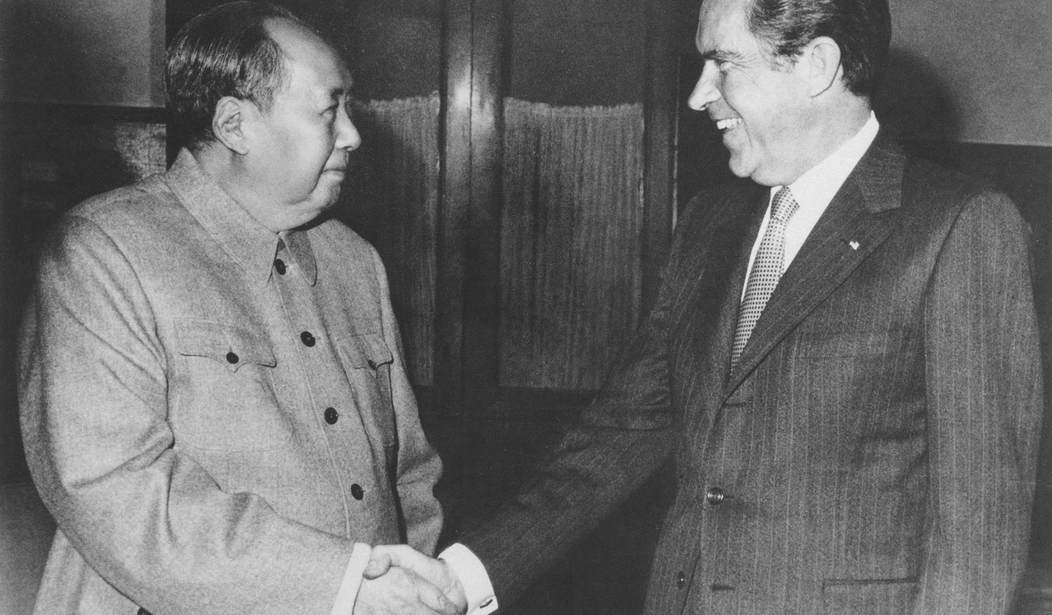

Former disgraced President Richard Nixon is making his way back into headlines, thanks to a coordinated effort by the Nixon Foundation, which has turned archival videos of the Republican president into short-form social media content, sparking a frenzy among young conservatives who describe their admiration for Nixon as “Nixonmaxxing.”
The root of this newfound admiration goes beyond a well-coordinated campaign by his foundation. For some, it’s a way to usher in a new wave of conservatism, one that embraces Nixon’s combative style, his “Silent Majority” coalition, and his image as a self-made man taken down by a political establishment.
Nixonmaxxing pic.twitter.com/LTa23SzufJ
— Richard Nixon Foundation (@nixonfoundation) February 2, 2026
This summer, we're Nixonmaxxing pic.twitter.com/sOmRJ4N4JM
— Christopher F. Rufo ⚔️ (@christopherrufo) July 18, 2026
In Nixon, many see shades of President Trump: a man targeted by the political establishment, whose Watergate-era persecution has, in the eyes of conservatives, been reinterpreted as little more than a coordinated campaign to take down a sitting president.
The relationship between Trump and Nixon is also no secret. The two were fond of one another, with Nixon even telling Trump in the 1980s that if he ever ran for office, he would win, a prediction Trump famously kept on display in the Oval Office.
Like Nixon, President Trump has also been a trailblazer on the foreign policy front. While Nixon reopened relations with China, Trump has taken on the United Nations, NATO, and a host of tyrannical regimes around the globe that seek to challenge American power.
This nails it. The Right's rediscovery of Richard Nixon is not about particular policies—some good, some bad—but about the aesthetic, the attitude, and the narrative of the self-made man who won 49 states on behalf of the Silent Majority, and was taken down in a Deep State coup. https://t.co/oEmNKHFOag
— Christopher F. Rufo ⚔️ (@christopherrufo) July 20, 2026
But Nixonmaxxing runs even deeper. For some, it’s a way to usher in a future Vance presidency, and, in a more sinister turn, a rejection of Reaganism.
Ronald Reagan stood for free markets, limited government, a strong foreign policy, and unapologetic American pride. Richard Nixon, by contrast, was never particularly loyal to the classic conservative tenets of free markets or limited government.
According to Andrew Ferguson, a nonresident fellow at the American Enterprise Institute (AEI), journalist, and historian who is writing a biography of the former president, Nixonmaxxing is “a rejection of Reaganism.”
“It’s another way of trying to put away the reigning philosophy of the Republican Party for 30 years," he said.
In other words, it’s an attempt at a conservative ideological switch. Unlike Reagan, Nixon had no qualms about wielding executive power, showed little desire to limit the welfare state, and was willing to impose wage and price controls, even creating new government agencies, including the Environmental Protection Agency (EPA). President Trump has exhibited several Nixonian leanings, but in many ways, he’s a hybrid of Reagan and Nixon. He remains more free-market oriented, a hawk on foreign policy, and a president who has made rooting out welfare fraud and shrinking the size of government a defining feature of his tenure.
His vice President, JD Vance, on the other hand, has been explicitly pro-Nixon. Vance has leaned into comparisons with Nixon, with young conservatives seeing echoes of the 37th president in his character. He’s been more overtly skeptical of free markets, calling instead for a form of capitalism aimed at the “common good,” though it remains unclear whether that would be achieved through government coercion. He has applauded the Trump administration’s move to take stakes in American companies, laughed that no one questioned it, and even urged conservatives to stop being afraid of executive power.
VP @JDVance tells @michaeljknowles that the economic position of the Republican party has moved from Milton Friedman to Alexander Hamilton.
— H.A. Hazony (@HAHazony) June 30, 2026
Less laissez-faire and more American developmentalism.
The economy is a tool to provide a good life for citizens. pic.twitter.com/fduCMQK6TV
Whether we like it or not, conservatives now stand at a crossroads: the ideology of Reagan or the ideology of Nixon. One thing is certain: the end of President Trump's presidency will put that internal battle on full display, with no incumbent left to paper over the divide.
Let's be clear about what that choice isn't, before making the case for what it should be. Returning to Reagan is not a call to return to Bush-era or Romney-era compassionate conservatism. Whatever those men represented, it wasn't Reagan, and conservatives tired of losing ground to the left have every right to want something stronger than that.
But the answer to a watered-down Reaganism was never supposed to be Nixon. It was supposed to be Reagan himself: free markets defended without apology, government kept small enough to stay out of the way, and a conservatism confident enough in its own ideas that it never needed executive power to win the argument for it.
The country doesn't need another Nixon. It needs another Reagan.