
The 1970s were a horrible decade. Gas lines. Economic malaise. Watergate. Vietnam. There was little good news nationally and globally. In Hollywood, things weren't that much better. Hollywood — once in the business of putting out optimistic, uplifting pictures — turned to letting younger directors make bleak, morally gray films that mirrored the depressing nature of the country.
In 1968, the Production Code (once Hollywood's predominant in-house censorship rules) gave way to the MPAA rating system, which allowed sex, violence, and unhappy endings. Movies like "Bonnie and Clyde" (1967) and "Easy Rider" (1969) were some of the first gritty, anti-establishment films made. Studios then turned over filmmaking to directors like Martin Scorsese, Francis Ford Coppola, and Robert Altman.
It wasn't until 1975 — the year the Vietnam War finally ended — that the tide started to turn. Even then, "Jaws" (considered the first summer blockbuster) wasn't a feel-good film. Sure, the good guy kills the shark, but a lot of people, including a young boy, are eaten along the way.
I would argue that the first genuinely feel-good film of the 1970s was "Rocky," released in 1976. And the only thing more inspirational and uplifting than the movie itself is the backstory of how it got made.
That's where "I Play Rocky" comes in.
(Editor's note: this review contains spoilers.)
Starring Anthony Ippolito as Sylvester Stallone, the film follows Stallone from his hardscrabble days in New York, when he still went by "Mike" and was slinging seafood at a local market while trying to go to as many auditions as he could. After quitting his job for another failed audition, Stallone finds himself sleeping on the New York streets, but he's not alone: he finds a puppy who, like him, is also homeless. Stallone names him "Butkis" after the football coach, and the two become inseparable.
Stallone takes a job at a movie theatre, where he's the ticket taker to AnnaSophia Robb's Sasha. She's the one who sees his potential and acts as his muse.
Stallone, whose acting career was limited to bit parts, and almost always as the meathead, including small roles in "Lords of Flatbush" (1974) and "Capone" (1975), always wanted something more. He wanted to be a star, and the mumbled speech and droopy eyes hid a man who was well-versed in cinema in an era long before IMDb.
Stallone and Sasha marry and move to California, where he takes a job as a valet parker, and Sasha works as a photographer. While their neighborhood may have changed, their financial situation did not.
At the lowest point of the film, Stallone is trying to buy food for Butkis and can't. So he sells his beloved dog to a stranger at the grocery store. Through his valet connections, Stallone is told to meet with producer Irwin Winkler (P.J. Byrne) and Robert Chartoff (Toby Kebbell) for an audition. Unfortunately, the role was cast, but they said they'd keep Stallone in mind.
As he's leaving yet another failed audition, Stallone slips a script into the pile on Winkler and Chartoff's secretary's desk. She read it and said it's really good.
While this part is disputed by the real-life Stallone, the film shows his fictionalized counterpart going to a bar where the Muhammad Ali v. Chuck Wepner fight is on television. Stallone bets the barman a dollar that Wepner lasts longer than a few rounds; Wepner — the underdog — goes 15.
Even if the fight wasn't Stallone's inspiration for "Rocky," the fact that he wrote the script, by hand, in three days is. It's also a fact that Winkler and Chartoff wanted the script. Badly.
But Stallone wanted something too: he plays Rocky. Or they don't get the script.
The producers, under orders from United Artists' head Sandy Maddox (Tracy Letts), keep offering Stallone more and more money — up to $360,000. That's roughly $2.1 million in today's money. Despite needing the cash because his wife was expecting their first child, and against the urging of his father, Frank Stallone, Sr. (Matt Dillon), Stallone held firm.
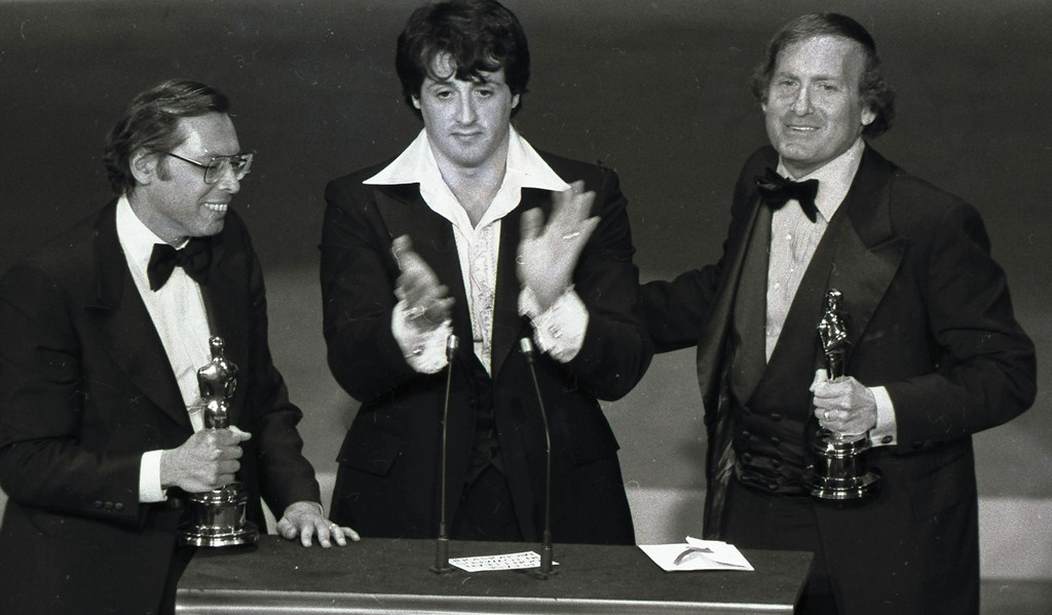
The studio caves, but not without conditions: the film gets made for $1 million, and if anything goes wrong, Stallone gets fired, and Rocky is recast with a "real actor." Despite tight shooting schedules, serious physical injuries, and New York union goons trying to shut down the film, "Rocky" makes it to theatres.
It becomes a smash success and is nominated for 10 Academy Awards. It won three — including Best Picture, Best Director, and Best Film Editing. Stallone was nominated for Best Actor in a Leading Role and for