





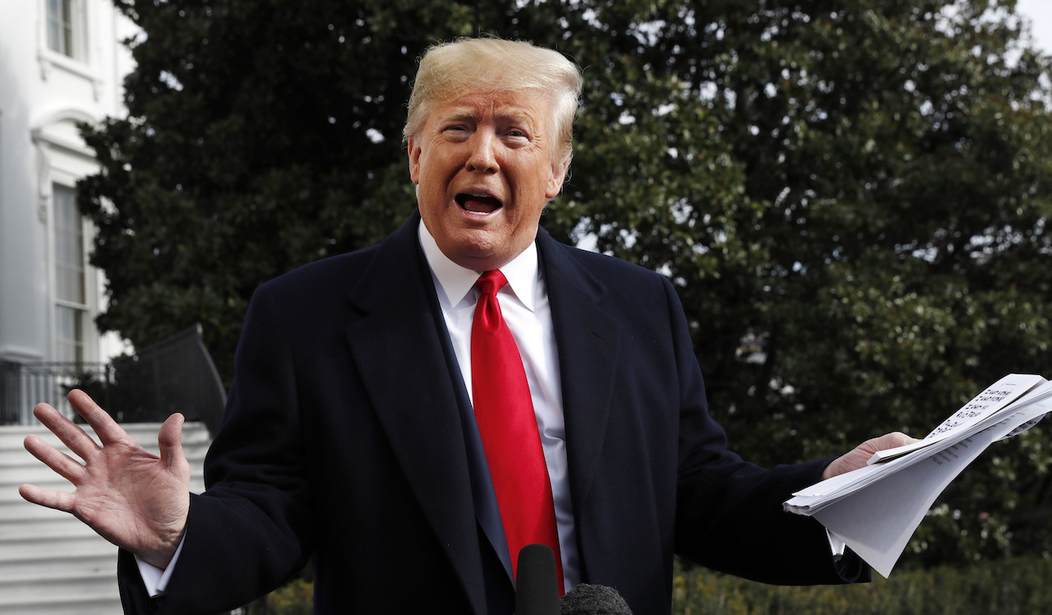
During special counsel Robert Mueller's investigation, his legal "dream team" tried to make a secondary case that Donald Trump also obstructed efforts to prove Trump-Russian "collusion."
Trump was said to have advised his lawyers and other subordinates, past and present, not to cooperate fully with the Mueller investigation. Yet the special counsel did not pursue any actionable cases of egregious interference by the White House.
Indeed, Mueller would never have concluded his $35 million, 22-month investigation had he not enjoyed cooperation from the White House.
White House employees were questioned freely by the special counsel. Documents were released. When the special counsel's exhaustive investigation into purported Trump-Russia collusion found no such crime, the fallback claim of obstruction arose. Trump allegedly wanted to curtail Mueller's parameters of inquiry into something that was proven not to be a crime.
Mueller found no grounds for a criminal referral on obstruction of justice. But he repeatedly hinted that Trump had thought about obstructing the non-crime of collusion.
In the Ukrainian melodrama, Trump is accused of the thought crime of considering the withholding of military assistance unless Ukraine investigated possible Ukrainian tampering in the 2016 U.S. presidential election and also former Vice President Joe Biden's intervention in Ukrainian politics on behalf of his son.
Biden had bragged at a Council on Foreign Relations conference that his threats to withhold non-military assistance to Ukraine led to the dismissal of a prosecutor, Viktor Shokin. It turns out Shokin may have been considering an investigation of the energy company where Biden's son Hunter had been given a lucrative position on the board of directors.

Two questions arise from hours of impeachment inquiry testimony before the House Intelligence Committee:
One, did Trump cut off military assistance, prompting the compliant Ukrainians to launch investigations to ensure that endangered military aid was not curtailed?
Two, did Trump reverse prior U.S. foreign policy by cutting off military assistance, thus threatening the security of Ukraine?
Regarding question No. 1, military assistance was delivered to Ukraine after a delay. Ukrainian President Volodymyr Zelenskiy never announced investigations of the Bidens or election tampering.
In response to question No. 2, the Obama administration's policy was to deny significant military assistance to Ukraine. Even non-military aid was apparently leveraged by Biden to force the Ukrainians to fire a prosecutor whose role in looking into Hunter Biden's company is still murky.
In other words, Trump is accused of thinking about cutting off aid as a lever to force Ukrainian investigations. Yet the prior administration never extended significant military aid and threatened to cancel non-military aid over a bothersome prosecutor.
That disconnect prompts another question: Is thinking about cutting off military aid to Ukraine a greater crime than declining to provide Ukraine with significant military aid?
Trump is also accused of the thought crime of contemplating bribery. Critics allege that Trump wanted Ukraine to do him a "favor" of inestimable value by launching those investigations.
Trump supposedly used the gifting power of the U.S. government to obtain a personal political benefit to his 2020 presidential candidacy.
But that premise is shaky on a number of grounds. Trump did not receive any such investigatory help from Ukraine. Yet even if Ukraine had announced the investigations that Trump had sought, the fact that Joe Biden chose to run for president in 2020 does not exempt him from government scrutiny of his suspect behavior with regard to Ukraine when he was vice president.
Both Democrats and Republicans seem to agree that corruption is endemic in Ukraine and demands constant vigilance as a condition for foreign aid. Moreover, the public did not learn about the bad optics of the Bidens in Ukraine from Trump-pressured Ukrainian leaks. Instead, Biden publicly bragged of his own clout in strong-arming the Ukrainians -- and ostensibly about how tough he would be as a future president. Any benefit to Trump of showcasing Biden's bad behavior came not from thinking about pressuring Ukraine, but from Biden's own braggadocio.
Joe Biden, not Donald Trump, smeared Joe Biden's reputation.
Trump has been accused of thought crimes, not actual crimes. Trump can be indiscreet, even crude, in his speech. But alleged bad thoughts are not crimes -- at least not outside George Orwell's dystopian novel "1984."






Join the conversation as a VIP Member