





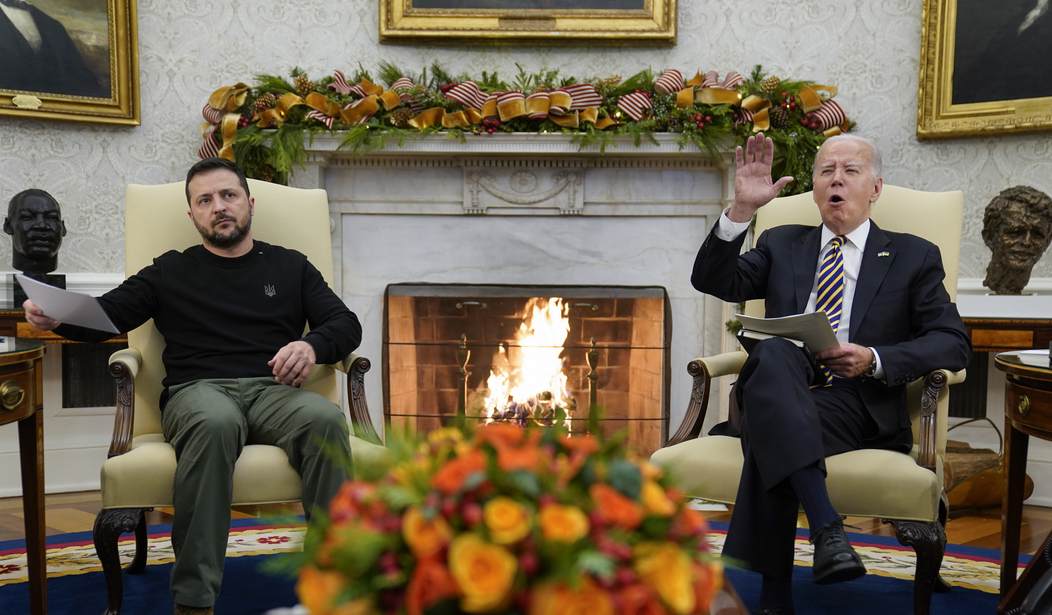
The Republican-controlled House of Representatives last Saturday voted 311 to 112 to approve a bill to spend $60.89 billion on aid for Ukraine.
Among House Republicans, this bill lost 112 to 101. Among House Democrats, it won 210 to 0. On Tuesday, the Senate voted 79 to 18 to approve it -- with Republicans casting 15 of the 18 votes against it. On Wednesday, President Joe Biden signed it into law.
Just two days after the House approved this $60.89 billion in aid for Ukraine, the State Department released its 2023 report on human rights in that country. It cited both the Russian military, which has invaded Ukraine, and the Ukrainian government itself for human rights abuses.
"Significant human rights abuses committed by Russia's forces in areas that were under Russian control involved severe and wide-ranging cases," said the State Department report. These included, among other abuses, "credible reports of: arbitrary or unlawful killings, including extrajudicial killings; enforced disappearance; torture and cruel, inhuman, or degrading treatment or punishment ... serious restrictions on freedom of expression and media freedom, including violence or threats of violence against journalists, unjustified arrests or prosecution of journalists ... severe restrictions on religious freedom ... and the existence of the worst forms of child labor."
So, what happened with human rights in those areas of Ukraine not controlled by Russian forces?
"There were also significant human rights abuses involving Ukrainian government officials, although not comparable to the scope of Russia's abuses," said the State Department report.
These "included credible reports of: enforced disappearance; torture and cruel, inhuman, or degrading treatment or punishment; harsh and life-threatening prison conditions; arbitrary arrest or detention; serious problems with the independence of the judiciary; restrictions on freedom of expression, including for members of the media, including violence or threats of violence against journalists, unjustified arrests or prosecutions of journalists, and censorship."
The State Department also cited Ukraine for "serious restrictions on internet freedom; substantial interference with the freedoms of peaceful assembly and association; restrictions on freedom of movement; serious government corruption; extensive gender-based violence; systematic restrictions on workers' freedom of association; and the existence of the worst forms of child labor."
The war, of course, was partly responsible for the situation in Ukraine. "Some of these human rights issues," said the State Department, "stemmed from martial law, which continued to curtail democratic freedoms, including freedom of movement, freedom of the press, freedom of peaceful assembly, and legal protections."
However, the State Department report on human rights in Ukraine for 2021 -- the year before Russia's invasion -- also cited Ukraine for human rights abuses. "Significant human rights issues," said that report, "included credible reports of: unlawful or arbitrary killings, including extrajudicial killings by the government or its agents; torture and cases of cruel, inhuman, or degrading treatment or punishment of detainees by law enforcement personnel; harsh and life-threatening prison conditions; arbitrary arrest or detention" and "serious problems with the independence of the judiciary."
"The government," said that 2021 report, "generally failed to take adequate steps to prosecute or punish most officials who committed abuses, resulting in a climate of impunity."
The 2023 report on human rights in Ukraine made virtually the same assertion: "The government often did not take adequate steps to identify and punish officials who may have committed abuses."
"Civil society and media noted corruption remained common at all levels in the executive, legislative, and judicial branches, influencing judicial and law enforcement institutions, the management of state property and state companies, and state regulation," said the State Department.
The appropriate question for the U.S. Congress is not whether Ukraine and Russia protect human rights. As the State Department's report makes clear, they do not. The question is whether it is in the interests of the American people to involve itself in the conflict between these two nations.
George Kennan, one of the greatest American diplomats of the last century, explained how American foreign policy should and should not work in his 1951 book "American Diplomacy." It was a chronic mistake in American foreign policy, he argued, to take a "legalistic-moralistic" approach.
"As you have no doubt surmised, I see the most serious fault of our past policy formulation to lie in something that I might call the legalistic-moralistic approach to international problems," Kennan wrote. "This approach runs like a red skein through our foreign policy of the last fifty years."
"It is the belief that it should be possible to suppress the chaotic and dangerous aspirations of governments in the international field by the acceptance of some system of legal rules and restraints," he said.
The U.S. Congress cannot control the war in Ukraine or determine its outcome.
But in a nation where the federal debt is now $34.59 trillion and federal spending is projected to hit $6.94 trillion in this fiscal year, Congress can -- and should -- turn its attention to ending the deficit spending and bringing down that debt.

Join the Conversation
VIP members get the ability to comment on articles.