





From February 2022 to December 2023, Congress appropriated about three times as much money for its response to the conflict in Ukraine as the federal government spent on Customs and Border Protection.
Congress approved approximately $113.4 billion in spending related to the Ukraine conflict during this period, while the government spent only $37.82 billion on Customs and Border Protection.
"The U.S. Congress appropriated approximately $113.4 billion in supplemental appropriations for the U.S. response to Russia's full-scale invasion of Ukraine between February 2022 and December 2023, making the United States the largest single donor of assistance to the Ukraine response," said a report published Feb. 15 by the inspectors general for the Department of Defense, the Department of State and the U.S. Agency for International Development.
"This funding," said the report, "supports security assistance for NATO and other partner nations; support for an enhanced U.S. military presence and activity in Europe; and the replenishment of U.S. military stocks transferred to the Ukrainian Armed Forces (UAF).
"The funding," it said, "also supports security, economic, and humanitarian assistance to Ukraine and other countries affected by the war; support for the operations of U.S. government agencies involved in the Ukraine response."
What impact did this massive U.S. investment have on the course of the conflict?
"While the Ukrainian Armed Forces (UAF) succeeded in recovering more than half of the territory that Russian forces had seized at the start of the conflict, the frontline of the war in Ukraine has not moved significantly since the gains made in the fall 2022 Ukrainian counteroffensive," said the IG report.
"During the [last] quarter [of 2023], Russian forces continued to occupy most of Luhansk, Donetsk, Zaporizhzhia, Kherson, and Crimea oblasts," said the report. "This lack of substantial progress on both sides belies the heavy fighting and high casualty rates during 2023."
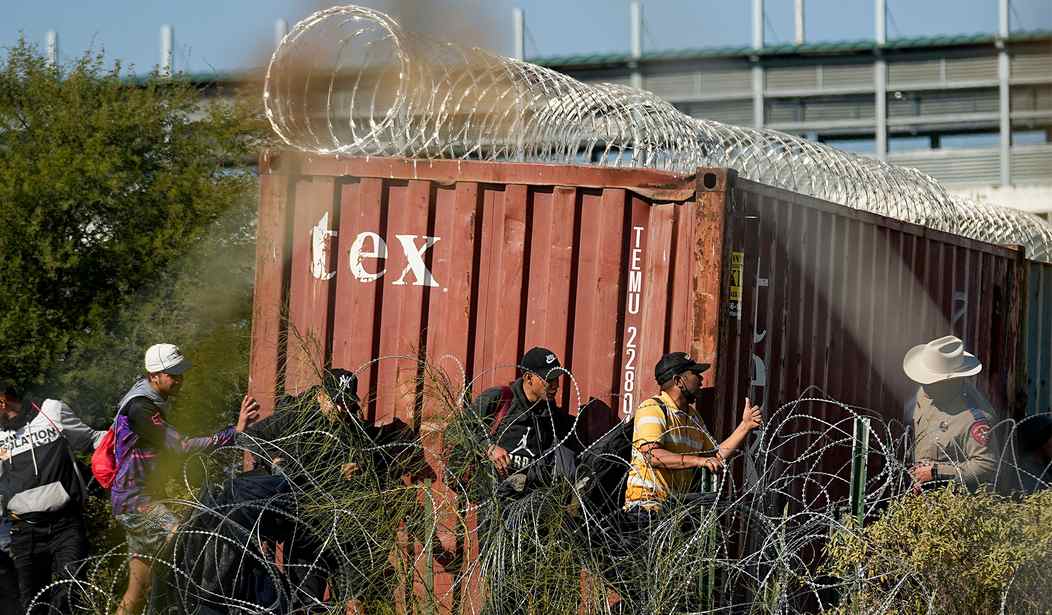
From February through September 2022, the U.S. government spent $12.063 billion on Customs and Border Protection, according to the Monthly Treasury Statement. In all of fiscal 2023, which ended last September, it spent $20.032 billion; and, in October through December, it spent $5.727 billion.
That means that from February 2022, when Russia started its all-out war against Ukraine, until December 2023, the U.S. government spent a total of $37.822 billion on Customs and Border Protection. That equals just 33.35% of the $113.4 billion that, according to the inspectors general, Congress approved "in supplemental appropriations for the U.S. response to Russia's full-scale invasion of Ukraine" during that same period.
So, what happened at the U.S. border during this period?
As this column has noted before, the number of individuals on the terrorist watchlist that the Border Patrol encountered trying to sneak across our southern border has steadily increased in recent years -- rising from 15 in fiscal 2021 to 169 in fiscal 2023. So far in this fiscal year, there have been 58.
Which poses a greater security threat to the American people: Terrorists coming across our southern border, or a war between Russia and Ukraine?
In 1793, when France declared war against Britain and the Netherlands, President George Washington saw no reason to involve the United States in that conflict. As this column has noted before, he promptly issued a Neutrality Proclamation.
"[T]he duty and interest of the United States require, that they should with sincerity and good faith adopt and pursue a conduct friendly and impartial toward the belligerent powers," Washington declared.
He never backed down from this position.
In his Farewell Address, as this column has also noted before, Washington reiterated the principle of his Neutrality Proclamation.
"Excessive partiality for one foreign nation and excessive dislike of another cause those whom they actuate to see danger only on one side, and serve to veil and even second the arts of influence on the other," Washington said. "Real patriots, who may resist the intrigues of the favorite, are liable to become suspected and odious, while its tools and dupes usurp the applause and confidence of the people to surrender their interests."
"Europe has a set of primary interests, which to us have none, or a very remote relation," said Washington. "Hence she must be engaged in frequent controversies, the causes of which are essentially foreign to our concerns. Hence therefore it must be unwise in us to implicate ourselves, by artificial ties, in the ordinary vicissitudes of her politics or the ordinary combinations and collisions of her friendships or enmities.
"Our detached and distant situation invites and enables us to pursue a different course," he said.
"Why forgo the advantages of so peculiar a situation?" he said. "Why quit our own to stand upon foreign ground? Why, by interweaving our destiny with that of any part of Europe, entangle our peace and prosperity in the toils of European ambition, rivalship, interest, humor, or caprice?"
What would Washington think about a Congress that invested more in a conflict between Russia and Ukraine than it invested in securing our own border?

Join the Conversation
VIP members get the ability to comment on articles.