





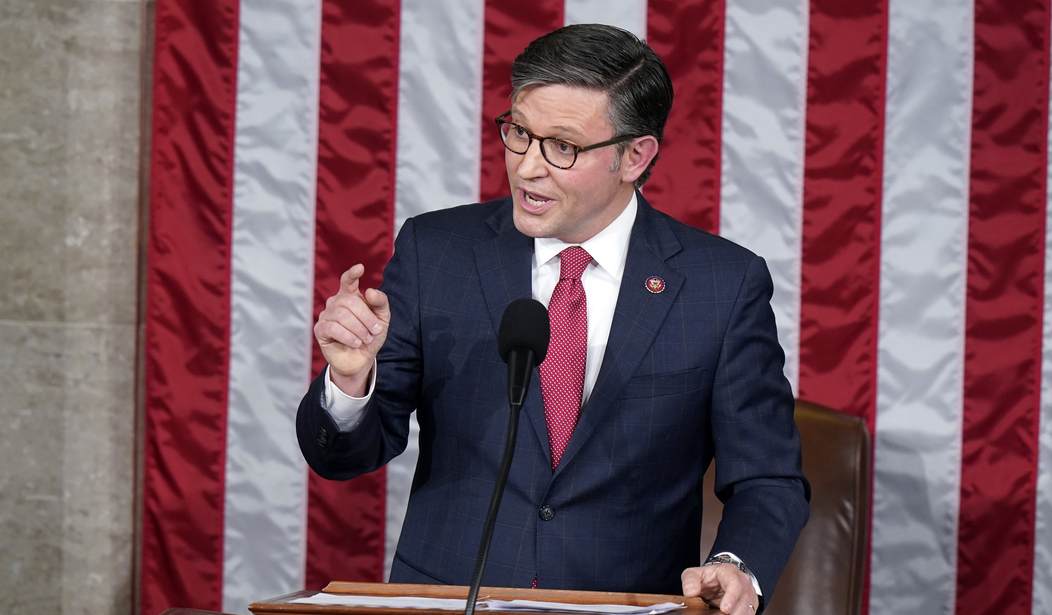
Newly elected House Speaker Mike Johnson has posted on his congressional website what he calls "The 7 Core Principles of Conservatism."
"In 2018," the website explains, "Speaker Johnson drafted this summary of the central beliefs of American conservatives to help anchor the work of the House Republican Conference in the timeless principles that made our nation the freest, strongest, and most prosperous in human history."
One of the principles on Johnson's list is: "Fiscal Responsibility."
"Because government has refused to live within its means, America is facing an unprecedented debt and spending crisis," Johnson says in his explanation of this principle. "Federal debt now exceeds $33.5 trillion, and our current fiscal path is unsustainable and dangerous, jeopardizing our nation's economic growth, stability and the security of future generations. Congress has a moral and constitutional duty to resolve the crisis, bring spending under control, balance the federal budget, reform and modernize entitlement programs, eliminate fraud, waste and abuse, pursue continued pro-growth tax reforms and permanent tax reductions, and restore regular order and accountability in the budget and appropriations processes."
Johnson is right. Congress does have a "moral and constitutional duty" to "bring spending under control" and "balance the federal budget."
When President Joe Biden took office on Jan. 20, 2021, the federal debt was $27,751,896,236,414.77, according to the U.S. Treasury Department. This Monday, it was $33,836,693,993,860.35.
In the first two years, 10 months and one week of the Biden administration, the federal debt climbed $6,084,797,757,445.58.
In October, according to the Bureau of Labor Statistics, there were approximately 161,676,000 people employed in the United States. The $33,836,693,993,860.35 in federal debt accumulated as of Monday equaled approximately $209,287 for each of the 161,676,000 people with jobs in this country.
The $6,084,797,757,445.58 that the debt increased in the Biden administration's first two years, 10 months and one week equals approximately $37,635 for each of those 161,676,000 workers.
In fiscal 2023, according to the Monthly Treasury Statement for September, the federal government paid $879.307 billion in gross interest on Treasury Debt Securities. The Monthly Treasury Statement for October estimated that the federal government will pay $1.002503 trillion in gross interest on Treasury Debt Securities in fiscal 2024.
This is despite the fact that the average interest rate on the federal debt is lower now than it was early in this century.
As of Jan. 31, 2001, 11 days after President George W. Bush took office, the average interest rate on the total interest-bearing debt was 6.594%, according to the U.S. Treasury Department. At the end of this October, it was only 3.052%.
But on Jan. 31, 2001, the total federal debt was only $5,716,070,587,057.36. Now, it is nearly six times that much.
Will the interest rate the federal government must pay on this debt increase as the debt itself increases?
Perhaps President Biden should have asked Xi Jinping, the president of the People's Republic of China, when they held their recent summit. Back in August 2011, when then-Vice President Biden made a visit to the PRC, entities in that Communist country were the largest foreign holders of U.S. government debt -- owning $1.2785 trillion in U.S. debt securities.
Entities in Japan were the second-largest holders, owning $906.7 billion is U.S. debt.
As this column has noted before, Xi, who was then vice president of the PRC, made a joint appearance with Biden at that 2011 meeting. Xi told the world then that Biden had talked to him about the U.S. government cutting its deficit and dealing with its "debt problem."
"Yesterday in my discussion with Vice President Biden, he briefed me about efforts of the U.S. government in spurring growth and jobs, cutting the budget deficit, properly handling the debt problem, and preserving the confidence of global investors," Xi said, according to a transcript posted by the White House.
When Biden made another joint appearance that day with then-Chinese Premier Wen Jiabao, Biden, as this column has noted, thanked this communist leader for China's help in funding the federal debt of the United States.
"We appreciate and welcome your concluding that the United States is such a safe haven because we appreciate your investment in U.S. treasuries," Biden told Wen. "And very sincerely, I want to make clear that you have nothing to worry about in terms of their -- their viability."
Since then, according to Treasury Department data, China's holdings of U.S. Treasury securities have dropped from $1.2785 trillion to $778.1 billion (as of this September). That's a 39.1% decline.
In June, the Congressional Budget Office published its 2023 "Long Term Budget Outlook." This report warned that the federal government could be headed toward a "fiscal crisis."
"If federal debt continued to rise in relation to GDP at the pace that CBO projects it would under current law, it would have far-reaching implications for the fiscal and economic outlook," said the report.
"There would be an elevated risk of a fiscal crisis -- that is, a situation in which investors lose confidence in the U.S. government's ability to service and repay its debt, causing interest rates to increase abruptly, inflation to spiral upward, or other disruptions to occur," said CBO.
"The United States' fiscal position would be more vulnerable to an increase in interest rates," CBO said, "because the higher debt is, the more an increase in interest rates raises debt-service costs."
Back in May, as this column has noted before, then-Speaker Kevin McCarthy made a deal with Biden to pass the ironically named "Fiscal Responsibility Act." It suspended the federal debt limit until Jan. 1, 2025 -- putting it past the 2024 election.
They presumably hoped to prevent the debt from becoming an issue before that election.
Speaker Johnson needs to resume the fight now to advance his principle that Congress has "a moral and constitutional duty" to "bring spending under control" and "balance the federal budget."


Join the Conversation
VIP members get the ability to comment on articles.