





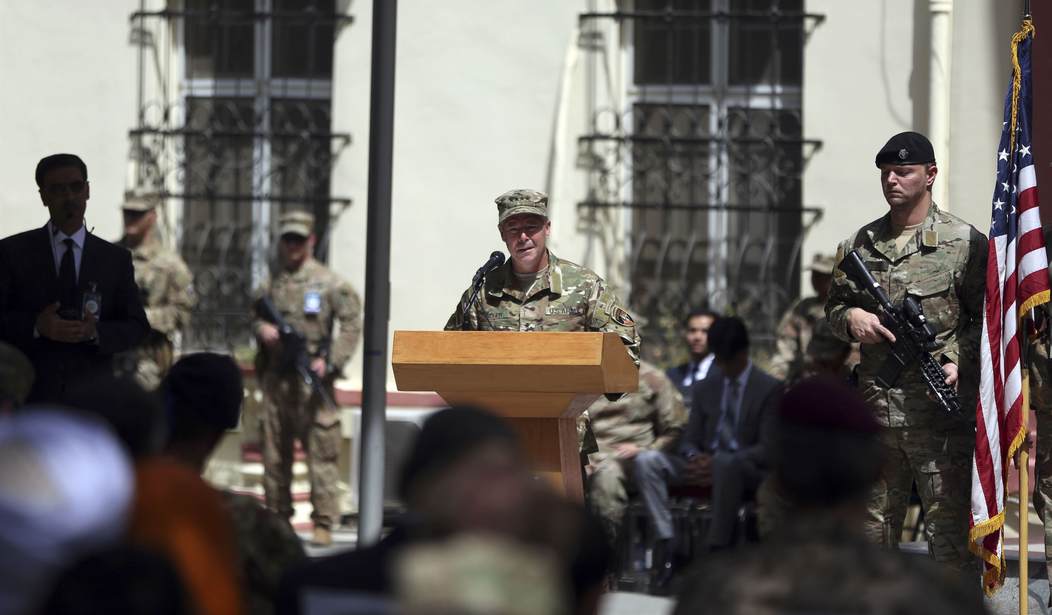
Seventeen years ago, U.S. forces invaded Afghanistan to overthrow the Taliban and prevent al-Qaida from using that country to launch attacks against us.
Four years later, then-President George W. Bush declared it was "the policy of the United States to seek and support the growth of democratic movements and institutions in every nation and culture, with the ultimate goal of ending tyranny in our world."
What has been the result?
Today, Americans cannot sit in a car in Kabul.
In May, the lead inspector general for Overseas Contingency Operations issued a report on the continuing operations against al-Qaida and its offspring, the Islamic State, that began after the Sept. 11, 2001, terrorist attacks.
The IG assessed the security situation in Kabul in light of a mission called Resolute Support, whose objective is "the establishment of self-sustaining Afghan National Defense and Security Forces and security ministries that together seek to maintain security in Afghanistan."
The IG noted that Kabul is officially deemed to be territory that is "under government control." But that does not mean you can get in a car and drive down the street there.
"Kabul, for example, is under government control, yet, as previously mentioned, frequent violence results in hundreds of deaths in the capital each year," said the IG. "This leaves many residents living in fear and has also led the international community to significantly limit its movements in the city. In the past, U.S. and international military personnel would routinely drive around Kabul."
But those days are gone.
"Currently, to limit exposure to security threats on local roads," said the IG, "U.S. personnel generally use helicopters for routine movements between Coalition sites, including even to travel the short distance from Resolute Support headquarters to the Kabul International Airport."
Freedom is not flourishing in Afghanistan.
In 2003, under the leadership of President Bush, the United States invaded Iraq to overthrow Saddam Hussein. This did not begin a series of events leading to the end of tyranny in our world, let alone in the Middle East.
Instead, it created a power vacuum that led to the rise of the "Islamic State," which created a "caliphate" that extended into Syria.
The Islamic State then launched a campaign of genocide against Christians.
But when the Syrian civil war broke out in 2011, then-President Barack Obama -- who had recently ordered the U.S. military to help Libyan rebels overthrow Libyan dictator Moammar Gadhafi -- called for the removal of Syrian dictator Bashar Assad.
"For the sake of the Syrian people, the time has come for President Assad to step aside," Obama said.
He apparently thought we could lead our allies in doing a better job at nation building in Syria than we had in Afghanistan or Iraq.
Five years later, Donald Trump was elected president. He did not advocate regime change. "But now is the time to rebuild our country, to take care of our people and to fight for our great American workers for a change," Trump said this March in Richfield, Ohio.
"(W)e're knocking the hell out of ISIS," he said, referring to the fact that the Islamic State's geographical caliphate had been largely eliminated.
"We'll be coming out of Syria, like, very soon," he said.
With his Russian and Iranian allies, Syrian dictator Assad is now aiming to eliminate the last rebel bastion in his country: Idlib.
"Idlib has been a significant safe haven for Al Qaeda in recent years," the Trump Defense Department said in a March 16, 2017, press release explaining a U.S. airstrike there.
"Gradually, Idlib also became a base for the Nusra Front, Al Qaeda's Syrian affiliate," the Congressional Research Service said in an August 2018 report. "As government forces retreated from the province, al Qaeda members from Afghanistan, Pakistan, and elsewhere relocated to Idlib."
Yet, with the battle for Idlib seemingly imminent, the administration -- which currently has more than 2,000 troops deployed in Syria -- is changing its policy toward that country.
"The new policy is we're no longer pulling out by the end of the year," James Jeffrey, the State Department's representative for Syria engagement, told the Washington Post.
He said, as the Post put it, "U.S. forces are to remain in the country to ensure an Iranian departure and the 'enduring defeat' of the Islamic State."
He added, "That means we are not in a hurry."
"Assad has no future," he told the Post, "but it's not our job to get rid of him."
President Trump, whose policy is to put America first, should remember that the ultimate strategic question for our government when it comes to Syria is not who runs the regime in Damascus but whether the situation there threatens the lives, liberty or prosperity of the American people.

Join the Conversation
VIP members get the ability to comment on articles.