





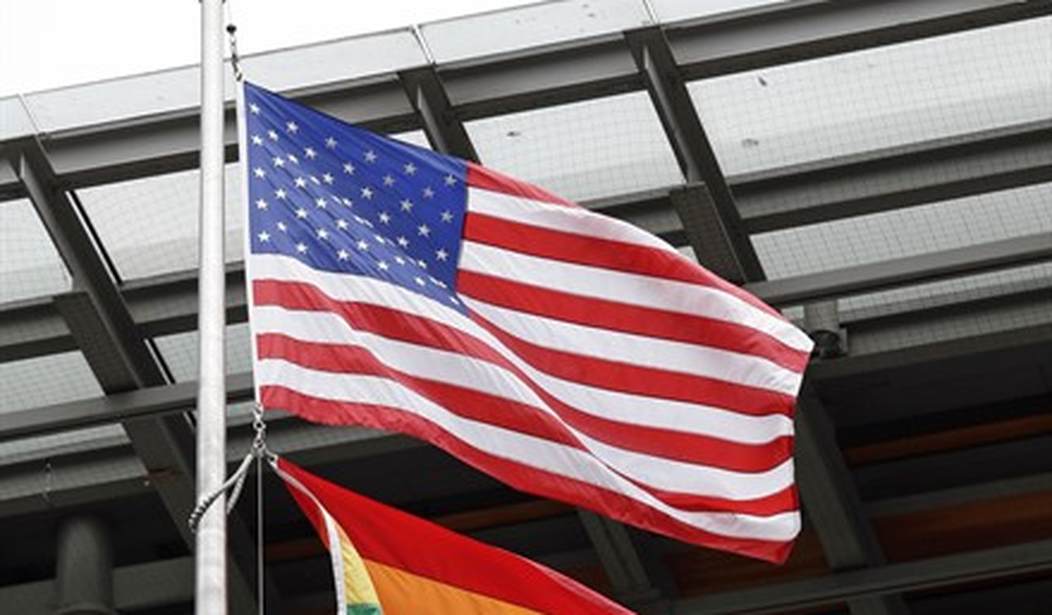
As we approach the first Fourth of July in the time of President Trump, a holiday Americans also call Independence Day, it's hard to find much independent thinking. Polarized rages and rants follow red and blue patterns of division, deepening the fragmentation of national unity and making patriotic pride suspect. Verbal fireworks are today's "bombs bursting in air."
With so much acrimony and continuous anger, partisanship trumps patriotism.
We act as if our political differences are breaking points, as though, as Yeats famously put it, "Things fall apart; the centre cannot hold." In an attempt to counter the lingering rancor of a bitter presidential campaign, the new president proclaimed his Inauguration Day a National Day Of Patriotic Devotion. This was a vanilla phrase urging Americans to "maintain faith in our sacred values and heritage," but the Atlantic sneered that it was "hard to tell whether it's a banal sentiment, or an echo of the more troubling rumbles of white-identity politics." (Who knew?)
Official proclamations of presidents have a way of disappearing down the memory hole of bloviations past, while bloviations present heighten focus and invite criticism. President Barack Obama proclaimed the day of his inauguration in 2009 a National Day of Renewal and Reconciliation. It might have been characterized as an empty alliterative phrase at best, or worse, an echo of more troubling rumbles of Uncle Tom appeasement. But those were more mellow days, and it was generally ignored.
Few recall that outgoing President Jimmy Carter proclaimed the third week of February in 1981 National Patriotism Week; it was to be observed by his successor, no doubt assuming that President Ronald Reagan was better at carrying off that kind of sentiment. Carter also called on all primary and secondary schools to study the Pledge of Allegiance, the national anthem, seals and mottos, historic monuments and heroes. Was anybody aware of that happening?
President Trump is widely accused of jingoism for even mouthing the platitudes of patriotism. Ours is a time of airbrushing heroes from history no matter who is in the White House. There's a hole in a heart too worldly-wise to take pride in our history, and the younger generations will pay for it in hurt as they grow up in what really is a land of the free and the home of the brave.
"And because our history is complex, the teaching of it requires texture and nuance, not ideology or opportunistic politics," Robert D. Kaplan, senior fellow at the Center for a New American Security, writes in Foreign Policy Magazine. He has little patience for Trump's simplistic view of American history but finds a danger just as great emanating from "the hard-line academic left," where textbooks are written in the ideology of campus protest. If anyone in the nation's past is to be admired, they must be carefully cherry-picked.
He specifically cites the way John C. Calhoun, a former vice president and secretary of war who was a notable anti-British hawk in the War of 1812 and one of the most gifted political theorists and orators of his day, must be erased from history with his "pro-slavery stridency." Similarly, President Andrew Jackson, a protean figure of the early republic whose military leadership in the War of 1812 kept the British from closing the Mississippi and dividing the country, must be painted out because he removed thousands of Cherokees from the Atlantic to the Oklahoma wilderness.
Kaplan writes: "But while historical reputations may change over time, delegitimizing rather than merely critiquing the core drama of the American experience -- the settlement of a continent, which Jackson and Calhoun did so much to foster -- will leave us morally helpless in dealing with the challenges of a dangerous world that cries out for our help."
He reminds us that we are who we are through our best and worst attributes, shameful and ennobling, with ideals sometimes honored only in the breach. We ended slavery through a bloody Civil War, and righted wrongs against man, woman and now, transgender individuals. In settling a continent so rich in natural resources, fertile earth, solid rock, muddy rivers, crystal lakes, leafy glens, petrified forests, black coal and subterranean gushers, it was brave men and courageous women who risked their lives to make the land a better place.
They were not always heroic but often were. We survived the Great Depression, galvanized to win two world wars and the Cold War. We are heirs to strengths forged in a hardscrabble experience that enabled us to preserve nothing less than civilization.
When Jefferson begins his famous declaration, "When in the course of human events," he's talking about us humans who thrive with a government of the people, by the people, for the people. Let's appreciate that -- and light a sparkler to honor the birthday of that great declaration.

Join the Conversation
VIP members get the ability to comment on articles.