


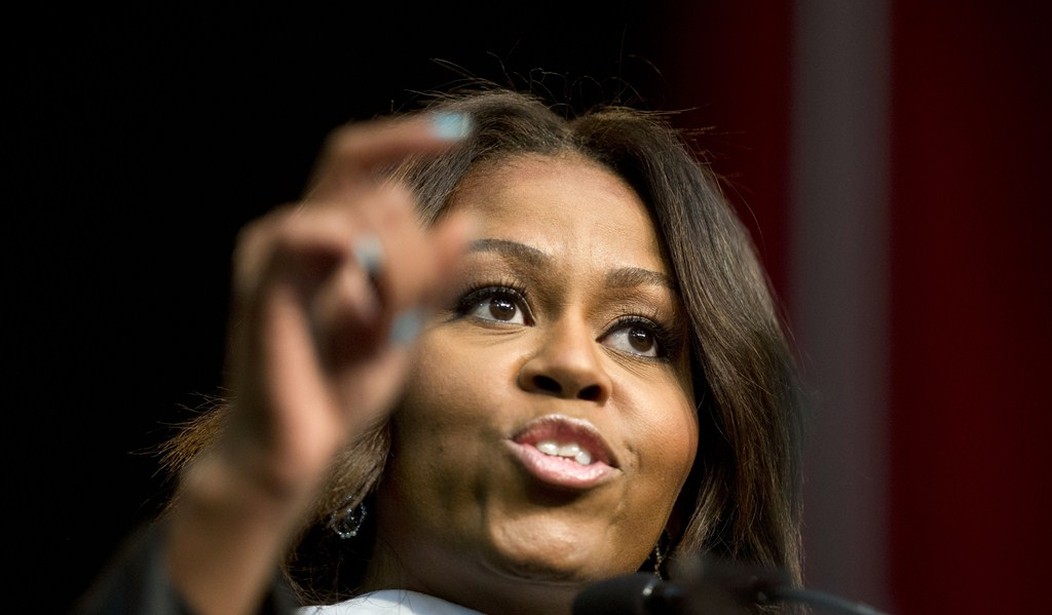
Michelle Obama can give as good as she gets, and she's getting a hard time from conservatives over two speeches she gave last week. The first was a commencement speech at Tuskegee University in Alabama, and the other was at the opening of the new Whitney Museum of American Art in downtown New York City.
She was accused of "playing the race card" by emphasizing ethnic divisions, taking offense in a place where none was intended, when she could be elevating the conversation about what unites us. The National Review calls her a "racial scold" for suggesting that minority children don't feel welcome at a museum like the new Whitney. Minority children think "that's not a place for me, for someone who looks like me, for someone who comes from my neighborhood."
Well, that may be what some children think, but it's unfair to make that point at the Whitney, which has long had a reputation as one of the most "multi-culturally sensitive" elite art museums. Art, with its appeal to aesthetic values, is a place where blacks and whites can share perspectives without prejudice and without emphasis on race today.
She might have talked about Nancy Elizabeth Bishop, a sculptor of African-American and Native-American ancestry, who suffered racial prejudice in the 1930s, and whose wooden sculpture, called "Congolais," is triumphantly on display at the Whitney because of its quality, not because the artist is black. Or she might have drawn attention to Alexander Calder's whimsical "circus," and acted as tutor for children intimidated in unfamiliar surroundings, by drawing attention to Calder's tiny circus wagons, lion tamers and sword eaters, which can be appreciated by spectators of all ages, hues and ethnic divisions. White children can be intimidated in places strange to them, too. Must everything be polarized by race?
She could have called attention to a current show at the National Museum of African Art, nestled among the elite museums on the National Mall under the umbrella of the Smithsonian. The museum is celebrating its 50th anniversary with an exhibition of work by both African artists and American artists of African descent. These works speak to each other, showing how different cultural experiences express creativity, using art as a universal language.
Recommended

Her speech to the graduates at Tuskegee was of a different order. When I listened to an excerpt from the radio in my car, I was annoyed that she seemed to be encouraging the graduates to remember indignities they might have endured. When I read the whole speech, what sounded like inflammatory rhetoric was followed by passages that were both informed and inspiring.
The first lady is right to mark the slights of prejudice aimed at blacks -- we can all use reminders. She cited "the folks who crossed the street in fear of their safety, the clerks who kept a close eye on us in all those department stores." (The Rev. Jesse Jackson once spoke of the relief he felt when he saw that young men following him on a dark street were not black.) Actual slights and unkind gestures can be redressed.
"I want to be very clear that those feelings are not an excuse to just throw up our hands and give up," she told the graduates. "They are not an excuse to lose hope. To succumb to feelings of despair and anger only means that, in the end, we lose." History compels a different blueprint "to build ourselves and our communities up." She emphasizes the importance of the ballot, "not just when my husband or somebody you like is on the ballot."
Mrs. Obama got off to a rocky start with conservatives with her remark during the 2008 campaign, when, as millions of Americans were rallying around her husband, she remarked that "for the first time in my adult life I am proud of my country." It was duly noted that in her adult life her country had enacted the Civil Rights Act of 1991, eliminated segregation and elected hundreds of blacks to office across the land.
Conservatives who read accounts of the first lady's remarks would warm to her pride in these graduates, pride in who they are, what they have accomplished and what they can become. She told the graduates that she takes the greatest pride as a mother of two daughters and for the opportunity to speak on behalf of military families and parents raising healthier kids.
The first lady, an accomplished woman in her own right as a lawyer trained in the Ivy League, has surely learned that racial slights and perceptions, like beauty, are often in the eye (and the ear) of the beholder. Neither eye nor ear is solely dependent on color for making judgments, either at Tuskegee or at the Whitney. She could talk about that sometime.









Join the conversation as a VIP Member