







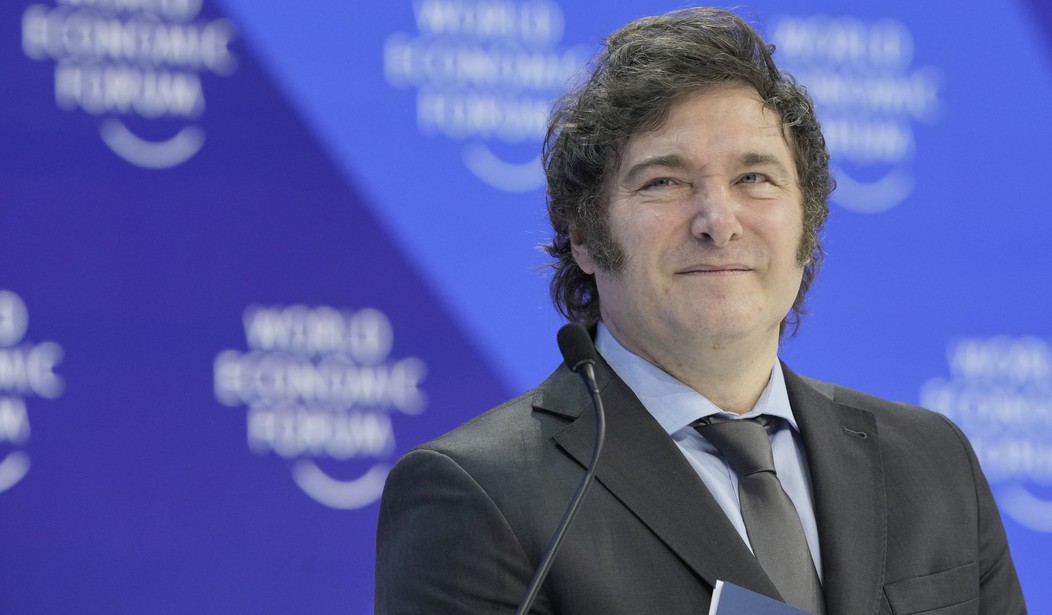
December 10th marks one year since Javier Milei took office as president of Argentina. While his supporters point out that inflation has fallen from 25 percent a month to less than 3 percent under his leadership, his opponents say that poverty in Argentina has risen sharply.
Firstly, on inflation: it is important to remember that Argentina has been plagued by double-digit inflation every year since 1945, with the exception of the 1990s, when the peso was pegged to the dollar.
Thanks to his reform program, Milei has achieved a budget surplus for the first time in 15 years, which is nothing short of a sensation. According to an analysis by the Spanish Instituto Juan de Mariana:
“In monetary terms, Milei has combined two types of improvements: on the one hand, the qualitative improvement of the Central Bank’s balance sheet, contaminated by many years in which the public deficit was covered by printing money; on the other hand, the quantitative improvement of the peso’s conditions, with a view to stabilizing the monetary base, which will contribute to generating a relative scarcity of the national currency, appreciating its value against the dollar. The gap between the official exchange rate and the true exchange prices of the peso for the dollar was around 150 percent when Milei came to power, but by the end of 2024 it is around three percent, clearing the way for the future withdrawal of the exchange rate peg.”
So, what about the poverty rate? Milei inherited a poverty rate of 45.2 percent, which briefly rose to over 50 percent. However, it has recently decreased and is now slightly below its initial level. This trend, along with a decline in the gross national product, was to be expected, and I had predicted as much before Milei took office.
Similarly, during the market economy reforms of Leszek Balcerowicz in Poland from 1990 to 1992 and of Margaret Thatcher in the UK in the early 1980s, the gross national product initially fell, even more sharply than under Milei. Hidden unemployment became open unemployment and what had been heavily state-subsidized companies were often unable to survive. These are normal adjustment processes in radical market economy reforms, but in Poland and Great Britain they were followed by a remarkable economic resurgence and a massive improvement in living standards.
It is likely that the development will be the same in Argentina and may even exceed my initial expectations within the next two years. Another passage of the Instituto Juan de Mariana analysis states: “Productive activity was already in decline in 2023 and, as expected, the adjustment measures taken by the new liberal government contributed to an initial scenario of contraction, manifested in the first two quarters of 2024. However, since the third quarter of the year, the economy has started to show signs of recovery, reaching production levels close to those recorded before Milei’s arrival in power, but now with a monetary mix and fiscal adjustment. The improvement exhibited by the Argentine economy following monetary and fiscal adjustment suggests that the government has successfully managed this challenge.”
Deregulation is already bearing fruit, and this is crucial for maintaining the loyalty of Milei’s supporters. The efforts of the new Ministry of Deregulation and State Transformation, led by Federico Sturzenegger, have been particularly noteworthy, including the abolition of the country’s rent control laws. This led to a substantial and rapid increase in the supply of housing. Previously, many landlords had stopped renting as it was no longer financially viable due to the combination of rent control and inflation. The monthly rent for an average flat in the city of Buenos Aires fell by 30 percent in real terms between November 2023 and July 2024 as a result of the abolition of the rent control laws.
Milei’s success, as I have emphasized all along, hinges on his ability to weather this initial “dry spell,” which essentially boils down to whether Argentinians have enough patience and understand that the problems that built up over decades cannot be fixed in a year.
At the moment, it looks as if the Argentinians recognize this, as Milei’s approval rating is still almost 50 percent. He has many supporters, especially among the poor. However, internationally, left-wing media and politicians are quick to blame Milei for the turmoil caused by his Peronist predecessors. And not just left-wing politicians: in Germany, when the leader of the free-market FDP, Christian Lindner, recently called for “a little more Milei,” the leader of the CDU – and most likely Germany’s next chancellor – Friedrich Merz replied that he was “appalled” by Lindner’s comments because Milei was “ruining” his country and trampling people underfoot. The poor in Argentina – who make up the majority of Milei’s supporters – seem to understand his message better than some supposedly conservative politicians outside the country.
Rainer Zitelmann is a historian and the author of the books The Power of Capitalism and How Nations Escape Poverty



Join the Conversation
VIP members get the ability to comment on articles.