





Big city elections provide clues about trends in national politics, the composition and attitudes of Democratic constituency groups, and voters' responses to emerging matters. Recent examples include the March 2019 primary for mayor of Chicago and the June 2021 Democratic contest in New York City.
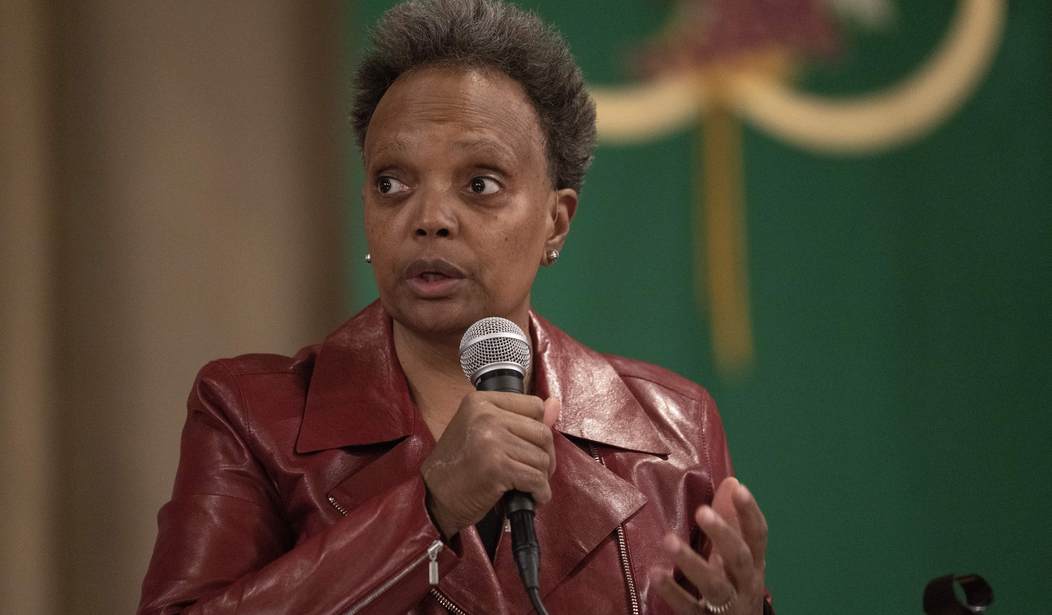
The latest example is last week's nonpartisan mayoral primary in Chicago, in which the 2019 winner, Lori Lightfoot, finished third among five serious candidates, with only 17% of the vote. That's a pathetic showing for an incumbent mayor, and a measure of the impact of a vast increase in murders and violent crimes, such as carjacking, since the "mostly peaceful" Black Lives Matter riots and demands for defunding the police started in late May 2020.
The crime problem played a similar role in the victory of New York Mayor Eric Adams, an NYPD veteran, two years ago. The key constituency in Adams' victory were middle-class black voters -- people with jobs and families in large parts of Brooklyn, southeastern Queens and the north Bronx. They spurned the candidacy of Maya Wiley, a left-wing ally of incumbent Bill de Blasio, and gave next to no support to Kathryn Garcia, the New York Times endorsee who carried affluent white people in Manhattan and fashionable areas of Brooklyn.
Lightfoot, who is black, did carry Chicago's heavily black South and West Sides. But she topped 50% in only three or four precincts -- most black people voted for someone else. And she was almost entirely abandoned by the Lakefront liberals who, four years ago, had formed her primary base of support.
Even though Chicago's population is now approximately one-third white, one-third black and one-third Latino, the candidate who led in early public polls, Rep. Chuy Garcia (D-IL), ran a poor fourth, with just 14% of the vote, after being pummeled with attacks by Lightfoot. He carried but seldom exceeded 50% in majority Latino neighborhoods, where turnout was light.
The big winners were Paul Vallas, one-time (1995-2001) head of the Chicago school system and a strong backer of proactive policing, who led with 33%, and Brandon Johnson, Cook County commissioner and former Chicago Teachers Union organizer, who won 22%.
Vallas, of Greek descent, won enormous majorities in the mostly white bungalow wards in northwest Chicago (you pass through them on the way to O'Hare) and in the city's southwest fringes. They're the ancestral home of white ethnics who supported Mayor Richard Daley in various elections. They are a waning percentage of Chicago voters -- a counterpart of white ethnics from Staten Island and various enclaves in the Bronx and Queens that voted for Adams in New York's mayoral race.
Vallas also carried the Lakefront wards from the South Loop north to Irving Park Road. These are full of Chicago's most successful white college graduates, professionals in soaring apartments, and beautifully restored and renovated townhouses. Once Republican-leaning, the area is as heavily Democratic as New York's Upper East Side, but residents appear unnerved to see North Michigan Avenue attacked by shoplifting gangs and carjackers.
Yet college graduate white people are not a united constituency. Precincts north of Irving Park and a mile or two inland from the Lakefront were carried by Johnson. White voters there are less affluent, younger, interlaced with significant percentages of Latinos and black people and a few small pockets of Asians.
These areas resemble the Manhattan-adjacent areas of Brooklyn and Queens (Williamsburg, Bushwick, Long Island City, Astoria) that voted for Wiley in 2021 and elected Rep. Alexandria Ocasio-Cortez (D-NY) over House Democratic leadership favorite Joe Crowley in 2018. These are the young professionals coping with the overproduction of elites, the graduate student proletariat, and the woke junior employees to whose demands liberal executives and editors seem to capitulate. These are the backers of "Occupy Wall Street" and "Defund the Police."
Who's going to win? The first public poll shows Vallas leading Johnson, 44% to 32%. Cook County Board President Toni Preckwinkle, Lightfoot's runoff opponent in 2019, is backing Johnson. Businessman Willie Wilson, who won about 20% of black people's votes last week, is expected to endorse Vallas.
A couple of interesting quirks: Vallas seems to have finished second among Hispanics, and Johnson appears to have won larger percentages from white people and Latinos than from black people. Middle-class black people may decide the result in Chicago just as they did in New York.
Whoever wins, the results show the increasing importance of white college graduates in the Democratic Party. And although it's been less widely appreciated (but apparent also in 2021 in New York), it reveals the existence of an economic class division within that constituency.
Join the Conversation
VIP members get the ability to comment on articles.