





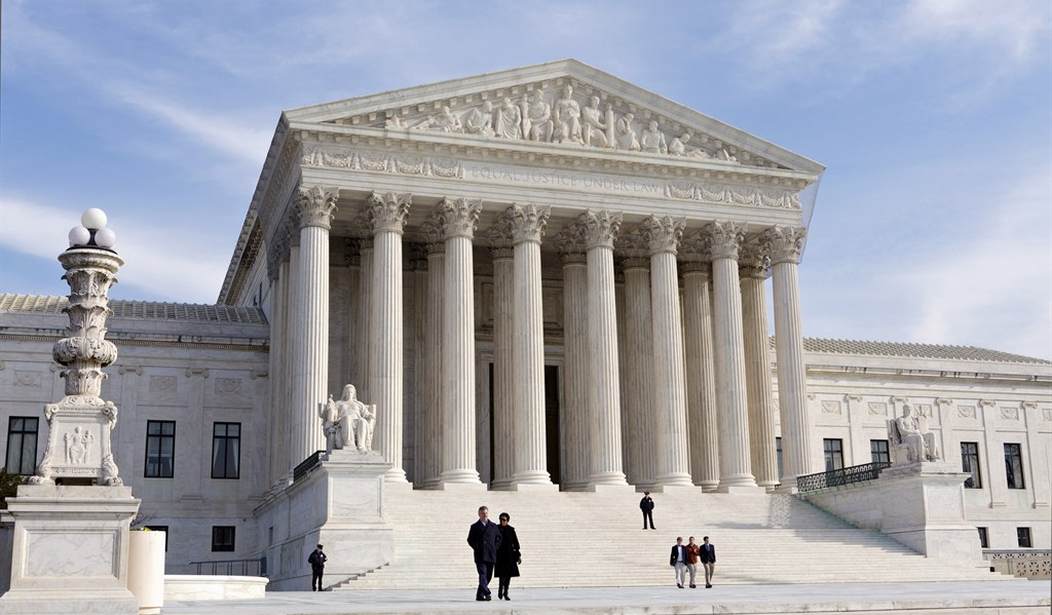
On Wednesday the Supreme Court heard oral arguments in King v. Burwell, the case challenging the IRS's decision to pay subsidies to lower-income health insurance buyers in states with federal insurance exchanges -- even though the Obamacare legislation authorizes subsidies only in states with exchanges "established by the state."
The Obama administration is thus in the uncomfortable position of arguing that the president's signature law says what it doesn't say. Nevertheless, initial analyses of the oral argument suggest the government might win.
The four Democratic-appointed judges seemed determined to advance arguments that, if you look at the statute as a whole, Congress wanted to pay subsidies to lots of people, even if it didn't say so. A similar argument was made with considerable invective in a dissent in an identical case by D.C. Circuit Judge Harry Edwards, a Democratic-appointed judge who otherwise during a long career encouraged consensus and civility in a once-rancorous court.
Justice Anthony Kennedy's questions suggested there may be a fifth vote to uphold the administration's position. Justice Kennedy asked whether the "established by the state" provision might amount to an unconstitutional commandeering of the state governments.
Commandeering is legal shorthand for the widely agreed doctrine that Congress cannot command the states to adopt legislation. Instead, Congress typically offers the states money if they accept certain conditions. No highway and transportation money if you don't establish a 55 mile-per-hour speed limit, for example, or a minimum drinking age of 21.
Limiting subsidies, as the Obamacare statute does, to states that establish their own exchanges is thus not unusual; it's typical of how Congress gets states to do what it wants. But there are limits.
In the June 2012 National Federation of Independent Business v. Sebelius decision upholding the constitutionality of Obamacare, the Supreme Court also ruled, 7-2, that Obamacare could not compel states to vastly increase Medicaid spending or lose all Medicaid funds. Raising the ante, the court held, amounted to commandeering.
Did Justice Kennedy's questioning Wednesday indicate that he believes that the disparate treatment of states with and without state health care exchanges amounts to commandeering? Perhaps, though justices' questions are not always good guides to their ultimate conclusions.
But if it was, does that mean that Justice Kennedy would allow the IRS to read into the statute authorization of subsidies? Or does it mean that he would regard the provisions for subsidies in some states and not in others as null and void? We won't likely know until the decision comes down, probably in late June.
But beyond the legal issues, the very existence of King v. Burwell is remarkable politically. For the framers of Obamacare certainly did not expect 36 states to reject the blandishment of federal subsidies and refuse to set up state exchanges.
MIT Professor Jonathan Gruber explained why, in a now-famous videotaped talk back in 2012. "If you're a state and you don't set up an exchange, that means your citizens don't get their tax credits," he said. "If your governor doesn't set up an exchange, you're losing hundreds of millions of dollars of tax credits to be delivered to your citizens."
When the videotapes surfaced last year, Gruber said that he had misspoken, "like a typo." But obviously he was just reading the statute as written, and obviously he expected that the states would find federal money too tempting to resist.
That expectation was based on some knowledge of history. Over the last half-century, states have usually been willing to jump through Congress's hoops in order to receive supposedly "free" federal money.
For example, after Medicaid was passed in 1965, 37 states joined the program within two years and by January 1970 only two held out -- Alaska, which joined in 1972, and Arizona, which held out until 1982. In the 1980s, as Congress (largely through the backroom work of Henry Waxman) increased the states' required Medicaid spending, many governors grumbled, but no state dropped out of the program.
In contrast, after the Supreme Court let states reject Obamacare's Medicaid expansion, 22 states did so. And 36 states refused to set up state health insurance exchanges, despite Obamacare's "established by the state" language.
Governors and legislators are responsive to public opinion, and their increased willingness to forego federal dollars shows an increasing mistrust of centralized command-and-control government. That's going to be a continuing factor in politics and government, whichever way King v. Burwell goes.

Join the Conversation
VIP members get the ability to comment on articles.