




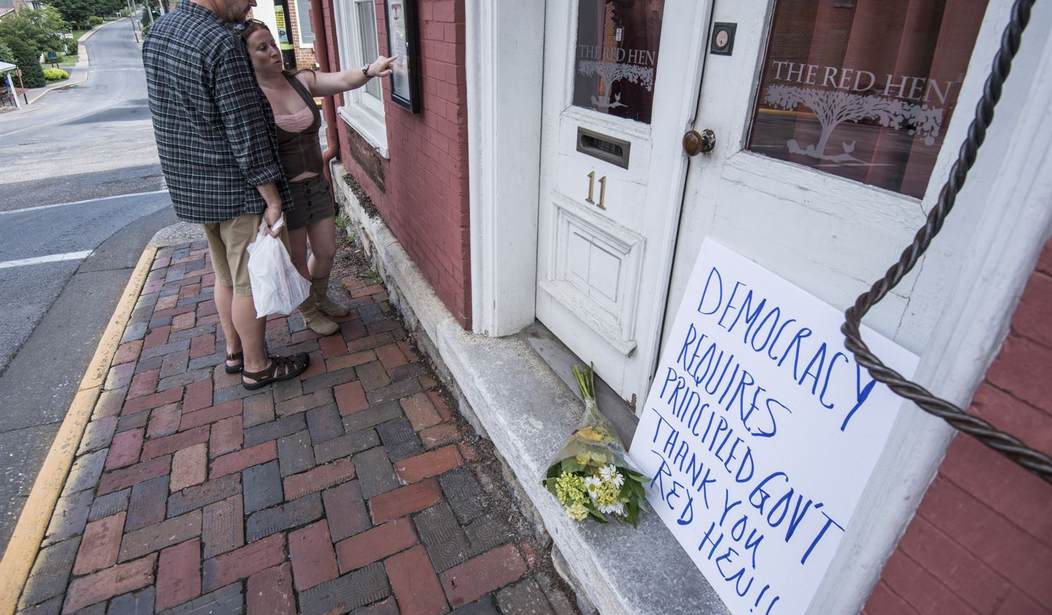
Washington D.C. expressly prohibits their restaurants from discriminating against patrons on the basis of political affiliation.
D.C. enacted the Human Rights Act in 1977. The purpose of the Act was to end discrimination in the District.
It is the intent of the Council of the District of Columbia, in enacting this chapter, to secure an end in the District of Columbia to discrimination for any reason other than that of individual merit, including, but not limited to, discrimination by reason of race, color, religion, national origin, sex, age, marital status, personal appearance, sexual orientation, gender identity or expression, familial status, family responsibilities, matriculation, political affiliation, genetic information, disability, source of income, status as a victim of an intrafamily offense, and place of residence or business.
While a law that creates a protected class out of political affiliation would be puzzling in most jurisdictions, this law seems right at home in our nation's capital, where members of Congress and the President's team are expected to frequent public accommodation establishments such as restaurants and theaters.
The D.C. Court of Appeals has described their anti-discrimination law as a "powerful, flexible, and far-reaching prohibition against discrimination of many kinds.”

Specifically, D.C.Code § 2-1402.31 prohibits discrimination in public accommodations, which includes restaurants. In relevant parts, the code reads:
It shall be an unlawful discriminatory practice to do any of the following acts, wholly or partially for a discriminatory reason based on the actual or perceived: race, color, religion, national origin, sex, age, marital status, personal appearance, sexual orientation, gender identity or expression, familial status, family responsibilities, genetic information, disability, matriculation, political affiliation, source of income, or place of residence or business of any individual:
To deny, directly or indirectly, any person the full and equal enjoyment of the goods, services, facilities, privileges, advantages, and accommodations of any place of public accommodations;
Under D.C. law, “political affiliation” means the state of belonging to, or endorsing, any political party. And “political party” means an association which nominates a candidate for election to an office and qualifies to have the names of its nominees appear on the election ballot. That would include both the Republican and the Democrat parties.
Thus, D.C. restaurants, movie theaters, or other public businesses which discriminate based on a customer's affiliation with either Republicans or Democrats might find themselves in court.
Who knows, maybe there's a Democrat cake baker out there who will refuse services to a Republican based on political affiliation and that Republican will sue ... or, maybe that Republican will just leave and go to another business and not waste her time.
Disclaimer: This article is for entertainment purposes only and is not to be construed as legal advice. And whether this anti-discrimination law would survive an appeal to the Supreme Court on Constitutional grounds is a whole separate issue.







Join the conversation as a VIP Member