





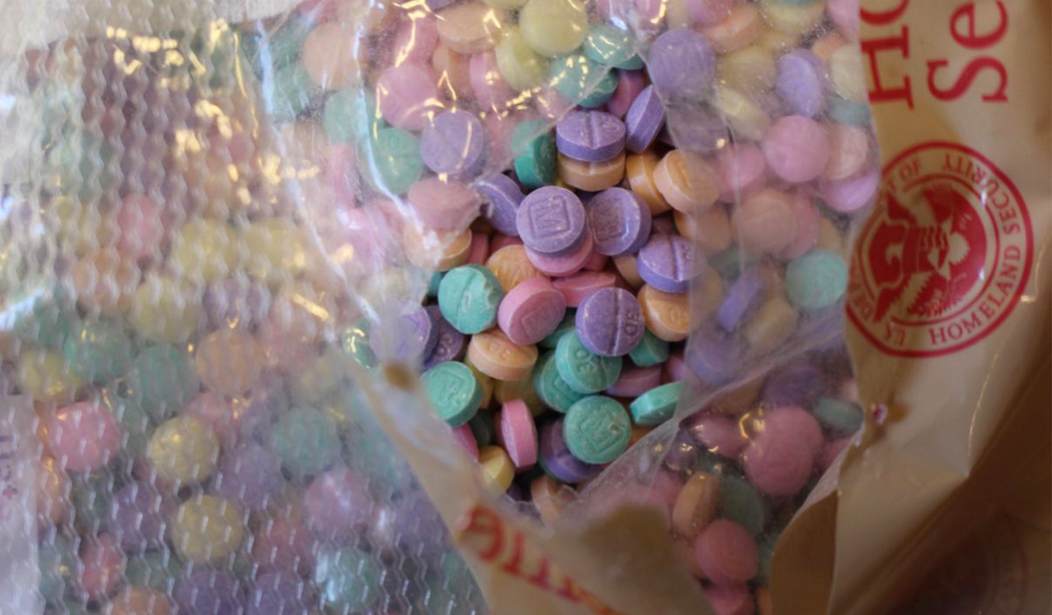
America's fight against drug cartels is entering a new phase.
Fentanyl overdoses now kill more Americans each year than guns, car crashes, or any other cause of death for adults under 50. The Trump administration and Congress have responded forcefully -- by imposing tariffs on Chinese goods to pressure Beijing to curb exports of precursor chemicals, labeling Latin American cartels as terrorist organizations, and proposing tens of billions in new spending on border security and drug enforcement.
But the White House and Congress cannot do it alone. Crushing international drug traffickers requires a whole-of-government approach -- one that goes beyond border walls and drug seizures and reaches into every corner of the federal bureaucracy.
Cartels are businesses: sophisticated, transnational, and ruthlessly efficient. They exploit weaknesses across our system, not just in law enforcement and border security, but also in trade policy, financial regulation, immigration, and beyond. Every federal agency -- from the Departments of State and Homeland Security to Defense, Commerce, and even the Federal Reserve -- needs to scrutinize its rules and programs with a simple question in mind: how might traffickers be using this to their advantage?
Too often, the answer is unsettling.
Consider the financial system, which cartels depend on to launder billions in illicit revenue. Their operations depend on converting dirty cash into clean capital, often by routing funds through shell companies, crypto mixers, and lightly regulated foreign banks until the money appears legitimate. While law enforcement has poured resources into border control and drug seizures, far less scrutiny has been given to the federal programs that quietly enable these flows in the first place.
One such vulnerability lies within the Federal Reserve's own operations.
The Fed's Foreign Bank International Cash Services (FBICS) program allows certain foreign banks, including those with no U.S. presence, to obtain U.S. dollars directly from the Federal Reserve Bank of New York. Intended to support legitimate commerce, the program opens a side door into the financial system -- one that bad actors can exploit if oversight is lax.
The warning signs are already here. In 2024, Canadian regulators fined Exchange Bank of Canada -- one of the inaugural participants in the FBICS program -- over $2 million for failing to stop money laundering. Another current FBICS participant, Moneycorp, is a bank licensed in Gibraltar -- a jurisdiction that was on the global anti–money laundering watchlist until early 2024. Former employees have described its compliance systems as "inept" and "unethical." Two of its top executives previously helped manage bulk cash operations at HSBC, a bank that was fined nearly $2 billion in 2012 for laundering money linked to drug cartels. Now those same people help run a firm that gets physical U.S. currency directly from the Fed – and they recently applied to open an uninsured bank on U.S. soil. Because it wouldn’t be FDIC-insured, the bank conveniently avoids the oversight and regulation that apply to federally insured institutions.
Scrutiny is also weak in other corners of the government.
Consider America's trade infrastructure. Cargo preclearance systems, low-risk designations, and limited customs capacity create a tempting gap for traffickers. Cartels have exploited automated shipping lanes and freight corridors to move drugs or laundering-linked goods in bulk, knowing that less than 5% of ocean cargo entering U.S. ports is physically inspected by U.S. Customs and Border Protection. Programs designed to speed up trade are being weaponized by smugglers who move faster than the systems meant to stop them.
Another blind spot: the U.S. mail system. Materials to make synthetic drugs like fentanyl can be shipped in lethal quantities through small packages that slip through postal and courier channels. Cartels and fentanyl producers also exploit e-commerce platforms and take advantage of customs exemptions for low-value shipments, making it nearly impossible to intercept dangerous drugs before they reach American neighborhoods. The infrastructure of convenience has become a pipeline for death.
This war will not be won at the border alone. It will be won only when every agency in Washington treats the cartel crisis as its responsibility -- not just the DEA or Customs and Border Protection, but the Federal Reserve, State, Homeland Security, Commerce, and others. Cartels coordinate every part of their operations. It is time Washington coordinated every part of its response.
Paul E. Vallely is a retired U.S. Army major general who serves as a senior military analyst for Fox News. Gen. Vallely is the founder and chairman of the Stand Up America US Foundation.



Join the Conversation
VIP members get the ability to comment on articles.